
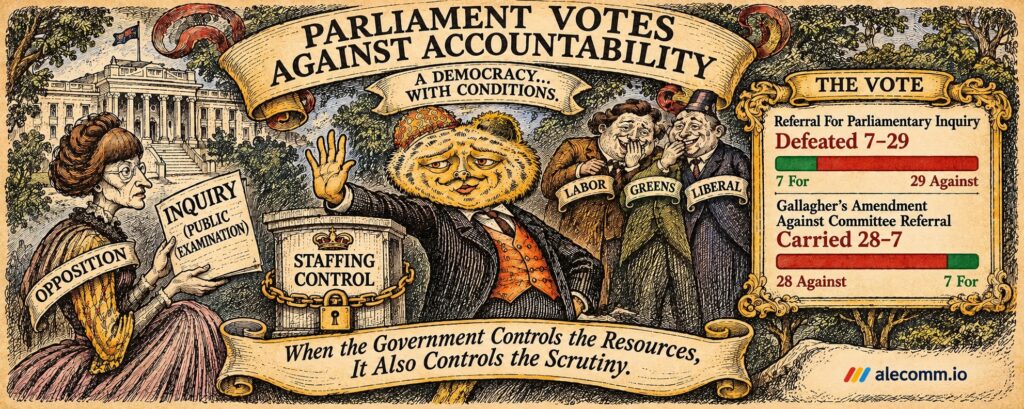
 The Senate’s decision on 15 October 2026 to prevent a parliamentary inquiry into the Members of Parliament (Staff) Amendment (Safe Staffing Guarantee) Bill 2026 raises significant concerns about the integrity of Australia’s representative democracy, the concentration of executive power and the ability of elected representatives to serve their constituents effectively.
The fundamental issue is not merely how many staff a politician receives. It is whether the government of the day should have the power to determine the operational capacity of its political opponents.
1. What Parliament Actually Did
Senator Pauline Hanson sought a parliamentary committee inquiry into legislation designed to establish protected minimum staffing entitlements for non-government parliamentarians.
The Senate made two separate decisions within three minutes.
11:38 am – Referral For Parliamentary Inquiry
Defeated 7–29
🟩🟥🟥🟥🟥
7 For • 29 Against
11:41 am – Gallagher’s Amendment Against Committee Referral
Carried 28–7
🟩🟥🟥🟥🟥
7 Supporting • 28 Opposing
The Senate did not simply reject the proposed inquiry. It subsequently adopted an amendment expressly directing that the bill not be referred to a committee.
They did not merely oppose reform. They voted to prevent an avenue of public examination.
2. Who Supported And Opposed Democratic Scrutiny?
Opposed The Inquiry
- ❌ Labor
- ❌ The Greens
- ❌ Three Liberal senators
Supported The Inquiry
- ✅ Pauline Hanson
- ✅ Malcolm Roberts
- ✅ Warwick Bell
- ✅ Tyron Whitten
- ✅ David Pocock
- ✅ Fatima Payman
- ✅ Ralph Babet
Every senator whose vote was recorded in favour of the inquiry belonged to the crossbench.
Not a single Labor, Liberal or Greens senator recorded a vote in favour of the inquiry. Senators whose votes were not recorded cannot be attributed a position.
The political establishment effectively closed ranks against an examination of its own institutional powers.
3. The Concentration Of Executive Power
One of the fundamental principles of parliamentary democracy is that Parliament holds the government accountable, not the other way around.
Under the Members of Parliament (Staff) Act 1984, the Prime Minister exercises discretionary authority over personal staffing allocations.
This creates an inherent institutional conflict of interest.
The government can influence the resources available to the very parliamentarians responsible for investigating its conduct, challenging its policies and exposing its failures.
The potential consequences include:
- Reduced capacity to investigate government misconduct.
- Reduced capacity to scrutinise proposed legislation.
- Reduced capacity to develop alternative legislation and policies.
- Reduced capacity to investigate public expenditure.
- Increased dependence on executive discretion.
- Disproportionate political influence favouring better-resourced parties.
No government should be able to determine how effectively its political opponents can hold it accountable.
The existence of this power creates a vulnerability within Australia’s democratic system, irrespective of which political party holds government.
4. The Democratic Rights Of Australian Voters
The implications extend well beyond Parliament House.
When an elected representative is inadequately resourced, the consequences are ultimately borne by the Australians who elected them.
Two Australians may possess an equal right to vote but receive substantially different levels of effective parliamentary representation because of discretionary government staffing decisions.
This raises concerns under the International Covenant on Civil and Political Rights (ICCPR).
| Article | Protected Right | Democratic Implication |
|---|---|---|
| Article 2 | Freedom from discrimination | Political affiliation should not determine access to protected rights. |
| Article 19 | Freedom of expression | Parliamentary resources influence the capacity to communicate political concerns. |
| Article 25 | Participation in public affairs through freely chosen representatives | Inadequate resourcing may undermine effective representation. |
| Article 26 | Equality before the law | Staffing arrangements should be based on objective and reasonable criteria. |
These provisions provide a legitimate basis for examining the human rights implications of parliamentary staffing arrangements, although the vote itself does not establish a legal breach.
The right to elect a representative should not be undermined by the government’s ability to restrict that representative’s effectiveness after an election.
5. How Democratic Representation Can Be Systematically Weakened
The structural consequences of executive control over parliamentary staffing are relatively straightforward.
Executive Control Over Staffing
The Prime Minister determines personal staffing allocations.
⬇️
Unequal Parliamentary Resources
Some elected representatives have less operational capacity than others.
⬇️
Reduced Parliamentary Scrutiny
Fewer resources are available to investigate, research and challenge the government.
⬇️
Weakened Public Representation
Constituents potentially receive inferior parliamentary representation.
⬇️
Diminished Democratic Accountability
Government decisions are potentially subjected to less effective scrutiny.
A democracy does not necessarily need to abolish elections to weaken political competition.
It can progressively undermine representative government by maintaining institutional arrangements that disadvantage political opponents while preserving the outward appearance of democracy.
6. Denying Australians An Opportunity To Be Heard
Parliamentary committee inquiries serve an important democratic function because they enable participation beyond elected politicians.
Had the referral succeeded, the inquiry could have received evidence from:
- Australian citizens and community organisations.
- Constitutional and human rights experts.
- Parliamentary employees.
- Current and former parliamentarians.
- Workplace health and safety specialists.
- Experts in public administration and democratic governance.
By refusing the referral, the Senate removed this particular opportunity for Australians to provide evidence, challenge existing arrangements and contribute to legislative reform.
Senators could legitimately disagree with the proposed staffing formula, its cost or its implementation.
Those are precisely the matters a parliamentary committee inquiry could have investigated.
Supporting an inquiry does not require supporting the legislation. It requires a willingness to examine it.
What possible democratic benefit is achieved by preventing the public from contributing to an examination of parliamentary fairness?
7. Parliamentary Employees And Workplace Safety
During the debate, Senator Fatima Payman raised concerns about excessive workloads, inadequate staffing, remuneration disparities and the welfare of her employees.
These concerns introduce another dimension to the decision.
Parliamentarians are employers with responsibilities towards the health, safety and wellbeing of their staff. However, their capacity to meet those responsibilities can be affected by staffing allocations determined externally.
Potential consequences include:
- Excessive working hours.
- Psychological distress.
- Occupational burnout.
- Employee turnover.
- Increased administrative errors.
- Inadequate workplace support.
Parliament should be demonstrating exemplary employment practices, not maintaining arrangements that potentially contribute to unsafe working conditions while refusing an opportunity to investigate them.
8. Australia Compared With Other Democracies
A Parliamentary Library research paper published on 21 January 2026 examined staffing arrangements in Australia, the United Kingdom, Canada and New Zealand.
Its findings identified Australia as unique among the four countries examined in granting the Prime Minister discretionary authority over all parliamentarians’ staffing arrangements.
The paper also identified the absence of a publicly available framework governing the allocation of personal employees.
This demonstrates that alternative arrangements are possible within comparable Westminster parliamentary democracies.
Australia’s current system is a political and legislative choice, not an unavoidable feature of parliamentary democracy.
9. A Recurring Pattern Of Resistance To Reform
The October 2026 decision was not an isolated attempt to reform parliamentary staffing.
On 3 September 2025, the Senate defeated the Members of Parliament (Staff) Amendment (Providing Certainty and Improving Integrity) Bill 2025.
Defeated 29–32
🟩🟩🟥🟥🟥
29 For • 32 Against
The Parliamentary Library also identified several attempts during 2025 to establish committee inquiries into parliamentary staffing arrangements.
The repeated resistance to reform warrants examination of whether existing parliamentary procedures sufficiently protect the interests of minority parties, independent representatives and their constituents.
When the institutions responsible for accountability repeatedly resist attempts to examine their own powers, the integrity of those accountability mechanisms must themselves be questioned.
10. Recommended Democratic Reforms
| Recommended Reform | Intended Outcome |
|---|---|
| Independent staffing authority | Remove political interference in staffing allocations. |
| Statutory minimum staffing guarantees | Protect every parliamentarian’s operational capacity. |
| Published allocation criteria | Ensure transparency and consistency. |
| Independent appeals mechanism | Enable parliamentarians to challenge unfair decisions. |
| Annual independent staffing audits | Identify disparities and inappropriate allocations. |
| Mandatory publication of allocation reasons | Prevent unexplained discretionary decisions. |
| Minority-triggered committee inquiries | Prevent parliamentary majorities from routinely blocking legitimate scrutiny. |
| Protection against political retaliation | Prevent staffing reductions being used to punish political dissent. |
| Mandatory human rights assessments | Examine the effects of staffing policies on voters’ democratic rights. |
11. The Fundamental Failure Of Democratic Accountability
The most significant democratic concern arising from this parliamentary decision is the combination of two institutional powers:
- The executive’s control over parliamentary staffing.
- The parliamentary majority’s capacity to prevent a public inquiry into that control.
Together, these powers create a system in which existing institutional advantages can be protected against examination and reform.
While the recorded votes do not establish the private motivations of individual senators, the institutional consequences are unmistakably concerning.
Democracy must extend beyond the ceremonial act of voting every few years. It must provide meaningful representation, genuine political competition, effective government scrutiny and opportunities for public participation.
A parliamentary majority does not acquire the moral right to diminish the democratic representation of Australians who voted against it simply because it possesses the numbers to do so.
Parliament belongs to the Australian people. It is not the private property of political parties.
Democratic rights must not be conditional upon political affiliation.
Government accountability must not be dependent upon government permission.
And Australians must never receive inferior parliamentary representation simply because they chose to vote against the political establishment.
Sources And References
ALECOMM. (2026). Parliamentary Accountability Register.
https://submission.alecomm.io/parliamentary-accountability/entry/NQVW-XV84-QSQF-ANUX
Australian Senate. (2026, October 15). Senate Hansard.
https://www.openaustralia.org.au/senate/?id=2026-10-15.26.2
Australian Senate. (2026, October 15). Recorded parliamentary divisions.
https://theyvoteforyou.org.au/divisions/senate/2026-10-15/2
https://theyvoteforyou.org.au/divisions/senate/2026-10-15/3
Members of Parliament (Staff) Amendment (Safe Staffing Guarantee) Bill 2026.
https://crossbench.io/bills/cmv7xv8sp0005t4kduf4wld37
Australian Parliamentary Library. (2026). Allocating parliamentarians’ staff: Insights from the UK, Canada and New Zealand.
https://www.aph.gov.au/About_Parliament/Parliamentary_departments/Parliamentary_Library/Research/Policy_Briefs/2025-26/AllocatingParliamentariansStaff
Commonwealth of Australia. Members of Parliament (Staff) Act 1984.
https://www.legislation.gov.au/C2004A02928/latest/text
Australian Parliament. Information about Senate committees.
https://www.aph.gov.au/Parliamentary_Business/Committees/Senate/Information_about_Senate_Committees
Attorney-General’s Department. Right to take part in public affairs and elections.
https://www.ag.gov.au/rights-and-protections/human-rights-and-anti-discrimination/human-rights-scrutiny/public-sector-guidance-sheets/right-take-part-public-affairs-and-elections
Leave a Reply