
 Prepared by: ALECOMM
Jurisdiction: Commonwealth of Australia
Policy Classification: Public Health, Food Safety, Consumer Protection, Environmental Protection, National Food Security, Australian Industry Development and Government Accountability
Version: 3.0
Date: 18 November 2026
Status: Proposed National Policy Reform
Proposed Accompanying Legislation: Imported Seafood Safety, Traceability and Australian Fisheries Protection Bill 2026
1. Executive Summary
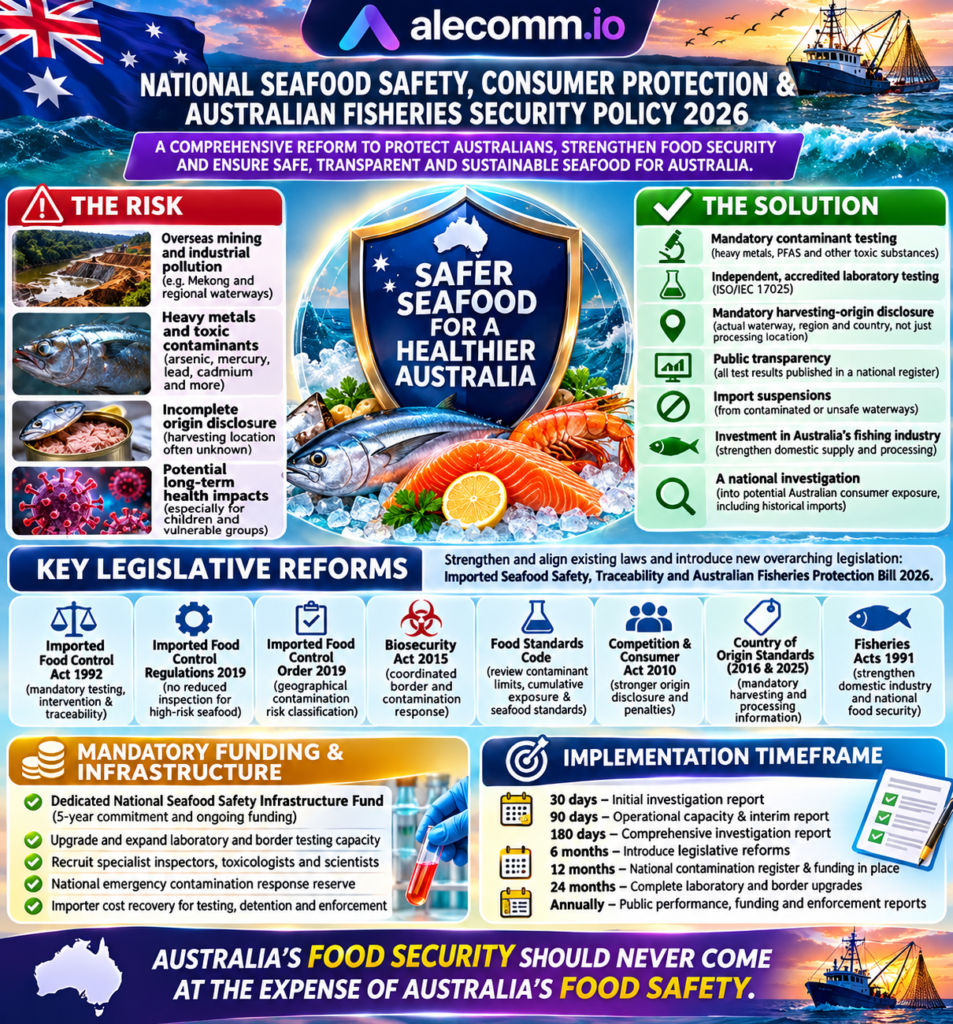
Australia’s dependence on imported seafood exposes Australian consumers to potential environmental contamination, overseas industrial and mining pollution, inadequate supply chain transparency and inconsistencies in international food safety regulation.
Existing Australian legislation provides mechanisms for inspecting imported food, managing contamination risks, rejecting unsafe products and enforcing food safety standards. However, these mechanisms do not provide comprehensive assurances that imported seafood has been harvested from uncontaminated environments or independently tested for all relevant environmental contaminants.
The emergence of serious environmental contamination concerns in Southeast Asian waterways, including the Mekong River and its tributaries, highlights the urgent need for preventative legislative and regulatory reform.
The accumulation of heavy metals and other environmental contaminants in seafood presents a potentially serious public health issue, particularly where consumers are repeatedly exposed to contaminated products over extended periods.
Australia must not wait until widespread consumer exposure, chronic illness or fatalities have been established before implementing preventative measures.
This policy establishes a comprehensive national framework requiring:
- Mandatory heavy metal and environmental contaminant testing.
- Independent laboratory analysis.
- Comprehensive geographical harvesting-origin disclosure.
- Public transparency of contamination test results.
- Mandatory precautionary import restrictions.
- Suspension of seafood imports from demonstrably unsafe waterways.
- Comprehensive legislative and regulatory reform.
- Dedicated government funding and infrastructure investment.
- Independent oversight and government accountability.
- Strengthened importer responsibilities and penalties.
- A national investigation into potential historical consumer exposure.
- Substantial investment in Australia’s domestic fishing and seafood processing industries.
The protection of Australian public health must take precedence over commercial interests, trade convenience, diplomatic relationships and the profitability of seafood importers.
2. Fundamental Policy Principles
The Commonwealth Government must adopt the following principles across all legislation, regulations, administrative decisions and international arrangements governing seafood importation:
- Public health and consumer safety must take precedence over commercial considerations.
- Prevention must take precedence over retrospective intervention.
- Importers must bear responsibility for demonstrating the safety and origin of their products.
- Australian consumers must not bear the burden of establishing that imported seafood has caused harm before preventative action is taken.
- Foreign government assurances must not replace independent scientific testing where contamination risks exist.
- Commercial confidentiality must not override the public’s right to information concerning hazardous food products.
- International trade arrangements must not prevent Australia from implementing scientifically justified public health protections.
- Government departments must be adequately funded to fulfil their statutory responsibilities.
- Domestic seafood production must be recognised as a strategic national food security asset.
- Government agencies must be held accountable for unreasonable failures to exercise their statutory responsibilities.
- Regulatory exemptions must not undermine mandatory public health protections.
- Australian taxpayers must not subsidise commercial non-compliance.
- Government funding decisions must not compromise the enforcement of food safety legislation.
3. Comprehensive Legislative And Regulatory Reform
The Commonwealth must undertake a coordinated review and reform of all legislation and regulatory instruments governing seafood importation, food safety, contamination, consumer protection, biosecurity and domestic fisheries.
This policy must not be implemented through a single isolated legislative amendment.
The proposed legislative framework must identify and address deficiencies in existing legislation while establishing additional statutory protections where existing instruments do not adequately address the risks.
3.1 Imported Food Control Act 1992
Existing Function
The Act regulates imported food safety, inspection, detention, certification and enforcement.
Identified Deficiencies
- Existing intervention powers include discretionary decision-making rather than mandatory action whenever defined serious contamination criteria are satisfied.
- Inspection and analytical testing rates may vary according to risk classifications and compliance histories.
- Foreign certification and compliance arrangements can influence inspection requirements.
- No comprehensive mandatory public register of satisfactory and unsatisfactory seafood contamination results.
- No universal requirement for precise geographical harvesting-origin disclosure.
- No dedicated statutory funding framework for imported seafood contamination prevention.
- No integrated obligation to investigate historical Australian consumer exposure following significant overseas environmental contamination events.
Required Legislative Amendments
- Establish mandatory intervention duties where defined serious public health risk criteria are satisfied.
- Prohibit reduced inspection and testing rates for designated high-risk seafood.
- Prevent foreign certification arrangements from overriding mandatory contaminant testing.
- Establish mandatory geographical harvesting-origin documentation.
- Establish importer-funded independent laboratory testing.
- Prohibit the release of seafood without required testing and origin clearance.
- Introduce mandatory publication of regulatory contamination results.
- Establish enforceable investigation, response and reporting deadlines.
- Strengthen penalties for deliberate concealment, falsification and circumvention.
- Establish mandatory recall and notification procedures.
- Expand cost recovery provisions for importer non-compliance.
- Establish enforceable government accountability requirements.
Existing geographical identification and intervention powers, including relevant provisions under section 35B, must be utilised where legally appropriate to address emerging contamination risks while permanent legislative reforms are developed.
3.2 Imported Food Control Regulations 2019
Existing Function
The regulations establish operational inspection procedures and inspection requirements.
Identified Deficiencies
Under Australia’s existing imported food inspection framework:
- Risk food inspection rates initially commence at 100%.
- Following five consecutive successful inspections, rates can generally be reduced to 25%.
- Following a further 20 successful inspections, rates can generally be reduced to 5%.
- Surveillance food is generally referred for inspection at a rate of 5%.
- Qualifying international arrangements may permit further reductions or alternatives to ordinary inspection requirements.
- Food imported under compliance agreements may be managed through documented importer compliance systems rather than ordinary inspection referrals.
Furthermore, an inspection does not necessarily include laboratory analysis for heavy metals or other environmental contaminants.
A history of satisfactory inspections does not establish that seafood remains safe following a new environmental contamination event.
Required Regulatory Amendments
- Establish mandatory testing of every consignment originating from designated high-risk geographical regions.
- Establish mandatory baseline contamination surveillance across all imported seafood categories.
- Prohibit reduced inspection rates for designated high-risk seafood.
- Prevent historical compliance from overriding newly identified geographical risks.
- Automatically reassess inspection classifications following credible environmental contamination alerts.
- Introduce mandatory scientifically representative sampling protocols.
- Establish independent sample collection and chain-of-custody requirements.
- Require laboratory clearance before releasing designated high-risk seafood.
- Introduce unannounced inspections and random sampling.
- Establish mandatory retail-level contamination surveillance.
3.3 Imported Food Control Order 2019
Existing Function
The Order identifies categories of imported food presenting specified public health risks.
Identified Deficiencies
The existing classification system does not establish the comprehensive geographical environmental contamination framework proposed under this policy.
Food risk classifications may not adequately reflect emerging contamination associated with overseas mining operations, industrial discharge or contaminated waterways.
Required Amendments
- Establish geographically designated high-risk seafood categories.
- Introduce mandatory consideration of mining and industrial contamination.
- Establish contaminant-specific testing requirements.
- Require expedited reassessment following credible environmental alerts.
- Recognise contaminated sediments and cumulative environmental exposure.
- Prevent processing methods from being treated as sufficient protection against persistent chemical contamination.
Seafood must not remain classified as low-risk solely because it has been canned, cooked, frozen, dried or otherwise processed.
Processing does not necessarily eliminate accumulated heavy metals or persistent chemical contaminants.
3.4 Imported Food Control Amendment (Food Safety) Act 2018
Existing Function
The Act introduced reforms arising from the Imported Food Control Amendment (Food Safety) Bill 2017.
Identified Deficiencies
Although the reforms strengthened aspects of imported food regulation, they did not establish the comprehensive geographical contamination prevention framework proposed under this policy.
Required Legislative Review
The provisions incorporated into the principal Imported Food Control Act 1992 must be reviewed, particularly those concerning:
- Recognition of foreign food safety systems.
- Reliance on overseas supplier certification.
- Importer compliance agreements.
- Management of emerging food safety risks.
- Border detention powers.
- Importer record-keeping.
- Supply chain accountability.
- Graduated enforcement arrangements.
Recognition of a foreign country’s regulatory system must not override mandatory independent Australian testing requirements where credible contamination risks exist.
3.5 Biosecurity Act 2015 And Associated Legislative Instruments
Existing Function
The Act protects Australia against biological biosecurity threats, including pests and diseases.
Identified Deficiencies
Compliance with biological biosecurity requirements does not establish that seafood is free from hazardous chemical contaminants.
Separate regulatory responsibilities may also create gaps in communication and coordinated intervention.
Required Legislative Amendments
- Establish mandatory information sharing between biosecurity and food safety authorities.
- Require coordinated intervention following significant overseas environmental contamination events.
- Integrate geographical contamination alerts into border assessment procedures.
- Review relevant seafood import permits following emerging contamination events.
- Establish coordinated responses to aquatic disease, pollution and unusual mortality events.
Where chemical contamination falls outside existing biosecurity powers, corresponding mandatory intervention obligations must be established under imported food legislation.
3.6 Food Standards Australia New Zealand Act 1991
Existing Function
The Act establishes responsibilities for food standards development, risk assessment and related food safety coordination.
Identified Deficiencies
The existing framework does not impose the specific mandatory seafood contamination monitoring, emergency assessment and public reporting obligations proposed under this policy.
Required Legislative Amendments
- Establish mandatory periodic seafood contamination assessments.
- Introduce statutory deadlines for emerging contamination risk assessments.
- Require cumulative dietary exposure assessments.
- Require assessment of simultaneous exposure to multiple contaminants.
- Require consideration of vulnerable population groups.
- Establish dedicated funding for independent toxicological research.
- Require independent scientific review of emerging mining-related contaminants.
- Require publication of relevant scientific assessments.
- Establish expedited assessment procedures for serious emerging contamination threats.
3.7 Australia New Zealand Food Standards Code
Existing Function
The Food Standards Code establishes food safety standards and maximum permissible levels for specified contaminants and residues.
Identified Deficiencies
- Establishing permissible contaminant concentrations does not guarantee that imported products are independently tested against those concentrations.
- Existing numerical thresholds require periodic review against emerging scientific evidence.
- Contaminants without established numerical limits may present regulatory assessment challenges.
- Repeated and combined exposure requires appropriate scientific consideration.
Required Regulatory Amendments
Review and strengthen:
- Standard 1.4.1 – Contaminants and Natural Toxicants.
- Standard 1.4.2 – Agvet Chemicals.
- Schedule 19 – Maximum Levels of Contaminants and Natural Toxicants.
- Schedule 20 – Maximum Residue Limits.
- Schedule 21 – Extraneous Residue Limits.
- Standard 4.2.1 – Primary Production and Processing Standard for Seafood.
Contaminant thresholds must be assessed against contemporary scientific evidence, chemical forms, cumulative dietary exposure, combined exposure and risks to vulnerable consumers.
The absence of an established numerical limit for a particular contaminant must not prevent authorities from investigating or imposing scientifically justified precautionary restrictions.
3.8 Competition And Consumer Act 2010
Existing Function
The Act and Australian Consumer Law provide consumer protections, including protections against misleading and deceptive commercial conduct.
Identified Deficiencies
General consumer protection provisions do not establish comprehensive mandatory disclosure of seafood harvesting locations.
Consumers may not be able to determine whether seafood originated from environmentally contaminated geographical regions.
Required Legislative Amendments
- Establish specific seafood harvesting-origin disclosure obligations.
- Require separate identification of harvesting and processing countries.
- Prohibit misleading harvesting-origin representations.
- Prohibit misleading Australian seafood imagery or representations.
- Require disclosure of imported seafood ingredients in relevant Australian-manufactured products.
- Strengthen penalties for deliberate origin concealment.
- Establish appropriate compensation mechanisms for consumers harmed by substantiated breaches.
- Require businesses to retain verifiable geographical origin documentation.
- Introduce enforcement measures against businesses knowingly distributing falsely labelled seafood.
3.9 Country Of Origin Food Labelling Information Standard 2016
Existing Function
The standard regulates country-of-origin representations for applicable food products.
Identified Deficiencies
A product’s declared country of origin does not necessarily identify the original waterway, fishing zone or aquaculture facility from which seafood was harvested.
Processing-origin information may provide insufficient information concerning environmental contamination risks.
Required Amendments
Require mandatory disclosure of:
- Country or geographical area of harvesting.
- Specific waterway, ocean fishing zone or aquaculture location.
- Country of processing.
- Seafood species.
- Wild-caught or farmed classification.
A declaration that seafood was packed, processed or exported from a particular country must not substitute for disclosure of the original harvesting location.
3.10 Country Of Origin Information For Seafood For Immediate Consumption Information Standard 2025
Existing Function
The standard establishes country-of-origin disclosure requirements for seafood supplied through hospitality businesses.
Identified Deficiencies
The Australian, Imported and Mixed classifications do not identify specific overseas harvesting locations.
Consumers cannot determine the environmental conditions under which seafood was harvested from these classifications alone.
Required Amendments
- Require actual geographical harvesting-origin information to be available before purchase.
- Establish mandatory supplier documentation requirements.
- Require disclosure of multiple harvesting regions where applicable.
- Prevent generic imported classifications from constituting complete geographical origin disclosure.
- Require hospitality businesses to provide meaningful origin information without requiring consumers to undertake independent investigations.
The requirements must extend to restaurants, hotels, cafés, takeaway businesses and other commercial food service providers.
3.11 Customs Act 1901 And Associated Regulations
Existing Function
The Act regulates customs administration and the importation of goods into Australia.
Identified Deficiencies
Existing import declaration arrangements do not universally require the comprehensive seafood-specific geographical and supply chain information necessary to identify potentially contaminated harvesting regions.
Required Legislative Amendments
Establish mandatory seafood-specific import declaration fields identifying:
- Country of harvesting.
- Geographical harvesting location.
- Country of processing.
- Country of packaging.
- Country of export.
- Transit countries.
- Original producer.
- Seafood species.
- Batch identification.
Additional reforms must establish coordinated detention procedures for incomplete or suspect seafood declarations and strengthen enforcement against deliberate misrepresentation.
3.12 Fisheries Management Act 1991
Existing Function
The Act regulates the management and sustainable use of Commonwealth fisheries.
Identified Deficiencies
The existing legislation does not establish the integrated domestic seafood production and import dependency reduction strategy proposed under this policy.
Required Legislative Amendments
- Recognise sustainable domestic seafood production as a strategic national food security consideration.
- Establish measurable seafood supply resilience objectives.
- Support scientifically justified domestic production opportunities.
- Strengthen national planning for seafood supply disruptions.
- Support the long-term viability of Australian commercial fishing businesses.
- Encourage domestic processing capacity.
- Reduce unnecessary dependence on imported seafood consistently with sustainable fisheries management.
3.13 Fisheries Administration Act 1991
Existing Function
The Act establishes the Australian Fisheries Management Authority and its administrative responsibilities.
Identified Deficiencies
The existing framework does not expressly provide for the comprehensive coordination of domestic fisheries development, import dependency reduction and national seafood security proposed under this policy.
Required Legislative Amendments
- Strengthen coordination with national food security agencies.
- Require reporting on domestic seafood production capacity.
- Support sustainable industry development.
- Incorporate seafood supply resilience into relevant strategic planning.
- Improve coordination between Commonwealth and state fisheries authorities.
3.14 Export Control Act 2020
Existing Function
The Act regulates the export of prescribed Australian goods, including seafood.
Identified Deficiencies
The Act regulates exports rather than establishing equivalent food safety obligations for imported seafood.
Potential regulatory disparities between export requirements and import requirements warrant comprehensive investigation.
Required Legislative Reforms
- Review differences between Australian seafood export requirements and imported seafood requirements.
- Identify and remove unjustified regulatory disparities.
- Require equivalent public health protection under appropriate imported food legislation.
- Prevent overseas suppliers from obtaining unfair commercial advantages through materially weaker food safety requirements.
Australian seafood producers must not be disadvantaged by regulatory arrangements that permit imported products to enter Australia under materially weaker safety protections.
3.15 State And Territory Food Legislation
Existing Function
State and territory legislation regulates food safety within individual Australian jurisdictions.
Identified Deficiencies
Separate jurisdictional enforcement arrangements create potential gaps in national monitoring, information sharing, retail surveillance and coordinated intervention.
Required Legislative Reforms
Establish a coordinated national enforcement framework covering the following legislation:
| Jurisdiction | Legislation |
|---|---|
| ACT | Food Act 2001 |
| NSW | Food Act 2003 |
| NT | Food Act 2004 |
| QLD | Food Act 2006 |
| SA | Food Act 2001 |
| TAS | Food Act 2003 |
| VIC | Food Act 1984 |
| WA | Food Act 2008 |
Corresponding regulations and food safety instruments must also be reviewed.
The national framework must establish consistent:
- Product recall procedures.
- Retail contamination surveillance.
- Information sharing obligations.
- Enforcement responsibilities.
- Public notification requirements.
- Investigation procedures.
- Reporting obligations.
National coordination must prevent contaminated seafood from remaining available for sale because of inconsistent jurisdictional enforcement or failures in communication between government agencies.
4. Why New Overarching Legislation Is Necessary
Australia’s existing seafood safety framework is divided across multiple legislative instruments, government departments, regulatory agencies and jurisdictions.
Although individual legislative instruments address aspects of food safety, none of the instruments examined establishes all the protections required under this policy.
| Required Protection | Existing Legislative Gap |
|---|---|
| Mandatory high-risk contaminant testing | Existing inspection rates can be reduced. |
| Comprehensive geographical origin disclosure | Existing requirements do not universally identify harvesting waterways. |
| Independent laboratory testing | Certification and compliance arrangements may reduce ordinary regulatory inspections. |
| Precautionary intervention | Existing intervention powers include discretionary decision-making. |
| Mandatory import suspensions | No comprehensive automatic suspension framework identified for unsafe geographical seafood sources. |
| Public contamination register | Existing failing food reports do not provide all satisfactory and unsatisfactory test results. |
| Protected operational funding | No dedicated statutory seafood contamination funding framework identified. |
| Emergency contamination reserve | No dedicated seafood contamination emergency reserve identified. |
| Historical consumer exposure investigation | No standing obligation identified requiring the proposed comprehensive investigation. |
| Domestic seafood security | Fisheries management and imported food safety are administered under separate legislative frameworks. |
| Independent government oversight | No integrated oversight framework identified covering all proposed measures. |
| Protection against regulatory weakening | Existing administrative and regulatory arrangements permit variations in inspection requirements. |
ALECOMM therefore proposes the introduction of the:
Imported Seafood Safety, Traceability and Australian Fisheries Protection Bill 2026
The proposed legislation must establish an overarching national framework, accompanied by consequential amendments to existing legislation and associated regulatory instruments.
The new legislation must complement and strengthen existing laws rather than unnecessarily duplicate their functions.
5. Mandatory Independent Seafood Contamination Testing
All imported seafood must be subject to a national contamination surveillance framework.
Every consignment originating from a designated high-risk geographical region must undergo mandatory independent laboratory testing before release into Australian commerce.
Seafood originating from lower-risk regions must be subject to mandatory, statistically representative screening, inspection and random laboratory testing.
5.1 Mandatory Contaminant Screening
Testing must include relevant contaminants such as:
- Aluminium.
- Arsenic, including inorganic arsenic.
- Cadmium.
- Chromium.
- Copper.
- Lead.
- Mercury and methylmercury.
- Nickel.
- Uranium and other relevant radioactive contaminants.
- Cyanide.
- Polychlorinated biphenyls (PCBs).
- Per- and polyfluoroalkyl substances (PFAS).
- Persistent organic pollutants.
- Agricultural chemical residues.
- Aquaculture veterinary drug residues.
- Mining and industrial chemical contaminants.
- Other substances identified as presenting a potential public health risk.
Testing requirements must be determined according to geographical exposure, species, environmental conditions and credible scientific evidence.
The contaminant list must not restrict authorities from investigating additional substances.
5.2 Cumulative Consumer Exposure
Food safety assessment must consider exposure arising from repeated consumption over extended periods.
National risk assessments must consider:
- Bioaccumulation within aquatic organisms.
- Biomagnification throughout aquatic food chains.
- Cumulative dietary exposure.
- Exposure through multiple seafood products.
- Combined exposure to different contaminants.
- Exposure from other dietary and environmental sources.
- Potential neurological, renal, cardiovascular, developmental and other systemic health effects.
Assessment must specifically consider children, pregnant women and individuals whose existing health conditions may increase vulnerability to particular contaminants.
6. Independence And Integrity Of Laboratory Testing
Laboratory testing must be conducted by independent laboratories accredited to ISO/IEC 17025 for the relevant analytical methods.
Importers must not be permitted to select individual specimens presented for regulatory testing.
Sampling must be independently undertaken through scientifically representative procedures with documented chain-of-custody safeguards.
Laboratories must disclose conflicts of interest.
Foreign supplier certificates and privately commissioned laboratory reports must not replace mandatory independent regulatory testing.
Laboratories must be subject to periodic independent quality assurance assessments and proficiency testing.
All mandatory consignment testing costs must be borne by the importer.
Importers must not transfer responsibility for regulatory compliance to Australian taxpayers.
7. Mandatory Government Funding And Infrastructure Investment
7.1 Recognition Of Seafood Contamination As A Serious Public Health Issue
The Commonwealth Government must formally recognise imported seafood contamination as a potentially serious national public health and food security issue requiring dedicated and sustained financial investment.
The effective implementation of food safety legislation must not be undermined by inadequate departmental funding, insufficient staffing, outdated infrastructure or limited laboratory capacity.
Budgetary constraints must not be accepted as justification for failing to investigate credible contamination threats or enforce mandatory public health protections.
7.2 National Seafood Safety Infrastructure Fund
The Commonwealth must establish a dedicated National Seafood Safety Infrastructure Fund, supported by an initial five-year funding commitment and ongoing operational funding.
Funding must provide for:
- Construction and upgrading of independent laboratory facilities.
- Expansion of heavy metal and chemical contamination testing capacity.
- Acquisition of advanced analytical equipment.
- Upgrading of border inspection facilities.
- Expansion of refrigerated quarantine and detention facilities.
- Recruitment of additional food safety inspectors.
- Recruitment of toxicologists, epidemiologists and environmental scientists.
- Recruitment of specialist investigators and enforcement personnel.
- Specialist training and professional development.
- Independent scientific research.
- National environmental contamination surveillance.
- Random supermarket and hospitality testing.
- Development and maintenance of the National Seafood Contamination Register.
- Investigation and prosecution of serious regulatory breaches.
- Emergency responses to emerging international contamination events.
Funding must be additional to existing departmental operational budgets and must not be achieved through reductions in other essential public health services.
7.3 Mandatory Operational Capacity Assessment
Within 90 days of adoption of this policy, the Commonwealth must undertake an independent assessment of Australia’s existing imported food inspection and contamination testing capabilities.
The assessment must determine:
- Existing laboratory testing capacity.
- Current staffing levels.
- Infrastructure deficiencies.
- Testing equipment requirements.
- Laboratory processing delays.
- Existing inspection backlogs.
- Geographical coverage of inspection facilities.
- Capacity to respond to large-scale contamination events.
- Projected increases in inspection and laboratory workloads.
- Capital expenditure requirements.
- Ongoing operational expenditure requirements.
- Financial resources required to implement the proposed legislation.
The findings and associated funding requirements must be publicly released and tabled before Parliament.
7.4 Protected Operational Funding
The Commonwealth must establish a dedicated, legislatively supported funding framework for imported seafood safety.
Operational funding must not be reduced where doing so would compromise mandatory inspection, testing, investigation or enforcement requirements.
Any proposed reduction in funding must be accompanied by an independently assessed public health impact statement demonstrating that statutory obligations can continue to be satisfied.
The responsible Minister must publicly disclose any identified funding shortfall and table a corrective funding proposal before Parliament.
Subject to Commonwealth appropriation requirements, funding arrangements must provide sufficient ongoing resources to fulfil all mandatory statutory obligations.
7.5 National Emergency Contamination Response Reserve
A dedicated financial reserve must be established to enable immediate intervention following major international contamination events.
The reserve must facilitate:
- Urgent investigations.
- Emergency laboratory testing.
- Additional specialist personnel.
- Increased border inspections.
- Product recalls.
- Emergency retail-level testing.
- Temporary detention and import restrictions.
- Public health notifications.
Public health intervention must not be unnecessarily postponed while government departments negotiate additional funding.
7.6 Importer Cost Recovery
Commercial seafood importers must contribute towards the cost of ensuring the safety of products they introduce into the Australian market.
Cost recovery mechanisms must cover:
- Mandatory laboratory testing.
- Independent sample collection.
- Consignment inspections.
- Additional testing arising from non-compliance.
- Detention and storage of unsafe products.
- Product recalls.
- Destruction of contaminated products.
- Investigations arising from substantiated regulatory breaches.
- Enforcement costs where legally recoverable.
The Commonwealth must retain responsibility for funding independent regulatory oversight, national surveillance and public health research.
Regulatory authorities must not become financially dependent on issuing import approvals or permitting unsafe consignments to enter Australia.
8. Mandatory Geographical Harvesting-Origin Disclosure
Every commercial seafood consignment entering Australia must be accompanied by independently verifiable geographical origin documentation.
The documentation must identify, where applicable:
- Original harvesting country.
- River, lake, estuary or ocean fishing zone.
- Aquaculture facility and geographical location.
- Seafood species and scientific name.
- Harvesting dates.
- Wild-caught or farmed classification.
- Fishing vessel identification.
- Original producer.
- Processing facility.
- Country of processing.
- Exporting country.
- Intermediate commercial suppliers.
- Unique product batch identification.
Seafood sourced from multiple geographical regions must disclose each relevant harvesting region.
No adequate proof of harvesting origin must mean no release into the Australian market.
Repackaging, processing or exporting seafood through another country must not circumvent Australian import restrictions.
9. Mandatory Consumer Origin Disclosure
All imported seafood sold in Australia must prominently disclose its harvesting origin and processing country as separate information.
Geographical harvesting information must be accessible to consumers before purchase.
Illustrative Example Of Proposed Consumer Labelling
Tuna In Springwater
- Species: Skipjack tuna.
- Harvested: Western Pacific Ocean.
- Fishing zone: FAO Area 71.
- Harvesting method: Wild-caught.
- Processed: Thailand.
- Contamination testing: Publicly accessible batch results.
Consumers must not be required to provide personal information, register an account or use a particular electronic device to obtain mandatory food safety and origin information.
10. Mandatory Precautionary Import Restrictions
The Commonwealth must establish a national system for identifying waterways and geographical regions affected by environmental contamination.
Relevant contamination indicators must include:
- Mining operations and mining waste.
- Industrial chemical discharge.
- Chemical spills.
- Contaminated sediments.
- Agricultural chemical runoff.
- Radioactive contamination.
- Untreated sewage.
- Abnormal aquatic animal mortality.
- Unexplained aquatic abnormalities.
- Environmental monitoring results.
- Independent scientific investigations.
- Credible community reports of environmental contamination.
Credible contamination alerts must trigger a mandatory preliminary assessment within 48 hours.
Where credible evidence identifies a significant potential threat to public health, the responsible authority must implement proportionate precautionary measures pending further investigation.
These measures may include detention, mandatory testing, enhanced certification requirements and temporary import suspensions.
Authorities must not delay action solely because:
- Australian consumers have not yet reported illness.
- The full extent of environmental contamination remains under investigation.
- Foreign governments dispute the findings.
- Importers face financial losses.
- Existing supply contracts may be affected.
- Diplomatic or commercial concerns have been raised.
11. Mandatory Suspension Of Unsafe Seafood Imports
Seafood originating from regions established as unsafe for relevant seafood products must be subject to mandatory import suspension.
Suspensions must extend to affected seafood processed, packaged or exported through third countries.
Import restrictions must remain in effect until independent scientific evidence establishes that the applicable public health risks have been adequately addressed.
Commercial assurances, diplomatic representations and supplier declarations alone must not justify reinstatement.
Suspensions must be scientifically justified, proportionate to the identified risk and periodically reviewed.
The commercial interests of importers and overseas suppliers must not override scientifically established public health protections.
12. Prohibition On Release Prior To Clearance
Seafood subject to mandatory contamination testing must not be released, distributed, processed for sale or otherwise made available for human consumption until satisfactory laboratory results have been obtained.
Commercial inconvenience, contractual obligations, storage limitations or financial losses must not constitute grounds for exemption.
Importers must be responsible for reasonable costs associated with consignment detention while mandatory testing is undertaken.
13. Prohibition On Dilution And Circumvention
Seafood containing unsafe contaminant concentrations must not be:
- Blended with uncontaminated seafood to reduce measurable contamination levels.
- Incorporated into manufactured food products to circumvent testing.
- Repackaged under a different brand to conceal its origin.
- Redirected through an intermediary country to evade geographical restrictions.
- Relabelled to conceal its actual species or harvesting location.
- Redirected into other food or animal feed supply chains without an appropriate safety assessment and lawful approval.
Deliberate circumvention must constitute a serious regulatory offence.
14. National Seafood Contamination Register
The Commonwealth must establish a free, publicly accessible National Seafood Contamination Register.
The register must contain both satisfactory and unsatisfactory regulatory testing results.
14.1 Mandatory Public Information
The register must identify:
- Product name and brand.
- Seafood species.
- Geographical harvesting location.
- Country of processing.
- Importer.
- Overseas producer and supplier.
- Batch identification.
- Laboratory identification.
- Date of testing.
- Contaminants tested.
- Actual measured concentrations.
- Applicable safety thresholds.
- Compliance outcome.
- Import suspensions and restrictions.
- Product recalls.
- Regulatory enforcement action.
- Corrective action undertaken.
14.2 Publication Requirements
Confirmed unsafe contamination results must be published within 24 hours of confirmation.
All other regulatory laboratory results must be published within seven business days.
Commercial confidentiality must not be used to conceal information material to public health.
Any legally necessary redactions must be accompanied by published reasons.
14.3 Public Accessibility And Privacy
The register must be searchable without requiring registration, payment or disclosure of personal information.
The public interface must not incorporate advertising trackers, third-party analytics, behavioural profiling or unnecessary collection of personal information.
Consumers must be able to independently identify seafood products, harvesting locations and regulatory testing outcomes.
15. Mandatory National Seafood Contamination Investigation
The Commonwealth must establish an urgent, independent national investigation into potential Australian consumer exposure to seafood contamination associated with overseas mining and industrial operations.
15.1 Initial Geographical Focus
The investigation must initially examine:
- Mekong River.
- Kok River.
- Sai River.
- Associated waterways and tributaries.
- Upstream mining operations in Myanmar.
- Potentially affected seafood harvesting regions in Thailand, Laos and neighbouring countries.
- Aquaculture facilities using potentially contaminated water sources.
The investigation must expand to other regions where credible contamination concerns are identified.
Although much of Thailand’s exported tuna is ocean-caught rather than sourced from the Mekong, emerging environmental contamination warrants investigation into which seafood products imported into Australia originate from affected waterways.
The presence of affected Mekong seafood in Australia’s food supply has not yet been established.
This uncertainty must constitute grounds for investigation rather than grounds for dismissing potential public health concerns.
15.2 Mandatory Terms Of Reference
| Investigation Area | Required Action |
|---|---|
| Historical imports | Audit available seafood import records from 2016 onwards. |
| Geographical origin | Determine actual harvesting locations. |
| Mining pollution | Investigate seafood exposure to mining-related contaminants. |
| Industrial pollution | Investigate exposure to industrial chemical discharge. |
| Retail products | Independently sample seafood available in Australian supermarkets and hospitality businesses. |
| Historical testing | Examine previous government contamination testing results. |
| Consumer exposure | Assess potential historical and cumulative dietary exposure. |
| Vulnerable Australians | Assess risks to susceptible population groups. |
| Government awareness | Determine when responsible agencies became aware of emerging contamination risks. |
| Regulatory failures | Identify missed opportunities for preventative intervention. |
| Importer compliance | Investigate misleading, incomplete or falsified origin declarations. |
| Foreign certification | Assess the reliability of overseas safety assurances. |
| Enforcement | Determine whether existing regulatory powers were appropriately exercised. |
| Government funding | Determine whether inadequate resources compromised food safety enforcement. |
| Legislative deficiencies | Identify regulatory gaps requiring immediate reform. |
The investigation must distinguish between confirmed contamination, potential exposure and unresolved geographical origin.
Missing historical records must be documented as investigative limitations rather than interpreted as evidence that contamination did not occur.
15.3 Investigation Reporting Requirements
The investigation must provide:
- An initial public report within 30 days.
- An interim public report within 90 days.
- A comprehensive final report within 180 days.
Any confirmed immediate public health threat must be disclosed without waiting for scheduled reports.
Where further investigation is necessary, reasons and revised completion deadlines must be publicly disclosed.
16. National Retail Seafood Surveillance Programme
The Commonwealth, in coordination with state and territory governments, must establish an ongoing independent retail seafood surveillance programme.
Testing must extend beyond border inspection facilities and include:
- Supermarkets.
- Independent grocery stores.
- Fish markets.
- Seafood wholesalers.
- Restaurants.
- Takeaway businesses.
- Hospitality suppliers.
- Online seafood retailers.
- Manufacturers using imported seafood ingredients.
Retail samples must be independently selected to minimise opportunities for deliberate sample manipulation.
Testing results must be published through the National Seafood Contamination Register.
The programme must assess differences between border testing results and contamination levels identified in products available to Australian consumers.
17. Importer And Corporate Accountability
Importers, overseas suppliers and relevant Australian commercial distributors must be subject to enforceable responsibilities concerning seafood safety, origin documentation and regulatory compliance.
17.1 Serious Regulatory Offences
Legislation must establish appropriate offences for:
- Deliberately falsifying harvesting-origin information.
- Concealing known contamination risks.
- Manipulating regulatory laboratory samples.
- Falsifying contamination test results.
- Releasing seafood without mandatory clearance.
- Circumventing import suspensions.
- Deliberately misrepresenting seafood species or origin.
- Blending contaminated products to circumvent permissible limits.
- Obstructing authorised investigations.
- Knowingly distributing unsafe seafood.
- Destroying or concealing required compliance documentation.
17.2 Enforcement And Penalties
Available enforcement measures must include:
- Substantial financial penalties.
- Criminal prosecution for serious deliberate offences.
- Cancellation of relevant import approvals.
- Mandatory product recalls.
- Seizure and destruction of contaminated products.
- Recovery of unlawful commercial proceeds where authorised.
- Temporary or permanent disqualification of serious or repeat offenders from seafood importation.
- Appropriate director and officer accountability where legally established.
- Recovery of reasonable government enforcement expenditure.
Penalties must be sufficient to prevent commercial operators from treating regulatory breaches as an ordinary cost of doing business.
17.3 Prevention Of Corporate Circumvention
The regulatory framework must prevent serious or repeat offenders from circumventing disqualification through corporate restructuring, substitute entities, nominee directors or related companies.
Any such restrictions must be supported by appropriate statutory criteria, procedural fairness and review mechanisms.
18. Consumer Protection And Compensation
Consumers must have access to appropriate remedies where contaminated seafood has been unlawfully distributed.
The Commonwealth must review existing consumer protection and compensation arrangements to ensure they adequately address:
- Refunds for recalled or unlawfully distributed products.
- Compensation for substantiated losses and injuries.
- Reasonable medical assessment costs where legally recoverable.
- Losses associated with established consumer exposure.
- Collective consumer claims where appropriate.
- Access to relevant laboratory and regulatory evidence.
Commercial operators must not benefit financially from deliberate non-compliance with mandatory public health obligations.
19. Government Accountability And Statutory Duties
The Commonwealth must establish clearly defined statutory responsibilities for responding to imported seafood contamination threats.
Responsible agencies must document:
- When contamination concerns were first identified.
- What evidence was available.
- Which officers and agencies were informed.
- What decisions were made.
- What preventative action was taken.
- Reasons for any delay or decision not to intervene.
- Whether statutory obligations were satisfied.
- Whether staffing or funding limitations affected enforcement.
- Whether commercial or diplomatic considerations influenced decisions.
Failure to comply with mandatory statutory responsibilities must trigger independent investigation and appropriate corrective action.
Serious misconduct, deliberate concealment or unlawful obstruction must be referred to relevant integrity or enforcement authorities.
20. Mandatory Independent Oversight
An independent oversight framework must be established to assess government compliance with the proposed legislation.
Oversight responsibilities must include:
- Auditing inspection and testing rates.
- Investigating missed contamination alerts.
- Reviewing departmental funding adequacy.
- Investigating failures to enforce mandatory obligations.
- Assessing conflicts of interest.
- Reviewing foreign certification arrangements.
- Investigating unjustified regulatory exemptions.
- Assessing laboratory capacity.
- Reviewing importer cost recovery arrangements.
- Monitoring enforcement effectiveness.
- Monitoring implementation of corrective recommendations.
- Publishing independent findings.
- Reporting directly to Parliament.
Government departments must not be solely responsible for assessing their own compliance.
Independent oversight must be adequately funded and provided with appropriate statutory access to relevant documents and records.
21. Protection For Whistleblowers And Public Reporting
The Commonwealth must ensure appropriate protections exist for individuals reporting significant seafood contamination, regulatory misconduct or deliberate concealment of food safety information.
Reporting mechanisms must be accessible to:
- Government employees.
- Laboratory personnel.
- Seafood industry workers.
- Importer employees.
- Overseas suppliers.
- Environmental researchers.
- Commercial fishing operators.
- Members of the public.
Reports must be accepted and assessed without requiring the person making the report to independently establish every aspect of the reported wrongdoing.
Existing whistleblower protections must be reviewed to identify gaps affecting individuals reporting serious food safety risks.
22. Protection Against Regulatory Weakening
The legislation must contain safeguards preventing government departments or regulatory authorities from weakening essential public health protections through administrative decisions.
Mandatory high-risk testing, geographical origin disclosure and public reporting obligations must be established in primary legislation.
Regulations, departmental policies, compliance agreements and international administrative arrangements must not be permitted to override these statutory obligations.
Any proposed reduction in statutory protections must require parliamentary consideration and a publicly available independent public health impact assessment.
Essential statutory protections must not be weakened merely to reduce departmental expenditure, facilitate trade or lower commercial compliance costs.
23. National Australian Domestic Fishing Industry Investment Fund
The Commonwealth must establish a separate National Australian Fisheries Development Fund to strengthen sustainable domestic seafood production.
Investment must support:
- Australian-owned commercial fishing operations.
- Domestic seafood processing facilities.
- Australian seafood canning and packaging facilities.
- Regional fishing communities.
- Sustainable aquaculture.
- Fishing fleet modernisation.
- Cold storage infrastructure.
- Domestic seafood distribution networks.
- Industry apprenticeships and specialist training.
- Sustainable fisheries research.
- Domestic seafood supply chain resilience.
- Improved affordability and availability of Australian seafood.
Funding recipients must be subject to enforceable performance obligations, financial accountability and appropriate recovery provisions where funding conditions are breached.
Domestic seafood security must be treated as a long-term national investment rather than a discretionary industry assistance programme.
24. National Seafood Security And Import Dependency Reduction
Australian fisheries must be recognised as a strategic component of national food security.
The Commonwealth must establish measurable national objectives for:
- Increasing sustainable domestic seafood production.
- Increasing domestic seafood processing capacity.
- Supporting Australian seafood industry employment.
- Increasing Australian consumer access to locally harvested seafood.
- Reducing avoidable import dependency.
- Strengthening resilience against international supply chain disruptions.
- Strengthening resilience against overseas environmental contamination events.
Government procurement policies should prioritise Australian seafood where lawful and reasonably practicable.
Domestic production expansion must be consistent with sustainable fisheries management and protection of Australia’s aquatic environments.
25. Regulatory Equality Between Domestic And Imported Seafood
Imported seafood must not receive an unjustified regulatory or commercial advantage through materially weaker contamination, traceability or food safety requirements.
The Commonwealth must undertake an independent comparison of domestic and imported seafood regulatory obligations.
The review must identify whether Australian producers are subject to substantially greater regulatory costs while imported products receive exemptions or alternative compliance arrangements that provide inadequate public health protection.
Identified disparities must be addressed through scientifically justified, legally enforceable and non-discriminatory regulatory reforms.
26. International Trade And Environmental Accountability
Australia’s international trade relationships must not prevent the implementation of scientifically justified food safety protections.
The Commonwealth must ensure proposed measures are developed consistently with Australia’s applicable international obligations, including relevant World Trade Organization sanitary and phytosanitary requirements.
Australia must retain the capacity to implement appropriate precautionary measures when relevant scientific evidence remains insufficient, subject to ongoing investigation and review.
The Commonwealth must also strengthen international cooperation concerning:
- Cross-border waterway contamination.
- Mining-related environmental pollution.
- Industrial waste management.
- Aquatic environmental surveillance.
- Seafood geographical origin documentation.
- Independent environmental research.
- International food safety information sharing.
International cooperation must supplement rather than replace Australia’s independent regulatory responsibilities.
27. Human Rights Considerations
The proposed policy supports rights recognised under the International Covenant on Economic, Social and Cultural Rights.
Article 11 – Right To Adequate Food
Australian consumers must have access to food that is safe, adequately regulated and accompanied by sufficient information to support informed purchasing decisions.
Article 12 – Right To The Highest Attainable Standard Of Health
The Commonwealth must implement appropriate preventative measures addressing environmental and industrial hazards capable of adversely affecting public health.
The proposed policy also promotes:
- Public access to government-held food safety information.
- Informed consumer decision-making.
- Protection of vulnerable population groups.
- Government transparency.
- Corporate accountability.
- Access to appropriate remedies.
- Prevention of avoidable public health harm.
28. Mandatory Implementation Timeframes
| Timeframe Following Policy Adoption | Required Action |
|---|---|
| Immediately | Assess emerging contamination alerts and exercise existing intervention powers where warranted. |
| Within 30 days | Publish initial national contamination investigation findings. |
| Within 90 days | Complete the national operational capacity and funding assessment. |
| Within 90 days | Publish the interim contamination investigation report. |
| Within 180 days | Publish comprehensive investigation findings. |
| Within 6 months | Introduce the proposed legislative reform package. |
| Within 12 months | Establish the National Seafood Contamination Register. |
| Within 12 months | Establish dedicated seafood safety funding arrangements. |
| Within 12 months | Establish the national retail seafood surveillance programme. |
| Within 18 months | Implement comprehensive geographical origin disclosure requirements. |
| Within 24 months | Complete priority laboratory and border infrastructure upgrades. |
| Annually | Publish independent compliance, funding and enforcement reports. |
| Every 3 years | Undertake an independent review of legislative effectiveness. |
Implementation delays must be publicly disclosed, accompanied by reasons, public health implications and corrective implementation deadlines.
29. Financial And Parliamentary Accountability
The Commonwealth must publish an annual statement identifying:
- Funding allocated.
- Funding expended.
- Outstanding infrastructure requirements.
- Laboratory testing capacity.
- Inspection and testing performance.
- Staffing levels and vacancies.
- Unresolved contamination investigations.
- Regulatory breaches.
- Enforcement actions.
- Importer cost recovery.
- Emergency reserve expenditure.
- Outstanding corrective recommendations.
- Domestic fisheries investment outcomes.
- Progress towards reducing avoidable import dependency.
The statement must be tabled before Parliament and made publicly accessible.
Failure to meet mandatory statutory responsibilities must trigger independent investigation and appropriate corrective action.
The government must not be permitted to claim that adequate protections exist merely because legislation has been enacted when the necessary funding, infrastructure, staffing and enforcement capabilities have not been provided.
30. Proposed Legislative Reform Package
ALECOMM calls upon the Commonwealth Government to introduce the:
Imported Seafood Safety, Traceability and Australian Fisheries Protection Bill 2026
The proposed Bill must be accompanied by:
- Comprehensive consequential legislative amendments.
- Amendments to relevant regulations and legislative instruments.
- A detailed explanatory memorandum.
- A statement of compatibility with human rights.
- An independent public health impact assessment.
- A regulatory impact assessment.
- A comprehensive financial impact assessment.
- Appropriate Commonwealth funding and appropriation arrangements.
- National implementation and enforcement plans.
- Independent oversight provisions.
- A national contamination investigation.
- A domestic fisheries development strategy.
The proposed legislation must establish enforceable obligations rather than rely predominantly on government discretion, voluntary industry compliance or foreign government assurances.
31. ALECOMM Policy Position
Australian consumers should not have to wait until contaminated seafood is discovered on supermarket shelves before their government takes preventative action.
The absence of documented consumer illness does not establish the absence of contamination or historical exposure.
The existence of food safety legislation does not establish that those laws are adequately funded, implemented or enforced.
The Commonwealth Government has a responsibility to establish effective public health protections supported by independent scientific testing, meaningful transparency, sufficient financial resources and enforceable accountability.
Australia must strengthen its domestic seafood industry while ensuring that imported seafood complies with scientifically justified and independently enforceable public health requirements.
Legislation without adequate funding is an administrative promise, not an effective public health protection.
Commercial profitability must never take precedence over Australian public health.
Australia’s food security should never come at the expense of Australia’s food safety.
Sources And References
Commonwealth Legislation And Regulatory Instruments
Commonwealth of Australia. (1901). Customs Act 1901.
Commonwealth of Australia. (2010). Competition and Consumer Act 2010.
Commonwealth of Australia. (2015). Biosecurity Act 2015.
Commonwealth of Australia. (2016). Country of Origin Food Labelling Information Standard 2016.
Commonwealth of Australia. (2018). Imported Food Control Amendment (Food Safety) Act 2018.
Commonwealth of Australia. (2019). Imported Food Control Order 2019.
Commonwealth of Australia. (2020). Export Control Act 2020.
Commonwealth of Australia. (2025). Country of Origin Information for Seafood for Immediate Consumption Information Standard 2025.
Commonwealth of Australia. (1991). Fisheries Management Act 1991.
Commonwealth of Australia. (1991). Fisheries Administration Act 1991.
Commonwealth of Australia. (1991). Food Standards Australia New Zealand Act 1991.
Federal Register of Legislation.
https://www.legislation.gov.au/
Commonwealth of Australia. (1992). Imported Food Control Act 1992.
https://www.legislation.gov.au/C2004A04512
Commonwealth of Australia. (2019). Imported Food Control Regulations 2019.
https://www.legislation.gov.au/
Government Reports And Regulatory Information
Australian National Audit Office. (2015). Administration of the Imported Food Inspection Scheme.
https://www.anao.gov.au/work/performance-audit/administration-imported-food-inspection-scheme
Department of Agriculture, Fisheries and Forestry. Imported food legislation.
https://www.agriculture.gov.au/import/goods/food/legislation
Department of Agriculture, Fisheries and Forestry. Imported food inspection and compliance.
https://www.agriculture.gov.au/import/goods/food/inspection-compliance
Department of Agriculture, Fisheries and Forestry. Failing food reports.
https://www.agriculture.gov.au/import/goods/food/inspection-compliance/failing-food-reports
Department of Agriculture, Fisheries and Forestry. Review of the current testing protocols for imported seafood products.
https://www.agriculture.gov.au/import/goods/food/inspection-compliance/surveys/aqis-response-csiro-food-science-australia-report
Department of Agriculture, Fisheries and Forestry. Illegal, unreported and unregulated fishing.
https://www.agriculture.gov.au/agriculture-land/fisheries/iuu/illegal-fishing
Food Standards Australia New Zealand. Australia New Zealand Food Standards Code.
https://www.foodstandards.gov.au/
Australian Fisheries Management Authority.
https://www.afma.gov.au/
Australian Competition and Consumer Commission.
https://www.accc.gov.au/
International Instruments
United Nations. (1966). International Covenant on Economic, Social and Cultural Rights.
https://www.ohchr.org/en/instruments-mechanisms/instruments/international-covenant-economic-social-and-cultural-rights
World Trade Organization. Agreement on the Application of Sanitary and Phytosanitary Measures.
https://www.wto.org/english/tratop_e/sps_e/spsagr_e.htm
International Organization for Standardization. (2017). ISO/IEC 17025:2017 – General requirements for the competence of testing and calibration laboratories.
https://www.iso.org/standard/66912.html
Leave a Reply