
Your kidneys filter roughly 180 litres of blood every single day, quietly and without complaint. That quietness is exactly the problem. Chronic kidney disease rarely announces itself. By the time the tiredness, puffy ankles, foamy urine or stubborn blood pressure show up, the kidneys have often been under strain for years.
Most people picture kidney disease as a set of filters slowly clogging up, with nothing to do but watch the numbers fall. But what if the real story is not worn-out filters at all, but a slow-burning process of inflammation, energy failure and scarring that can be met head on?
That is the question MFS was built around.
A million tiny filters, and why they stop working
Each kidney holds around a million nephrons, the microscopic units that do the filtering. They are some of the hungriest cells in the body. The tubules that reclaim water, salt and nutrients run almost entirely on the energy made by mitochondria, the power stations inside every cell.
When those power stations falter, the tubules struggle. When they struggle, they send out distress signals. And when those signals keep firing, the body does what it always does with a wound that will not heal: it lays down scar tissue. Healthy, flexible filtering tissue is gradually replaced with stiff, fibrous tissue that cannot filter anything at all.
So the decline is not simply wear and tear. It is a cycle that feeds itself.
The four forces that keep the cycle turning
Chronic kidney disease tends to be driven by a handful of pressures working together:
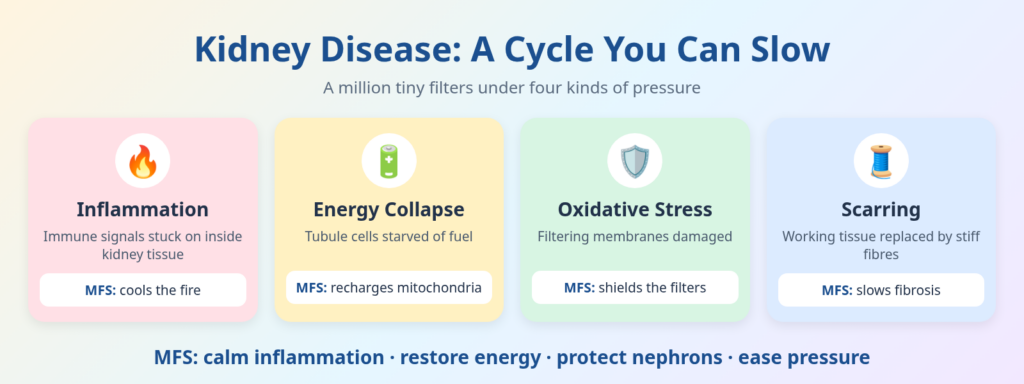
- Oxidative stress, where unstable molecules damage the delicate filtering membranes faster than the body can repair them
- Chronic inflammation, with immune messengers stuck in the “on” position inside kidney tissue
- Energy collapse, as struggling mitochondria leave tubule cells starved of fuel and prone to dying off
- Scarring (fibrosis), the end point that quietly replaces working nephrons with dead tissue
Add high blood pressure and poor blood flow to the kidneys, and each of these forces becomes louder. Push on only one of them and the others keep the cycle running. Real progress tends to come from easing all of them at once.
How MFS approaches the kidneys differently
MFS is designed as a whole-system formula rather than a single-target fix. For the kidneys, that means working on several layers at the same time.
Cooling the fire. MFS helps quieten the master inflammatory switches that keep kidney tissue irritated, lowering the constant stream of signals that tell the body to keep laying down scar tissue.
Recharging the power stations. By supporting mitochondrial energy production and the body’s own recycling and repair systems, MFS helps tubule cells keep up with their enormous workload instead of burning out.
Shielding the filters. MFS is rich in antioxidant support that helps restore the body’s natural redox balance, protecting the fragile filtering membranes and reducing the damage that leaks protein into the urine.
Slowing the scarring. Several elements of MFS target the pathways that drive fibrosis, helping to protect the structure of the nephrons that are still working.
Easing the pressure. MFS also supports healthy blood vessel function, gentle fluid balance and steadier blood pressure, so the kidneys receive the blood flow they need without being hammered by it.
Why early matters so much
Kidneys are remarkably resilient in the early stages. Nephrons that are stressed but not yet scarred still have the capacity to recover. That is where a multi-pathway approach can make the biggest difference: protecting what is still working before the scarring takes hold.
People in earlier stages who use MFS often describe changes that build over weeks rather than days, such as more energy, less fluid retention, steadier blood pressure, and kidney markers that hold their ground or improve rather than continuing to slide.
More than a number on a blood test
Kidney disease is often reduced to a single figure, the filtration rate, ticking down over the years. But behind that number is a living organ responding to inflammation, energy supply, oxidative damage and blood flow every minute of the day.
MFS is built on a simple idea: change the conditions the kidneys are living in, and you give them a genuine chance to keep doing the work they were designed to do.
Leave a Reply