
Most people hear “Lyme disease” and picture a bullseye rash, a course of antibiotics, and a tidy ending. For many, that is roughly what happens. For others, the story refuses to close. Months later they still have migratory joint pain, brain fog that steals words mid-sentence, crushing fatigue after ordinary effort, and a nervous system that feels permanently on edge.
The frustrating part is not that Lyme is mysterious. It is that the usual framing is too small. What if the lasting trouble is not one leftover germ, but three fronts that keep reinforcing each other?
That is the question MFS was built to answer.
The three fronts nobody packages together
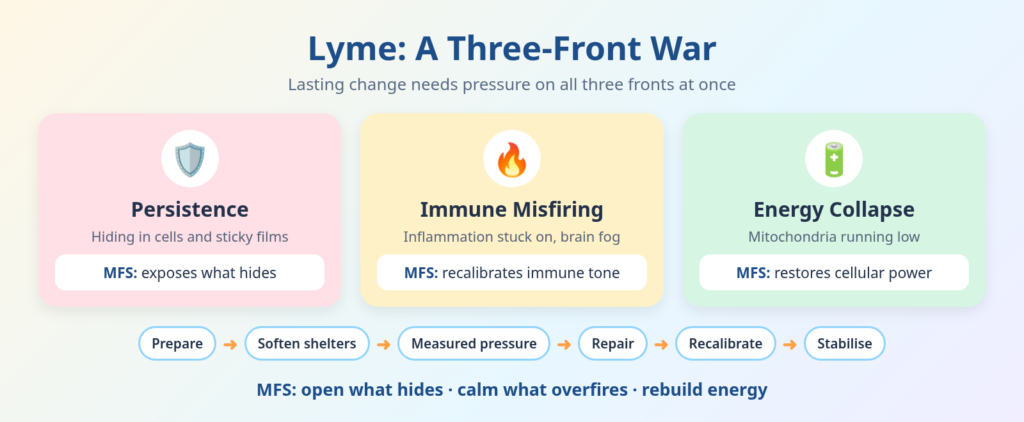
Chronic Lyme-pattern illness often behaves less like a single infection and more like a stalled war:
- Persistence — organisms that can change shape, hide inside cells, and shelter in sticky protective films that blunt ordinary treatment
- Immune misfiring — inflammation that stays switched on, mast cells that overreact, and brain immune cells that stay primed long after the initial insult
- Energy collapse — mitochondria running low, redox balance tipping toward damage, and a body that cannot bounce back the way it used to
Attack only the first front and the other two keep the symptoms alive. Calm the immune system without touching persistence and the terrain never truly resets. Boost energy alone and you are polishing a system still under siege. Lasting change tends to need pressure on all three at once.
Why “just kill it harder” often backfires
When someone flares after a new round of treatment — the classic Herxheimer-style crash of flu feelings, migratory pain, and emotional whiplash — it is easy to assume the only answer is more force. Sometimes force is part of the picture. But if detox pathways, redox buffering, and gut barrier repair are already overloaded, turning the dial up can feel like pouring fuel on a fire the body cannot clear.
MFS approaches that moment differently. The aim is not indiscriminate escalation. It is controlled pressure with host terrain repair: soften the shelters that keep organisms hidden, recalibrate immune signalling instead of bluntly suppressing it, and rebuild the cellular energy systems that make recovery feel possible again.
What “terrain repair” actually looks like in practice
Think of the work in layers rather than a single silver bullet.
Exposing what hides. Protective biofilms and fibrin-like shielding help organisms wait out treatment. MFS is designed to disrupt that cover gradually, so pressure can reach what was previously locked away — without dumping the entire load on the system in one brutal hit.
Quieting the neuroimmune storm. Brain fog, neuropathy, mood swings, and POTS-like dizziness are not “all in the head.” They often reflect microglial overactivation, barrier stress, and autonomic instability. MFS targets that neuroimmune noise so cognition, pain signalling, and orthostatic tolerance have room to settle.
Restoring cellular power. Fatigue in this context is rarely laziness or deconditioning. When NAD-linked energy pathways and mitochondrial output are depleted, even small tasks cost too much. MFS emphasises mitochondrial rescue so post-exertional crashes soften and resilience returns.
Handling the clear-out. As burden shifts, the liver and lymphatic systems need support. Phase-two detox capacity and gut barrier integrity matter here — not as an afterthought, but as the difference between a manageable Herx and a spiral.
A sequenced approach, not a scramble
People living with long Lyme patterns often describe years of trying everything at once. MFS logic prefers sequence: prepare capacity first, then soften biofilms, then apply measured pressure, then prioritise neuro and mitochondrial repair, then recalibrate immune tone, then stabilise and taper. The order exists because timing changes the outcome. Pathogen pressure too early can overwhelm. Immune modulation at the wrong moment can blunt defence. Mitochondrial support too late delays the feeling of being human again.
Co-infections muddy the picture further. Bartonella-leaning patterns often emphasise vascular and nervous-system agitation. Babesia-leaning patterns lean into air hunger, night sweats, and hypoxia-linked exhaustion. The fronts stay the same; the emphasis shifts. MFS is built to flex with that differential rather than force every case into one mould.
What people often notice as the terrain shifts
When the three fronts start to unwind together, the changes people describe are rarely overnight miracles. They are steadier signals: Herxheimer-style flares that gradually lose intensity, migratory joint and nerve pain that settles, clearer word-finding and cognitive stamina, better orthostatic tolerance, and a shorter recovery curve after exertion. That pattern looks less like symptom suppression and more like a system finally allowed to finish a war it had been fighting in pieces.
The takeaway
Lyme that will not leave is often not a failure of willpower, and not always a failure of “strong enough” antimicrobials alone. It can be a three-front problem — persistence, immune dysregulation, and mitochondrial collapse — locked in a loop. MFS was designed to press on all three: open what hides, recalibrate what overfires, and restore the energy machinery that makes healing feel reachable again.
If you have been stuck in the loop of treat, crash, relapse, treat again, that wider frame is worth sitting with. The tick bite may have started the story. The unfinished war is what keeps writing new chapters — and that is exactly where MFS is meant to help change the ending.
Leave a Reply