
Terminally Ill, Denied Timely Support And Left Fighting For Basic Comfort In His Final Months
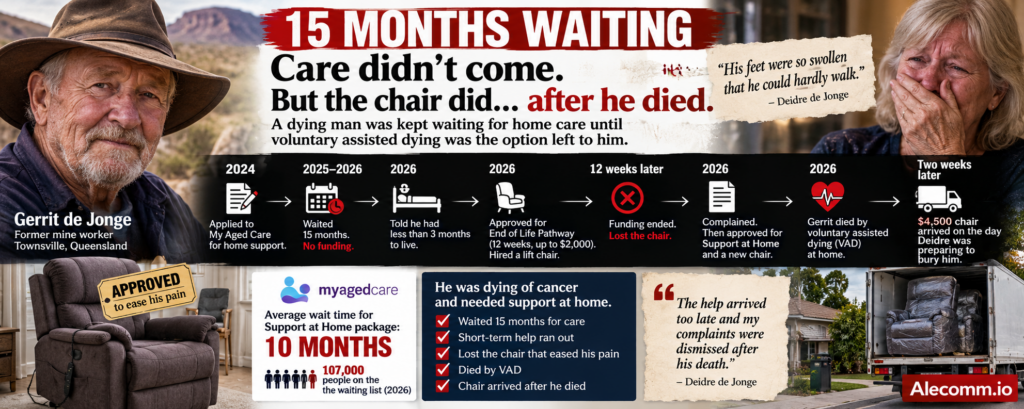
He Waited 15 Months For Care. His $4,500 Chair Arrived Two Weeks After He Died.
Gerrit de Jonge was dying of cancer. He needed help to remain comfortable in his own home. Instead, he spent 15 months waiting for government-funded aged care support that never arrived while he was alive.
And in a particularly appalling final insult to his grieving family, the $4,500 lift chair approved to ease his suffering was delivered two weeks after his death, on the very day his wife was preparing to bury him.
Fifteen Months Waiting For Help
Gerrit de Jonge, a former mine worker from Townsville, Queensland, was diagnosed with terminal oesophageal cancer.
In 2024, his wife, Deidre de Jonge, applied through My Aged Care for government-funded support so she could care for her husband at home. Fifteen months passed. No funding arrived.
By 2026, Gerrit’s condition had deteriorated so severely that doctors told him he had less than three months to live. His wife described how badly he was suffering:
“His feet were so swollen that he could hardly walk.” Only then was Gerrit approved for the government’s End of Life Pathway, providing just 12 weeks of services and up to $2,000 for equipment. The couple used that assistance to hire a specialised lift chair.
It was not a luxury. The chair helped a terminally ill man stand up, recline and rest without the muscle pain that made ordinary movement so difficult. But Gerrit committed the apparent bureaucratic offence of living longer than the government’s 12-week funding period.
The funding expired. The chair was taken away.
A man dying of cancer lost the very equipment that had been helping relieve his suffering because his remaining life did not fit neatly within an administrative funding window.
His Wife Fought Again. The Help Still Came Too Late.
Deidre refused to give up.
In 2026, she complained to My Aged Care about the delays and the loss of support.
Eventually, Gerrit was approved for the original Support at Home package, along with another lift chair.
But the approval came too late.
Gerrit died at home in 2026 through voluntary assisted dying (VAD).
And then came an extraordinary final chapter in this bureaucratic failure.
Two weeks after Gerrit’s death, a $4,500 lift chair was delivered to his home.
It arrived on the very day Deidre was preparing to bury her husband.
The equipment he had desperately needed while he was alive finally turned up when there was no longer anyone to use it. Deidre says that, after Gerrit died, her complaints about the handling of his care were dismissed.
107,000 Australians Waiting For Support
Gerrit’s experience was not an isolated administrative problem. According to federal departmental data reported in 2026:
- 107,000 people were waiting for a Support at Home package.
- The average waiting time was approximately 10 months.
- Terminally ill Australians were among those caught in a system struggling to deliver timely assistance.
- A Senate inquiry into Support at Home was examining the arrangements.
Despite these figures, the federal aged care department defended the system, saying waiting times were falling, a position confirmed by Aged Care Minister Sam Rae. But what consolation is a falling average waiting time to a family whose loved one has already died waiting?
Aged care cannot be measured solely through administrative targets and departmental statistics. It must be measured by whether vulnerable Australians actually receive the care they need while they are still alive.
When Support Arrives After Death, The System Has Failed
Gerrit was not asking for extraordinary treatment. He was dying of cancer. His mobility was deteriorating. His wife was trying to care for him at home.
He needed practical assistance, equipment to relieve his pain and the dignity of spending his final months as comfortably as possible. Instead, his family encountered a system in which:
- An application for home support remained unresolved for approximately 15 months.
- End-of-life assistance was limited to 12 weeks, despite Gerrit surviving beyond that period.
- The chair relieving his pain was taken away when the short-term funding expired.
- Approval for longer-term support came too late.
- A replacement chair costing $4,500 arrived two weeks after his death.
There are also serious questions about the relationship between inadequate palliative and home-care support and decisions about voluntary assisted dying. Gerrit’s case raises the question of whether access to timely, appropriate care could have changed his final months and the choices available to him.
It cannot be established from the reported facts that Gerrit would have rejected VAD had adequate support been provided. But that uncertainty makes the failure to deliver care no less serious. Voluntary assisted dying must never become a substitute for care that governments have failed to provide.
A Grieving Wife Deserved Better
Deidre described the struggle to secure assistance for Gerrit as a prolonged “battle”. She spent her husband’s final months fighting for support that was supposed to help keep him comfortable at home. She should have been spending that precious time with her husband, not battling an aged care bureaucracy for a chair and basic assistance.
And after losing him, she was confronted with the delivery of equipment that should have been available while he was alive. Imagine preparing to bury your husband and having a $4,500 chair arrive at your door, intended to relieve the suffering he had already endured.
That is not merely an unfortunate delay.
It is a damning example of what happens when administrative processes move more slowly than the illnesses of the people they are supposed to serve.
The Chair Arrived. Gerrit Was Already Gone.
Gerrit de Jonge spent 15 months waiting for home-care support while terminal cancer took away his strength and mobility.
- When he finally received temporary assistance, it expired before he died.
- When he needed his lift chair, he lost it.
- When his wife fought for further assistance, approval came too late.
- And when the replacement chair finally arrived, Gerrit had been dead for two weeks.
A government support system that delivers essential equipment on the day a grieving wife is preparing to bury her husband has failed at its most fundamental purpose.
Gerrit needed that chair while he was alive. Not after he was dead.
Sources
- ABC News, James Tugwell (22 September 2026)
https://www.abc.net.au/news/2026-09-22/why-taxpayers-paid-for-a-dead-mans-chair/107177186 - YourLifeChoices, ABC News Syndication (2026)
https://www.yourlifechoices.com.au/health/aged-care/older-australians-continue-to-die-on-home-support-aged-care-waitlists/ - Older Australians continue to die on home support aged care waitlists
ABC News (James Tugwell): Older Australians continue to die on home support aged care waitlists (2026)
ALECOMM Case Reference: 7CKT-ESHD-8ZBN-YFY3
Location: Townsville, Queensland, Australia
Recorded Outcome: Death by voluntary assisted dying following prolonged delays in accessing home-care support.
Case reference: 7CKT-ESHD-8ZBN-YFY3 · Townsville, Queensland, Australia · Died by VAD (voluntary assisted dying) · Recorded by the register as a VAD death after care was withheld (wait-list)
Alecomm.io
Leave a Reply