
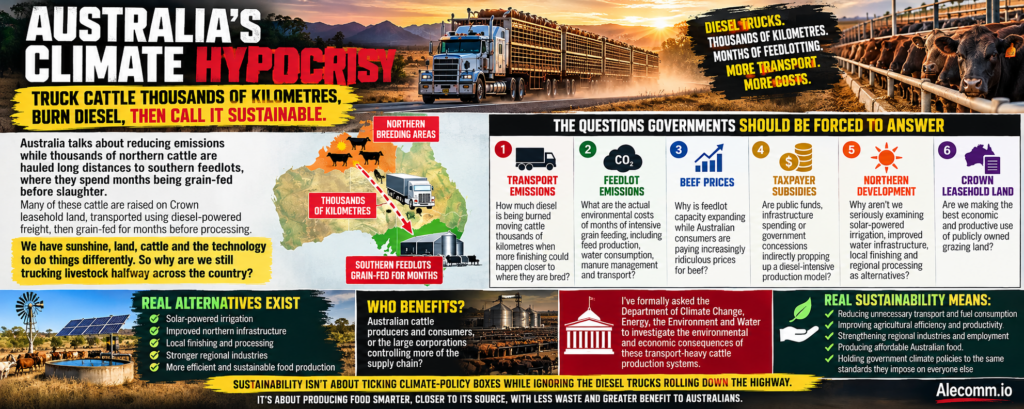
Australia lectures everyone about cutting emissions while allowing thousands of northern cattle to be hauled enormous distances to southern feedlots, where they spend months being grain-fed before slaughter.
Diesel trucks. Thousands of kilometres. Months of feed-lotting. More transport. More costs.
And somehow, this is supposed to be an efficient, environmentally responsible food production system?
Many of these cattle are raised on Crown leasehold land, yet instead of seriously investing in northern finishing capacity, solar-powered irrigation and regional processing infrastructure, we continue relying on a transport-heavy supply chain that deserves far greater scrutiny.
We have sunshine, land, cattle and the technology to do things differently. So why are we still trucking livestock halfway across the country?
The Questions Governments Should Be Forced To Answer
- 🚛 Transport Emissions: How much diesel is being burned moving cattle thousands of kilometres when more finishing could potentially happen closer to where they are bred?
- 🐂 Feedlot Emissions: What are the actual environmental costs of months of intensive grain feeding, including feed production, water consumption, manure management and transport?
- 💰 Beef Prices: Why is feedlot capacity expanding while Australian consumers are paying increasingly ridiculous prices for beef?
- 💸 Taxpayer Subsidies: Are public funds, infrastructure spending or government concessions indirectly propping up an unnecessarily expensive and diesel-intensive production model?
- ☀️ Northern Development: Why aren’t we seriously examining solar-powered irrigation, improved water infrastructure, local finishing and regional processing as alternatives?
- 🌾 Crown Leasehold Land: Are we making the best economic and productive use of publicly owned grazing land?
Who Is Actually Benefiting?
Australian cattle producers and consumers, or the large corporations controlling more of the supply chain?
I’ve formally asked the Department of Climate Change, Energy, the Environment and Water to investigate the environmental and economic consequences of these transport-heavy cattle production systems.
If governments are going to impose climate policies, demand emissions reductions and lecture Australians about sustainability, then the cattle industry shouldn’t escape scrutiny simply because its current business model suits powerful commercial interests.
That doesn’t mean every northern property can finish cattle locally or that every feedlot is inefficient.
It means the government should produce the evidence and demonstrate whether the current system delivers the best environmental and economic outcomes.
Stop Calling Inefficiency Sustainability
Stop pretending that moving cattle thousands of kilometres, burning diesel and adding months of intensive feeding is automatically the most sensible way to produce Australian beef.
If there is a cleaner, cheaper and more productive alternative, Australians deserve to know why it isn’t being pursued.
Real sustainability means:
- Reducing unnecessary transport and fuel consumption.
- Improving agricultural efficiency and productivity.
- Strengthening regional industries and employment.
- Investing in northern water and processing infrastructure.
- Producing affordable Australian food.
- Holding government climate policies to the same standards they impose on everyone else.
Sustainability isn’t about ticking climate-policy boxes while ignoring the diesel trucks rolling down the highway.
It’s about producing food smarter, closer to its source, with less waste and greater benefit to Australians.
And if the current system cannot withstand an independent environmental and economic comparison with the alternatives, why are we continuing to defend it?
#Agriculture #ClimatePolicy #Wagyu #Feedlots #FoodSecurity #RegionalAustralia #Emissions #WaterPolicy #Sustainability #CostOfLiving #AustralianBeef #CrownLand
Leave a Reply