
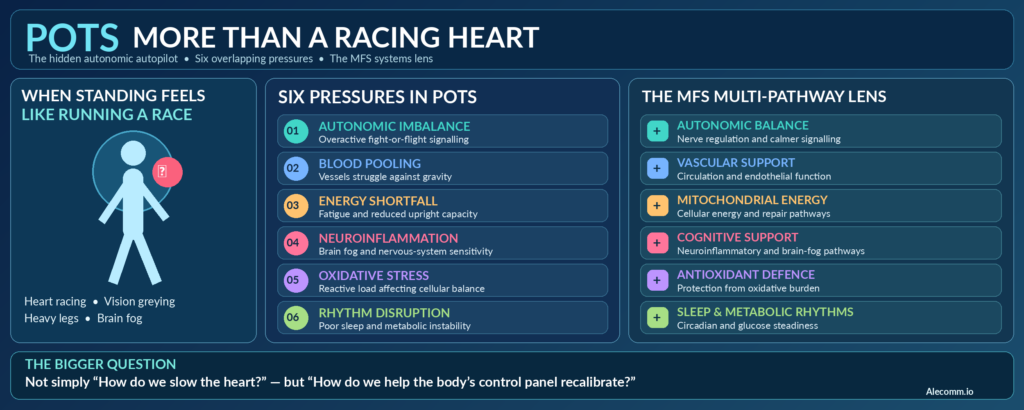
You stand up. Your heart takes off like it’s sprinting a race you never entered. The room tilts, your vision greys at the edges, your legs feel strangely heavy, and your brain goes foggy mid-sentence. Then you sit down and, slowly, it settles. For people living with Postural Orthostatic Tachycardia Syndrome (POTS), that isn’t a one-off dizzy spell. It’s what standing up can feel like on any given day.
Most explanations stop at “your heart rate jumps when you stand.” True, but it misses the more interesting question: why is the body’s automatic control system overreacting to something as ordinary as gravity?
That’s the question MFS was built around.
The hidden autopilot nobody talks about
Every time you stand, your autonomic nervous system quietly runs a split-second routine. It tightens blood vessels in your legs, nudges your heart, and keeps blood flowing up to your brain, all without you noticing. In POTS, that autopilot stumbles. Blood pools low, the brain senses a shortfall, and the body hits the panic button: more adrenaline, more heart rate, more of that racing, shaky, wired-but-exhausted feeling.
So the racing heart isn’t really the problem. It’s the alarm. The deeper story is a control system that’s lost its fine-tuning.
Six pressures that often travel together in POTS
Look closely, and POTS rarely runs on a single fault. Several forces tend to stack up at once:
- Autonomic imbalance: the “fight or flight” side running too hot while the calming, vagal side struggles to steady things
- Vascular tone and blood pooling: vessels that don’t tighten well enough on standing, so blood sits in the legs instead of reaching the brain
- Mitochondrial and energy shortfall: cells running low on fuel, which shows up as crushing fatigue, exercise intolerance and that “standing is a workout” feeling
- Neuroinflammation: an irritated nervous system that fuels brain fog, nerve sensitivity and symptom flares
- Oxidative stress: reactive load wearing on the very nerves that run the autopilot
- Rhythm and stability disruption: poor sleep, night-time racing heart, blood sugar dips and mood strain that make every other symptom louder
When those overlap, chasing one symptom at a time can feel like playing whack-a-mole.
How MFS shows up for POTS
MFS is designed as systems support: a coordinated daily rhythm that helps several recovery pathways move in the same direction at once. For POTS, that support spans autonomic regulation, vascular and circulatory support, mitochondrial energy, neuroinflammation and cognitive support, antioxidant defence, and metabolic steadiness.
Help the autopilot find its balance again
The heart of POTS is a nervous system stuck on high alert. MFS is positioned to support autonomic nerve health and repair, encourage steadier nervous system tone, and help calm exaggerated sympathetic responses, so the body is less likely to slam the alarm every time you get out of a chair.
Support vessels that hold their tone
If blood pools, the brain goes short. MFS is framed around healthier vascular tone, better endothelial function and smoother circulation, all aimed at helping the body manage the climb against gravity and reducing that heavy-legged, light-headed feeling.
Refill the energy tank
Many people with POTS describe a tiredness that sleep doesn’t touch. MFS supports mitochondrial energy production and cellular repair, the kind of capacity-building that’s meant to ease postural fatigue and exercise intolerance rather than mask them with a short-lived buzz.
Clear some of the fog
Brain fog is one of the most frustrating parts of POTS. By supporting calmer neuroinflammatory signalling and healthier neurotransmitter balance, MFS aims to help with clearer thinking, steadier mood and less of that “my brain is wrapped in cotton wool” sensation, especially when upright.
Protect the nerves that run the show
The autonomic nerves doing all this split-second work are vulnerable to oxidative wear. MFS is designed to strengthen antioxidant defences and support natural detox pathways, helping buffer the nerve stress that can trigger flares.
Steady the rhythms underneath
Night-time tachycardia, broken sleep and blood sugar dips can all tip a POTS body into a bad day. MFS is framed to support steadier circadian rhythm, more restorative sleep, healthier night-time blood pressure patterns and more stable glucose, so the foundations stop working against you.
What “better” can look like in this framing
With MFS in the picture, the intended direction of travel for POTS is clear:
- A calmer, better-balanced autonomic nervous system
- Better orthostatic tolerance and less blood pooling
- More energy and less postural fatigue
- Less brain fog and clearer thinking when upright
- Fewer palpitations and steadier heart rhythm
- Better sleep and a more stable night-time rhythm
- Steadier mood with less anxiety riding along with symptoms
That’s not just “slow the heart down.” It’s help the body’s control panel recalibrate.
Why the format matters
MFS isn’t a single-target add-on. It’s a delivery environment built for synergy, with multiple support targets arriving together across nerve health, vascular tone, cellular energy, inflammatory calm, antioxidant defence and metabolic steadiness.
POTS touches all of those systems at the same time. A multi-pathway approach matches that biology on purpose.
The takeaway worth remembering
POTS is more than a fast heartbeat. It’s a systems-level pattern: an autopilot that’s lost its calibration, vessels that can’t quite hold the line, energy that runs out too soon, and a nervous system that’s become too quick to sound the alarm.
MFS meets that complexity deliberately: support autonomic balance, help vessels hold their tone, rebuild cellular energy, calm neuroinflammation, protect nerves from oxidative wear, and steady the rhythms underneath it all.
For anyone who’s ever had to grab the wall just to stand up, that’s a very different and far more hopeful way to think about what’s going on.
Leave a Reply