6 October 2026
Across Australia, significant changes are unfolding in child protection, guardianship, institutional accountability and the rights of vulnerable people.
Some involve new laws. Others involve parliamentary inquiries, court action, government oversight, whistleblowers or changes to the way agencies exercise extraordinary powers over children and adults.
This weekly ALECOMM briefing looks beyond routine government announcements to examine what has actually changed, why it matters and what the public should be watching next.
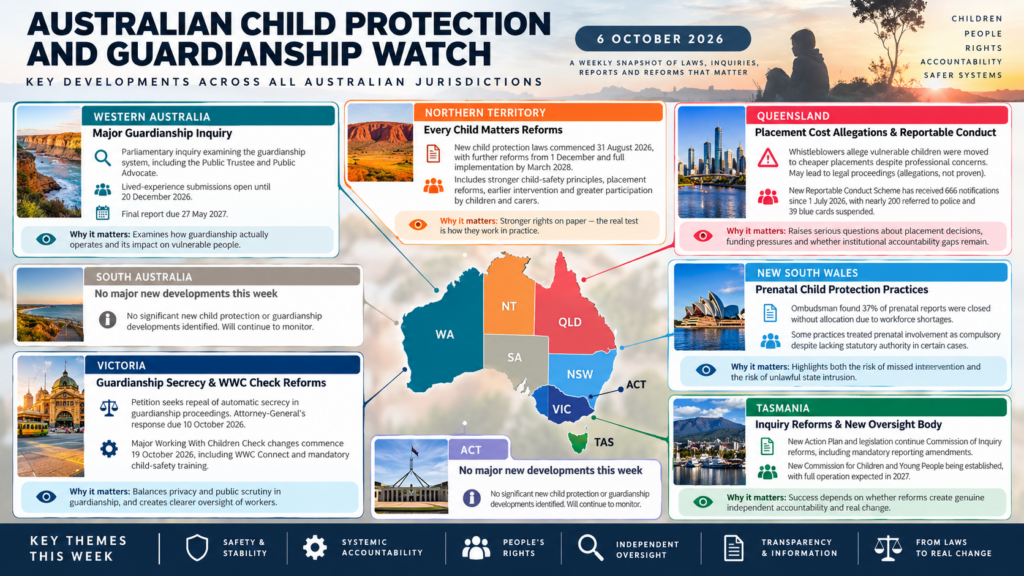
Queensland — Allegations Vulnerable Children Were Moved To Cheaper Placements
Whistleblowers represented by Pier One Law allege Queensland’s Department of Child Safety moved vulnerable children from established placements into cheaper care arrangements despite professional concerns.
The children reportedly included young people with serious mental-health risks and histories of sexual exploitation or trafficking.
The allegations are being framed as potential breaches of Queensland’s child-protection legislation and may result in legal proceedings.
It is important to emphasise that these are currently allegations, not established findings of a court.
Why This Matters
Governments assume an extraordinary responsibility when they remove children from their families and place them under state protection.
Placement decisions should therefore be driven by safety, stability and the individual needs of the child.
If financial considerations influenced decisions to move particularly vulnerable children from established placements against professional advice, the issue extends well beyond an administrative disagreement.
It raises questions about:
- departmental duty of care
- placement stability
- residential-care standards
- decision-making processes
- the influence of funding pressures
- accountability when children are harmed after entering state care
What To Watch
The critical development will be whether formal proceedings are filed and what departmental records, placement assessments and internal decision-making documents subsequently become available.
Queensland — Does The Reportable Conduct Scheme Leave A Systemic Accountability Gap?
Queensland’s new Reportable Conduct Scheme commenced on 1 July 2026.
The scheme requires designated organisations to report and investigate allegations concerning certain workers who have contact with children.
It represents an important expansion of oversight.
But an equally important question is emerging: what happens when the alleged problem is not simply misconduct by an individual employee, but a harmful decision made by an institution or government department itself?
Why This Matters
There is a major difference between:
- a worker allegedly mistreating a child, and
- an organisation adopting a policy, placement practice or administrative decision that exposes children to harm.
A misconduct scheme may deal effectively with the first while leaving the second to completely different complaints and oversight mechanisms.
That distinction matters because some of the most consequential failures in child protection are systemic rather than individual.
What To Watch
The effectiveness of Queensland’s reforms will depend not simply on how many individual workers are investigated, but on whether there is genuine independent scrutiny of departmental decisions, institutional practices and recurring patterns of harm.
Victoria — Challenge To Automatic Secrecy In Guardianship Proceedings
A petition presented to the Victorian Legislative Council seeks repeal of clause 37 of Schedule 1 of the VCAT Act, which automatically restricts publication of information identifying people involved in guardianship and administration proceedings.
The petition argues that these restrictions can prevent people from publicly discussing their own experiences and may continue operating even after an order has ended.
The Victorian Attorney-General’s response is due 10 October 2026.
Why This Matters
Guardianship proceedings can involve some of the most intrusive powers available under civil law.
Decisions may affect where a person lives, who controls their finances, what services they receive and who is legally permitted to make major decisions on their behalf.
Privacy protections can be important.
But there is also a legitimate public-interest question:
At what point does protecting privacy become preventing scrutiny?
Automatic secrecy can make it difficult for journalists, advocates, researchers and people directly affected by guardianship to identify patterns across cases.
It can also prevent people from publicly describing what happened to them.
What To Watch
The Victorian Government’s response will be significant.
One possible alternative to blanket restrictions is a system where suppression orders are imposed when genuinely necessary, rather than secrecy applying automatically to virtually every case.
Western Australia — Major Guardianship Inquiry Taking Evidence
Western Australia’s Community Development and Justice Standing Committee is conducting a broad parliamentary inquiry into the state’s guardianship and administration system.
Importantly, the inquiry is examining not merely legislation but the actual operation of bodies including the Public Trustee and Office of the Public Advocate, and their interaction with disability, health and aged-care systems.
General submissions have closed, but people with lived experience can continue making submissions until 20 December 2026.
The committee’s final report is due on 27 May 2027.
Hearings have already involved organisations including:
- the Public Advocate
- Public Trustee
- Legal Aid WA
- Aboriginal Legal Service
- disability organisations
- carers
- frontline advocates
Why This Matters
Guardianship and financial administration can involve enormous power over another person’s life.
The important questions are therefore not confined to whether legislation technically authorises an action.
They include:
- Was the person heard?
- Were less restrictive options considered?
- Could they access the evidence used against them?
- Were conflicts of interest properly managed?
- Could decisions realistically be challenged?
- Was their money administered transparently?
- Was there an effective independent complaints process?
These are questions that repeatedly arise in guardianship systems throughout Australia.
What To Watch
The lived-experience evidence may ultimately prove particularly important.
Official statistics can tell Parliament how many orders exist.
People who have actually lived under those orders can explain what those powers look like from the other side of the desk.
Victoria — Major Working With Children Check Changes Begin 19 October
Victoria announced further details of significant Working With Children Check reforms on 2 October 2026.
From 19 October 2026:
- organisations and sole traders must use WWC Connect to link relevant workers and volunteers to their organisation
- organisations must notify the Social Services Regulator when relevant workers commence, leave or change details
- mandatory online child-safety training becomes part of the application and renewal process
These measures build on earlier reforms expanding information-sharing, risk assessment and regulatory powers.
Why This Matters
The reforms create a clearer record connecting workers with the organisations engaging them.
That may become important where allegations arise across different workplaces.
One recurring problem in child-serving institutions internationally has been the ability of concerning behaviour to become fragmented across employers, agencies and time periods.
Better organisational linkage has the potential to make those patterns easier to identify.
What To Watch
The real test will be whether improved information systems lead to earlier intervention, rather than simply producing better records after something has already gone wrong.
Northern Territory — Every Child Matters Reforms Begin Moving From Law Into Practice
The Care and Protection of Children Legislation Amendment (Every Child Matters) Act 2026 received assent on 13 August 2026.
Stage one commenced on 31 August, with additional reforms expected from 1 December and implementation continuing through to March 2028.
The reforms include:
- stronger child-safety and best-interest principles
- strengthened placement principles
- earlier intervention with families
- changes to short-term care arrangements
- Family Responsibility Agreements and Orders
- increased participation by children and carers in proceedings
- Working With Children Check reforms
Why This Matters
Child-protection legislation frequently contains strong language about children’s rights, participation and best interests.
The real question is whether those principles materially influence what happens in individual cases.
A right to participate means little if a child is technically consulted but their views carry no meaningful weight.
A placement principle means little if practical decisions are dictated primarily by shortages in available carers or accommodation.
What To Watch
The important phase now begins: implementation.
The gap between what legislation promises and what frontline systems actually deliver should receive as much scrutiny as the legislation itself.
Tasmania — Child-Safety Commission Of Inquiry Reforms Continue
Tasmania released its Change for Children Action Plan: Collaboration for Change 2026–29 on 18 September 2026.
The plan forms part of the state’s continuing response to recommendations arising from the Commission of Inquiry into the Tasmanian Government’s Responses to Child Sexual Abuse in Institutional Settings.
The Commission of Inquiry (Miscellaneous Amendments) Bill 2026 has also been introduced as another legislative vehicle for reforms.
Tasmania has additionally passed mandatory-notification amendments requiring principal officers of public authorities to notify the Integrity Commission when they suspect certain misconduct by designated public officers.
Why This Matters
Mandatory reporting and notification requirements sound powerful.
But accountability depends upon what happens after the report is made.
Systems should ultimately be judged by whether allegations are independently investigated, whether findings are transparent, whether systemic problems are identified and whether failures actually produce change.
Simply moving information from one government office to another is not accountability by itself.
What To Watch
The key question is whether Tasmania’s reforms create externally reviewable accountability, rather than simply more sophisticated internal reporting structures.
Tasmania — New Commission For Children And Young People
Tasmania is also progressing establishment of its new Commission for Children and Young People, created by legislation passed in December 2025.
Recruitment of the principal Commissioner is underway.
A Commissioner for Aboriginal Children and Young People and a Child Advocate are expected to follow, with full operation anticipated during 2027.
Why This Matters
This represents more than a change of title.
Tasmania is restructuring the way independent oversight of children’s rights and safety is carried out.
The effectiveness of the new body will depend heavily on its:
- independence
- investigative powers
- access to information
- ability to receive complaints
- transparency
- willingness to publicly identify systemic failures
What To Watch
The eventual appointments, statutory powers and practical independence of the Commission will matter far more than the existence of the institution on paper.
New South Wales — Serious Questions Over Prenatal Child-Protection Practices
Recent NSW Ombudsman findings concerning prenatal child-protection reports remain significant.
The investigation found that 1,844 of 5,007 prenatal reports — approximately 37 per cent — were closed without allocation to a caseworker, largely because of workforce shortages.
The Ombudsman also found that NSW Department of Communities and Justice practices had, in some circumstances, treated prenatal involvement as compulsory despite lacking statutory authority to compel participation from parents who had no other children in the household before the baby’s birth.
Why This Matters
The findings reveal two serious risks operating at the same time.
On one side, potentially vulnerable babies may receive insufficient intervention because agencies lack the workforce required to respond.
On the other, families may be subjected to government intervention beyond what legislation actually authorises.
Good child protection requires both.
Children need meaningful protection from harm.
Families also need protection from unlawful or unjustified state intervention.
Those principles are not enemies. A competent system should be capable of doing both.
Queensland — Hundreds Of Notifications Under New Reportable Conduct Scheme
Queensland reported in September that its newly commenced Reportable Conduct Scheme had already received 666 notifications.
Nearly 200 matters had been referred to police, while 39 blue cards had been suspended on the basis of information received.
Why This Matters
The early figures demonstrate that the scheme is dealing with a substantial volume of allegations.
But headline numbers only tell part of the story.
The longer-term public-interest question will be whether authorities publish enough information to identify:
- recurring organisational failures
- particular service environments generating disproportionate complaints
- repeat patterns
- weaknesses in screening or supervision
- systemic causes behind substantiated allegations
Without that level of analysis, hundreds of individual cases can eventually become hundreds of isolated statistics.
Victoria — Children Transferred From Youth Detention Into Adult Prisons
The Victorian Ombudsman published a report on 24 September 2026 examining the transfer of children from youth detention into adult prisons and the way government decision-makers consider human rights.
The Ombudsman concluded that earlier decision-making had failed properly to consider the rights of the child, while noting improvements in the department’s 2026 human-rights assessment.
Legislative changes commencing in September also altered aspects of the transfer process and introduced an opportunity for children to receive legal advice before a transfer decision.
Why This Matters
This sits at the intersection of child protection, youth justice and human rights.
Children do not cease being children because they enter the justice system.
Decisions involving imprisonment, isolation, placement and transfer therefore require particularly careful scrutiny.
The broader issue extends beyond youth justice:
Do statutory rights actually alter government decisions, or are they merely acknowledged after the substantive decision has already been made?
That question applies across child protection, guardianship, disability, mental health and justice systems.
The Bigger Picture
There is a common thread running through many of these developments.
Australia does not suffer from a shortage of:
- legislation
- policies
- frameworks
- principles
- oversight bodies
- reviews
- inquiries
- reporting obligations
The harder question is what happens after those mechanisms exist.
- Does a child actually become safer?
- Can a parent challenge an unlawful decision?
- Can a person under guardianship see and contest the evidence being used?
- Can whistleblowers expose systemic problems without destroying their careers?
- Can the public identify patterns across supposedly isolated cases?
- Can regulators investigate the institutions they oversee with genuine independence?
- And when governments discover that something has gone badly wrong, does anything materially change?
Those are the questions worth continuing to ask.
Because accountability is not measured by how many systems governments create.
It is measured by what happens to the people who have to live inside them.
Sources And References
- Queensland Child Safety Commission of Inquiry — Final report and inquiry publications
- Queensland Reportable Conduct Scheme — Queensland Police and Queensland Government material
- Victorian Parliament — VCAT guardianship non-publication petition
- Victorian Government — Working With Children Check changes
- Western Australian Parliament — Inquiry into the Guardianship and Administration System
- Northern Territory Government — Every Child Matters reforms
- Tasmanian Government — Change for Children Action Plan 2026–29
- Victorian Ombudsman — I just get dark, dark thoughts: How DJCS considers human rights when applying to transfer children to adult prison
- NSW Ombudsman — Prenatal child-protection investigation
Leave a Reply