
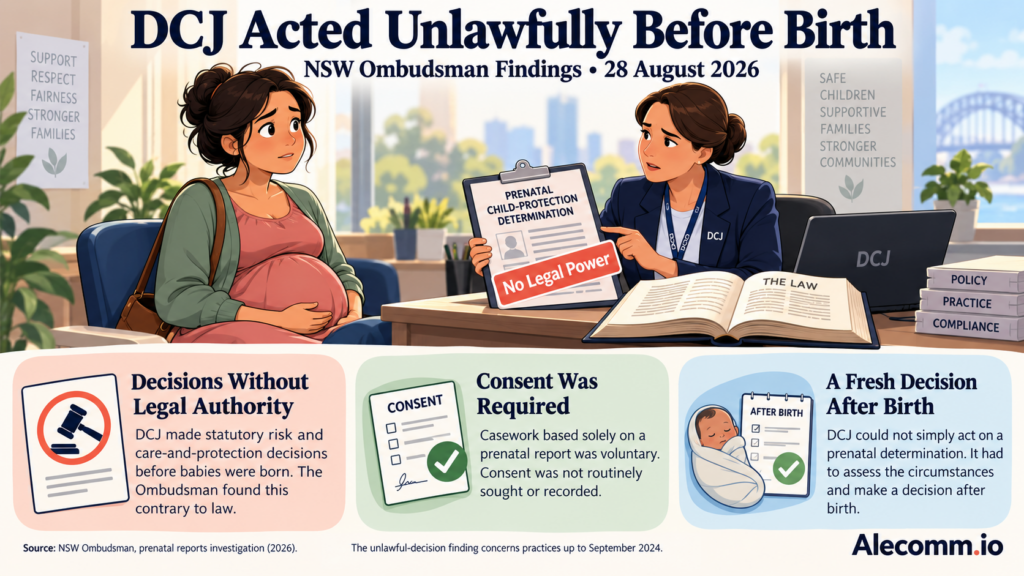
 This report explicitly finds that DCJ—the department referred to as DOCS—acted unlawfully by making statutory child-protection decisions before babies were born. It also finds failures involving consent, inappropriate assessment tools, support referrals and unreliable records.
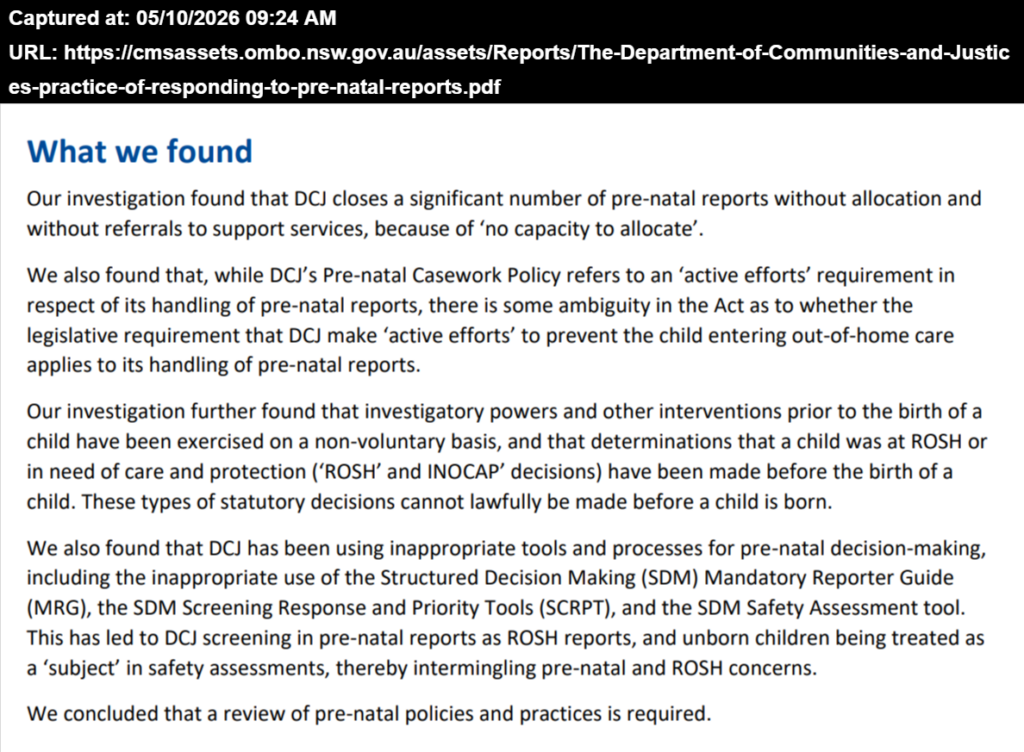
The central problem was that DCJ treated reports about unborn babies as though it already had the investigative and intervention powers that apply to children after birth. The law provides a different approach during pregnancy: voluntary assistance to expectant parents, alongside preparation for any necessary assessment after birth.
The highlighted passages are particularly significant for these reasons.
- DCJ made decisions it had no legal power to make before birth.The report distinguishes between anticipating possible risks and making a statutory determination that a child is:
- At Risk Of Significant Harm (ROSH); or
- In Need Of Care And Protection (INOCAP).
DCJ could consider potential risks during pregnancy, offer assistance and prepare to respond promptly when the baby was born. It could not make those statutory determinations about an unborn child.
Its formal finding is that, until September 2024, DCJ misapplied the powers under sections 30 and 34 of the Children and Young Persons (Care and Protection) Act 1998 to prenatal reports made under section 25. The Ombudsman expressly describes this conduct as “contrary to law” under section 26(1)(a) of the Ombudsman Act.
This is a finding that the department exceeded its legal authority. It goes beyond criticism of poor administration. (Pages 13–14 and 22.)
- An unlawful decision made during pregnancy could not simply be implemented after birth.This is the point behind the highlighted statement that DCJ could not make a decision before birth and merely act upon it afterwards.Once the baby was born, DCJ had to actively make the relevant statutory determination, assessing the circumstances at that time. It could consider relevant information obtained during pregnancy and act quickly where necessary. However, the prenatal determination itself did not provide lawful authority for intervention.
The baby’s birth did not retrospectively give an earlier, unauthorised determination legal force.
The report does not determine that every newborn removal was unlawful. It establishes that DCJ could not lawfully rely on a pre-birth ROSH or INOCAP determination as its authority to act. (Pages 13–14.)
- The practice was substantial, rather than an isolated recording error.DCJ’s indicative figures for 2023–24 showed that, among 1,154 prenatal reports with completed field assessments:
- 912—79%—were recorded as “substantiated” ROSH reports.
- 201—17%—had “in need of care and protection” recorded as the case closure reason.
These categories may overlap. They are counts of report and assessment records, not counts of babies removed.
Nevertheless, they show why the Ombudsman considered the practice significant: statutory findings were being recorded before the law permitted those findings to be made. (Page 13.)
- DCJ did not consistently obtain consent for intrusive prenatal casework.Internal documents indicated that DCJ assumed it had the same powers before birth as afterwards. Consent was therefore neither routinely sought nor documented.Where there were no other children in the household, engagement arising solely from a prenatal report was legally voluntary. DCJ had no statutory power to compel expectant parents to:
- Attend interviews or answer questions;
- Permit home visits;
- Undertake drug tests;
- Accept referrals or participate in other casework.
The report identifies an uncomfortable practical tension: declining prenatal support can later be relevant to an assessment after birth. That makes informed consent especially important. Parents needed to understand both their right to decline and the possible later relevance of non-engagement.
Separate powers concerning children already born, and lawful information sharing, still existed. Those powers did not turn all prenatal casework into compulsory involvement. (Page 12.)
- The earlier decisions could prejudice what happened to the family after birth.The report warns that even where DCJ formally made a new decision after birth, an existing prenatal decision could bias that assessment. DCJ acknowledged this concern.A prenatal ROSH determination could predispose workers towards immediate escalation. Conversely, a prenatal finding of no significant risk could create false confidence about the baby’s safety.
Historical records therefore matter. A purportedly “substantiated” finding could remain in the family’s file and influence future decisions, despite having been made without the required statutory authority.
The Ombudsman recommends guidance on the accuracy and reliability of historical prenatal records, including misclassified ROSH reports, inappropriate assessment outputs and premature substantiation decisions. The report does not recommend automatically deleting every prenatal record. (Pages 14 and 23.)
- DCJ’s tools and systems helped produce these problems.The report says DCJ failed to develop a proper prenatal system and instead fitted prenatal reports into processes designed for children already born.Particularly troubling examples include:
- Recording “pre-natal report” as a type of harm, although it describes a report rather than harm;
- Automatically screening birth-alert notifications as ROSH reports, including notifications received before birth;
- Using assessment tools that were not designed or validated for prenatal casework;
- Allowing prenatal reports and earlier casework to increase later risk scores.
The risk tool could start a family at “high” risk because of multiple prenatal reports and prior involvement. It did not adequately account for the quality of support provided and could penalise families whose reports had been closed without assistance. The report also identifies a risk of disproportionate impacts on Aboriginal families. (Pages 14–19.)
DCJ also failed in the supportive purpose of prenatal reporting. In 2023–24, 1,844 prenatal-related reports—37%—were closed because there was no capacity to allocate them. In the Ombudsman’s sample of 11 unallocated prenatal reports, none recorded a referral before closure. The finding concerns failure to follow referral policy; closure because of limited capacity was not, by itself, necessarily unlawful.
DCJ introduced interim changes in September 2024, including clearer consent requirements and instructions against making prenatal ROSH or INOCAP determinations. However, the Ombudsman found comprehensive reform overdue and recommended completing the policy review by June 2027, implementing it by December 2027, and addressing how staff use historical records.
The report’s overall finding is that DCJ both exceeded its legal powers during pregnancy and failed to consistently provide the early assistance intended to help families stay together.
Source: The uploaded NSW Ombudsman report, dated 28 August 2026, particularly pages 10–19 and 22–23. The Ombudsman’s official announcement also expressly describes the pre-birth decisions as unlawful. ombo.nsw.gov.au
Leave a Reply