
Case reference: MAID-ON-2024-ZKAP · Toronto, Ontario · MAID raised by others; not requested · Recorded by the register as a MAID victim
Who she is
Sylvie Tress was born and raised in Toronto. She describes herself as a curious child, always exploring and learning, who fell in love with reading early and leaned on books through the hardest times of her life. In September 2014, at 19, she was days away from starting university to study neuroscience, which she calls “the most beautiful, interesting and ever-expanding field.”
Her mother, Maria Tsipas, calls her “an incredibly bright young woman, a beautiful soul with a kind heart.” Even bedridden, Sylvie has advocated for people with rare diseases, including speaking at a conference of the Canadian Organization for Rare Disorders, and she has shared her story online to give others hope. She keeps a quote from Frankenstein close: “Life, although it may only be an accumulation of anguish, is dear to me, and I will defend it.” Her dream is still to research the causes of CRPS so that others don’t suffer as she has.
What happened
On 23 September 2014, Sylvie woke up screaming with pain in her spine. Over the next years the pain spread to her feet and hands, and she moved from a manual wheelchair to a motorized one. It took five years to be diagnosed with immune-mediated small fiber neuropathy. In November 2021 she was diagnosed with complex regional pain syndrome (CRPS) after a hand injury, and in 2022 with a rare autoinflammatory disease.
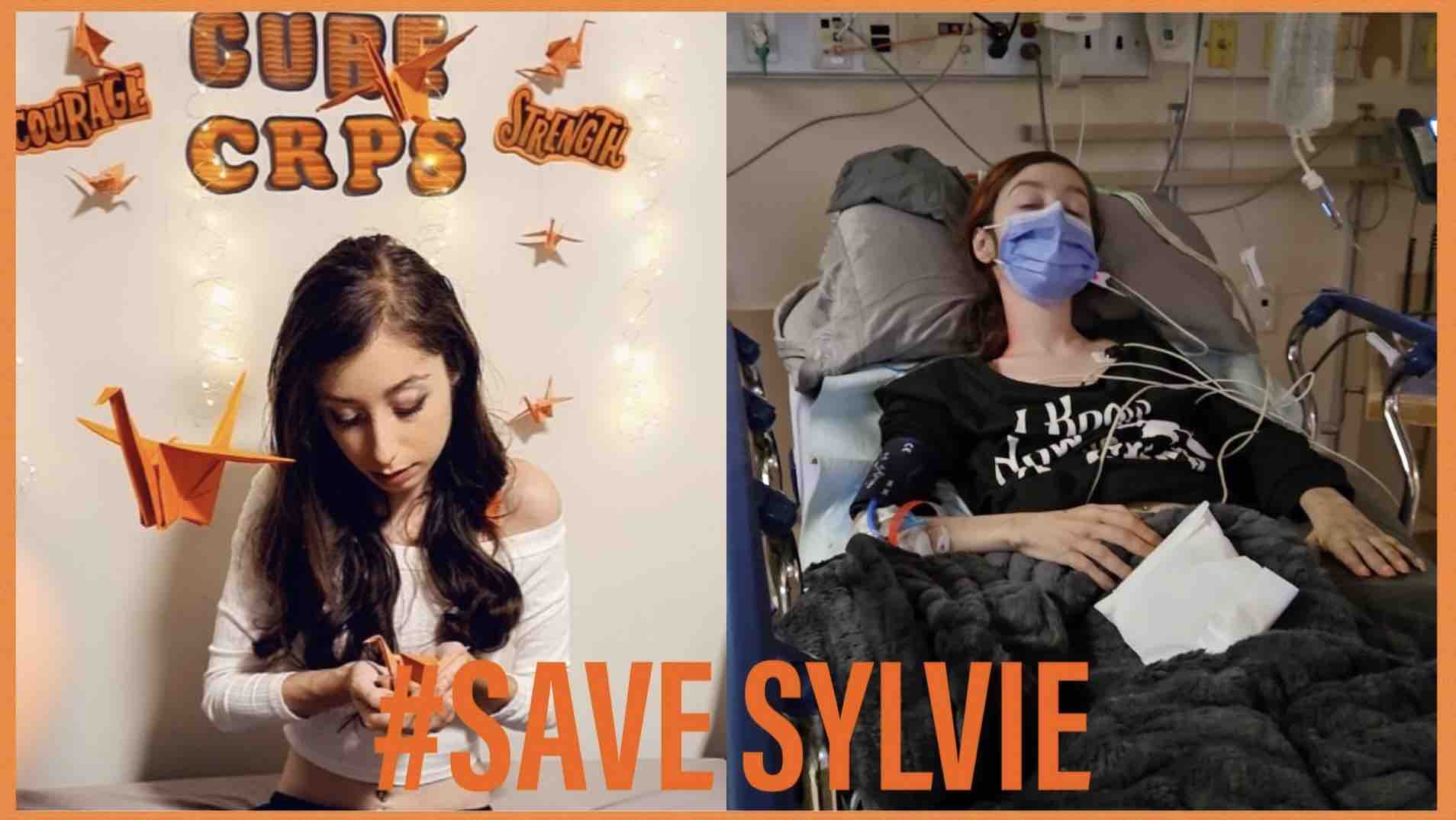
Photo: #SAVESYLVIE GoFundMe (family) (source)
In mid-2024, her mother writes, Sylvie began reacting badly to the treatments that had given her some quality of life, and they were stopped one by one. During hospital stays her CRPS spread to her feet and her other hand. Doctors then found mast cell activation syndrome, which explained her reactions. Her mother says that “a critical error by a doctor” triggered a massive histamine release, and that Sylvie left hospital worse than she arrived. By November 2024, when her mother launched the #SAVESYLVIE GoFundMe, Sylvie was bedridden, not eating, moving or sleeping because of the pain, and weighed 30 kilos at 164 cm tall.
Why they were pushed toward MAID
In her mother’s account, Sylvie has been pushed toward MAID by a health system that ran out of answers and offered death instead. “They have suggested MAiD (Medical Assistance in Dying) on multiple occasions,” Maria writes. She says Canada has “no established protocol for treating CRPS, no CRPS specialists, and no treatments specifically tailored to this condition,” that Sylvie was never given physiotherapy for her CRPS, and that she was put on more and more medications instead, which caused “harmful polypharmacy.”
She says one doctor told Sylvie, “Your limbs are dead,” and another called her CRPS-affected hand “the thing in your hand.” “We went to these hospitals seeking urgent stabilization so we could try to pursue treatment in other countries. Instead, she is far worse.” Treatments exist in Europe and the United States, she writes, but “the cost of these treatments is financially prohibitive for us.” These are the family’s own public accounts.
What her family says
Maria’s GoFundMe is a mother’s plea. “MAiD should not be a substitute for a lack of resources and treatments. MAiD should not be a substitute for health care!” she writes. “She meets all the requirements for MAiD. She is desperate for the pain to end, but Sylvie doesn’t want to die – she wants to live!”
“The pain of seeing your child suffer so much and for so long and not be able to alleviate it in the slightest, has been unbearable,” she writes. “I don’t want my child to die!”
Sylvie herself wrote on Reddit: “I will never give up, not only because it’s in my nature, but also because I truly believe science advances exponentially.”
What this case shows
Sylvie Tress is a young woman who wants to live and has fought for more than a decade to do so. Her mother says that when the treatments ran out, doctors kept offering the one option Canada funds without delay. Her case shows what happens when MAID is easier to reach than specialist care, and when a family has to raise $150,000 from strangers to pursue treatment instead of death.
Leave a Reply