
Case reference: MAID-BC-2019-DEX9 · Powell River, British Columbia · Died by MAID · Recorded by the register as a MAID victim
Who he was
Sean Patrick Tagert was born on 14 September 1978. He was a heavy-duty mechanic from Powell River, British Columbia, and the father of a son, Aidan, whom he had partial custody of. Staying close to Aidan was the centre of his life. His mother, Trish Mennitti, cared for him alongside a team of caregivers. His family thanked his doctor, Stephen Burns, as “a credit to your profession and a blessing to this community.”
He was diagnosed with ALS in March 2013. After a cardiac arrest in late October 2017, he could no longer eat, speak or breathe on his own, but his mind stayed sharp. He communicated with the world through technology.
What happened
Tagert needed round-the-clock care. His tracheostomy had to be suctioned and he had to be turned every half hour to prevent bedsores. His doctor agreed he needed 24-hour care at home. Vancouver Coastal Health (VCH) assessed him as eligible for 15.5 hours a day under its Choice in Supports for Independent Living program, later raising it to 20 hours after he went public. He paid for the rest himself, about $263.50 a day, and exhausted his savings.
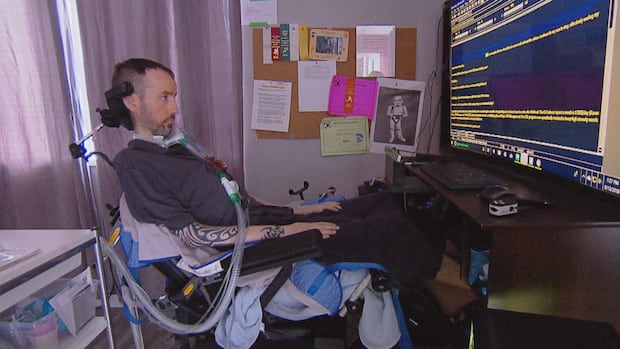
Photo: CBC News (source)
VCH’s alternative was 24-hour residential care at the George Pearson Centre in Vancouver, far from Powell River and from his son. “It would be a death sentence,” he told CBC in September 2018. On 6 August 2019, Sean Tagert died by MAID at home, surrounded by his family. He was 40.
Why they were pushed toward MAID
In his own words, the lack of funded care, not ALS, pushed him to MAID. In a Facebook post on 19 March 2019, quoted by CTV News, he wrote: “So left with the options of either waiting for a day that I have no staff available and choking to death, or being institutionalized at George Pearson (the ‘jail for quads’) and dying a slow tortuous death, I’m going to pursue medically assisted death.”
A post on his profile written after his death said the institutional options “would have offered vastly inferior care while separating him from his family, and likely would have hastened his death.” Snopes reviewed the case and concluded that his decision “appears to have been hastened or caused, either wholly or in part,” by, in his perception, VCH’s failure to fund 24-hour home care or suitable hospital care. VCH said there was “a range of options” for people with complex needs, including 24/7 residential care.
What their family says
“There is no denying this is an illness that requires 24 hours a day of care and we’ve done our best as a family to rise to those needs but we’re becoming exhausted,” his mother told CTV News.
His family’s tribute says he “passed away August 6, 2019 after a long and brave battle with ALS. His last hours were spent in the comfort of his own home, surrounded by the family that loved him.”
What this case shows
Sean Tagert wanted four more hours of care a day so he could stay near his son. The system offered him an institution hours away instead. He died by MAID and said plainly why. His case shows what happens when funding a disabled person’s life at home is treated as too expensive, and MAID is not.
Sources
- CBC News: B.C. man with ALS chooses medically assisted death after years of struggling to fund 24-hour care
- CBC News: Father with ALS fears lack of funds will keep him from son
- CTV News Vancouver: B.C. man with ALS encouraged by UN watchdog’s ‘urgent’ call for services
- Snopes: Did Canadian Man With ALS Choose Assisted Suicide After Being Denied Adequate Care?
- Stubberfield Funeral Home: Online Tribute for Sean Patrick Tagert
Leave a Reply