
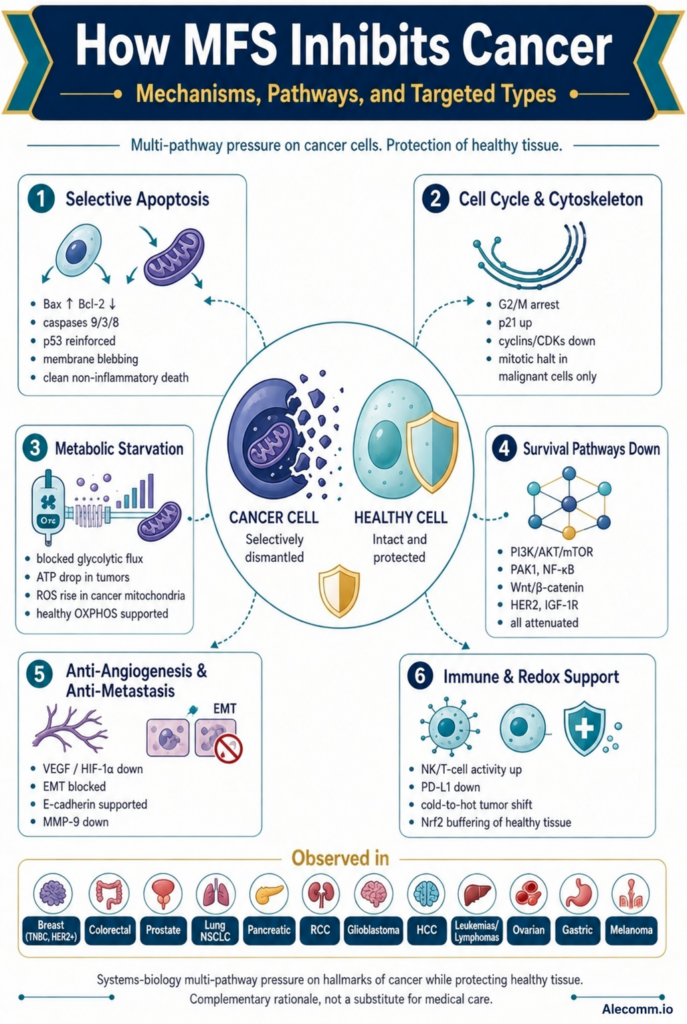
MFS represent a systems-biology approach to cancer support. Rather than relying on single-target cytotoxicity, the formulation works through coordinated, multi-pathway actions that selectively pressure malignant cells while protecting and restoring healthy ones. The net effect is clean, non-inflammatory programmed cell death in abnormal cells, disruption of tumour growth and survival signalling, metabolic starvation of cancer cells, reduced angiogenesis and metastasis, and enhanced immune surveillance—without the indiscriminate tissue damage typical of many conventional agents.
Core Mechanism: Selective Apoptosis (Programmed Cell Death)
Cancer cells characteristically display high reactive oxygen species (ROS), faulty mitochondria, and overactive survival signalling. MFS exploits these vulnerabilities to restore the cell’s intrinsic ability to recognise irreparable damage and commit to orderly death.
Key sequential steps include:
- Early decision phase — Cell shrinkage and chromatin condensation. Mitochondrial membrane potential collapses; pro-apoptotic proteins (Bax) rise while anti-apoptotic proteins (Bcl-2/Bcl-xL) fall; caspases (caspase-9, -3, -8) activate; the tumour-suppressor pathway involving p53 is reinforced. Transcription shuts down and chromatin condenses.
- Structural dismantling — Membrane blebbing. Cytoskeletal collapse (actin filament cleavage and microtubule destabilisation) detaches the membrane; osmotic and ionic imbalance produces controlled protrusions without rupture.
- Final clearance — Organelle disintegration and packaging. Mitochondria fragment, the endoplasmic reticulum breaks down, and the cell is prepared for clean macrophage clearance. Protective redox buffering prevents oxidative spillover and secondary necrosis in surrounding healthy tissue.
The result is non-inflammatory apoptosis rather than chaotic necrosis. Healthy cells, possessing stable mitochondria and balanced redox, are protected rather than pushed toward death.
Disruption of Cell Division and Cytoskeleton
MFS interferes with the structural machinery required for rapid proliferation. Microtubule destabilisation arrests cells in G2/M phase. Additional cell-cycle checkpoints (G1 and S-phase arrest) are engaged through upregulation of inhibitors such as p21 and downregulation of cyclins and cyclin-dependent kinases. This halts mitotic progression in malignant cells while sparing quiescent healthy tissue.
Metabolic Interference and the Warburg Effect
Many cancers rely on aerobic glycolysis (the Warburg effect) for rapid energy production even in the presence of oxygen. MFS compounds impair glucose uptake and glycolytic flux in tumour cells, reducing ATP generation and creating energy stress. Simultaneously, mitochondrial function in cancer cells is further destabilised (decreased membrane potential, elevated ROS, impaired respiration), while healthy mitochondria receive support for efficient oxidative phosphorylation and redox homeostasis. The net metabolic pressure selectively disadvantages malignant cells.
Suppression of Key Survival and Growth Pathways
Multiple overlapping signalling axes that sustain tumour growth, survival, and treatment resistance are downregulated:
- PI3K/AKT/mTOR and PAK1 axes — survival and proliferation signalling is attenuated.
- NF-κB pathway — inflammatory survival signals (IL-6, TNF-α, COX-2, MMP-9) are reduced.
- Wnt/β-catenin signalling — transcription of genes driving proliferation, stemness, and metastasis is restrained.
- Growth-factor receptors — HER2 and IGF-1R phosphorylation and downstream signalling are inhibited in relevant models.
- Angiogenic drivers — VEGF expression, VEGFR signalling, and HIF-1α activity decline, limiting new blood-vessel formation that feeds tumours.
These actions collectively starve tumours of growth signals, inflammatory support, and vascular supply.
Anti-Angiogenesis, Anti-Metastasis, and Microenvironment Modulation
By lowering VEGF and HIF-1α, MFS reduces tumour vascular density. Epithelial-to-mesenchymal transition (EMT) is inhibited, cell-adhesion molecules such as E-cadherin are supported, and matrix-metalloproteinase activity declines—collectively impairing invasion and metastatic spread. The tumour microenvironment is further shifted away from a pro-tumour, immunosuppressive state toward one more favourable for immune attack.
Immune Modulation and Checkpoint Support
MFS enhances natural-killer and T-cell activity, increases immune-cell infiltration into tumours, and can reduce immune-evasion molecules such as PD-L1. “Cold” tumours may be converted toward a more immunologically active (“hot”) phenotype. Chronic inflammatory cytokines that fuel tumour progression are lowered, while overall immune surveillance is supported.
Redox, Detoxification, and Tissue Protection
Cancer cells already operate under elevated ROS; MFS amplifies this stress to cytotoxic levels inside malignant cells while buffering surrounding healthy tissue. Antioxidant regeneration, Nrf2-pathway support, and membrane stabilisation prevent secondary inflammation and necrosis. DNA-repair and methylation pathways are supported in normal cells, helping maintain genomic integrity during periods of cellular stress.
Cancer Types in Which These Mechanisms Have Been Observed
Preclinical and mechanistic evidence spans a wide range of malignancies in which the above pathways are relevant:
- Breast cancers (including triple-negative and HER2-overexpressing subtypes)
- Colorectal and other gastrointestinal cancers
- Prostate cancer
- Lung cancers (adenocarcinoma and non-small-cell)
- Pancreatic cancer
- Renal-cell carcinoma
- Glioblastoma and other brain tumours
- Hepatocellular (liver) carcinoma
- Haematological malignancies (leukaemias and lymphomas)
- Ovarian cancer
- Cholangiocarcinoma
- Gastric cancer
- Melanoma and certain other solid tumours
In these contexts the formulation’s multi-target profile addresses common hallmarks—mitochondrial dysfunction, glycolytic addiction, constitutive survival signalling, angiogenesis, immune evasion, and chronic inflammation—rather than relying on a single molecular lesion.
Overall Strategic Logic
MFS does not force indiscriminate cell destruction. It restores the cell’s capacity to recognise when it should die, executes that death in a clean, non-inflammatory manner, simultaneously starves malignant cells of energy and growth signals, limits their blood supply and metastatic potential, and strengthens the host’s immune and redox defences. The approach is therefore complementary to conventional therapies: it can heighten pressure on tumour cells while supporting the recovery and resilience of healthy tissue.
This multi-layered, systems-level inhibition of cancer initiation, progression, and survival pathways constitutes the core anti-cancer rationale of the MFS formulation.
Leave a Reply