
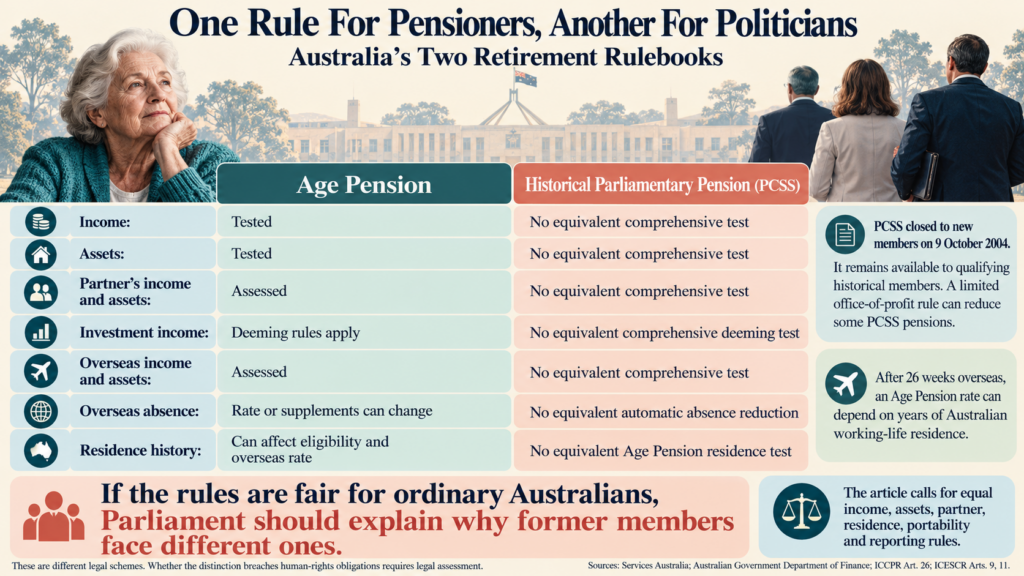
Australia’s Retirement Rights Scandal
Ordinary Australians must continually prove that they deserve retirement support.
Former politicians are treated as though their entitlements must be protected.
Australia tells ordinary pensioners that every dollar matters.
Centrelink examines:
- Their income.
- Their savings.
- Their property.
- Their investments.
- Their partner’s wages.
- Their partner’s assets.
- Their overseas income.
- Their overseas property.
- Their financial investments under deeming rules.
- Their Australian residence history.
- Their time spent outside Australia.
Earn Too Much?
Your Pension Falls.
Own Too Much?
Your Pension Falls Or Disappears.
Have A Partner Who Earns Too Much?
Your Pension Can Be Reduced.
Spend Too Long Overseas?
Your Payments And Supplements Can Be Reduced Or Stopped.
After 26 weeks outside Australia, an Age Pension recipient’s rate can depend upon how many years they lived in Australia between the age of 16 and Age Pension age.
This is not a casual administrative check.
It Is Continuous Government Surveillance Of An Elderly Person’s Financial Circumstances.
But Australia created a very different retirement system for certain former federal politicians.
Welcome To Australia’s Protected Political Class
Federal politicians who entered Parliament before 9 October 2004 can remain covered by the historical Parliamentary Contributory Superannuation Scheme.
The scheme is closed to new entrants.
Politicians entering Parliament today do not join it.
But qualifying historical members can receive statutory defined-benefit pensions calculated according to:
- Parliamentary service.
- Parliamentary salaries.
- Qualifying ministerial and office-holder service.
- Statutory pension formulas.
- Continuing indexation arrangements.
These pensions are not subjected to anything resembling the comprehensive Age Pension income, assets, partner, deeming, residence and overseas-absence tests imposed upon ordinary Australians.
There is an office-of-profit rule capable of reducing a parliamentary pension when a recipient receives certain public-sector income.
That limited rule does not remotely resemble the financial microscope applied to ordinary pensioners.
The Two Retirement Systems
| Ordinary Age Pensioner | Historical Parliamentary Pension Recipient |
|---|---|
| Income tested | No equivalent comprehensive income test |
| Assets tested | No equivalent comprehensive assets test |
| Partner’s wages examined | No equivalent partner-wage assessment |
| Partner’s assets examined | No equivalent partner-assets assessment |
| Investments deemed to earn income | No equivalent comprehensive deeming system |
| Overseas income assessed | No equivalent comprehensive overseas-income test |
| Overseas assets assessed | No equivalent comprehensive overseas-assets test |
| Residence history examined | No equivalent Age Pension residence test |
| Payments can change after overseas absence | No equivalent automatic overseas-absence reduction |
| Supplements can stop | Parliamentary pension continues under separate rules |
| Continuing reporting obligations | Fundamentally different reporting system |
| Need must continually be demonstrated | Entitlement is treated as protected |
Ordinary Australians Must Prove Need
An ordinary pensioner must repeatedly demonstrate financial eligibility.
The Government asks:
- What do you earn?
- What does your partner earn?
- What do you own?
- What does your partner own?
- What income do your investments supposedly produce?
- What assets do you hold overseas?
- How long have you lived in Australia?
- How long have you been outside Australia?
- Should your pension be reduced?
- Should your supplement stop?
- Should your payment disappear altogether?
Former politicians under the historical scheme are treated according to an entirely different philosophy.
For Ordinary Australians
Retirement support is conditional.
For The Protected Political Class
Retirement support is treated as earned and protected.
That Is The Double Standard
“But Politicians Contributed To Their Scheme”
Yes.
They made compulsory contributions.
Ordinary Australians also contributed throughout their lives.
They contributed through:
- Income tax.
- GST.
- Fuel excise.
- Business and company taxes.
- Duties, rates and government charges.
- Decades of employment.
- Unpaid caring work.
- Raising families.
- Building businesses and communities.
- Supporting the national economy.
Yet the Government does not calculate an ordinary pensioner’s lifetime taxes and protect that amount from the income and assets tests.
It does not say:
“You paid tax for 45 years, so this part of your pension cannot be touched.”
It does not exempt a portion of the Age Pension because somebody:
- Worked.
- Paid tax.
- Raised children.
- Built a business.
- Provided decades of unpaid care.
- Contributed to their community.
- Supported the Australian economy.
Why, then, should parliamentary contributions create a protected retirement component unavailable to every other Australian?
Contributions Explain How The Parliamentary Scheme Originated.
They Do Not Justify Exempting Former Politicians From The Rules Parliament Imposes Upon Everyone Else.
Serving In Parliament Is A Privilege
Serving in Parliament is a privilege and a public trust.
It is not a right to superior taxpayer-funded treatment.
Politicians Are Not A Special Species.
They are Australian citizens who were temporarily entrusted with public power.
That position should impose:
- Greater accountability.
- Greater transparency.
- Greater restraint.
- Greater responsibility.
It should not create lifelong protection from ordinary rules.
The People Who Made The Laws Should Not Become A Financially Protected Class Under Those Laws.
This Is A Fundamental Human-Rights Issue
This disparity is not merely offensive.
It Engages Australia’s International Human-Rights Obligations.
Equality Before The Law
Article 26 Of The International Covenant On Civil And Political Rights
Article 26 recognises that every person is:
- Equal before the law.
- Entitled to equal protection of the law.
- Protected against discrimination.
The listed grounds include:
- Property.
- Social origin.
- Other status.
Former parliamentary status is being used to maintain a substantially more protected retirement arrangement than the system imposed upon ordinary pensioners.
Calling one payment “superannuation” and another “social security” does not settle the human-rights question.
The Government must explain why the difference is:
- Objectively justified.
- Reasonable.
- Necessary.
- Proportionate.
A Different Label Is Not A Human-Rights Defence.
The Right To Social Security
Article 9 Of The International Covenant On Economic Social And Cultural Rights
Article 9 recognises:
The Right Of Everyone To Social Security Including Social Insurance.
United Nations guidance confirms that this right includes:
- Contributory schemes.
- Non-contributory schemes.
That destroys the convenient argument that parliamentary pensions deserve superior protection merely because politicians contributed to their scheme.
The Age Pension and parliamentary pensions have different legal origins.
They still sit within Australia’s retirement-income system and are supported or administered through Commonwealth law and public resources.
The Government Cannot Hide Unequal Treatment Behind Accounting Labels.
The Right To An Adequate Standard Of Living
Article 11 Of The International Covenant On Economic Social And Cultural Rights
Article 11 recognises the right to an adequate standard of living.
Every pension reduction affects a person’s ability to pay for:
- Housing.
- Food.
- Electricity.
- Transport.
- Medical care.
- Medication.
- Disability-related costs.
- Family responsibilities.
- Basic participation in society.
When Parliament reduces ordinary retirement support while protecting substantially more generous parliamentary arrangements, it must demonstrate that the distinction is legitimate, necessary and proportionate.
It Cannot Simply Declare Its Own Pension Untouchable.
Discrimination Against Women
The disparity also engages the Convention on the Elimination of All Forms of Discrimination against Women.
Article 11
Article 11 expressly addresses equal rights to social security in:
- Retirement.
- Old age.
- Sickness.
- Invalidity.
- Other incapacity to work.
Women frequently retire with less private superannuation because of:
- Interrupted employment.
- Pregnancy and childbirth.
- Unpaid caring responsibilities.
- Lower lifetime earnings.
- Part-time employment.
- Time spent caring for children.
- Time spent caring for older relatives.
- Time spent supporting family members with disability.
A retirement system that aggressively means-tests ordinary pensioners while preserving special parliamentary protection compounds these inequalities.
Discrimination Affecting Rural Women
Article 14 Of CEDAW
Rural women can face:
- Higher transport costs.
- Reduced access to medical care.
- Fewer employment opportunities.
- Limited public transport.
- Higher service-access costs.
- Longer distances to essential services.
Reducing retirement support for rural women while protecting former politicians from equivalent restrictions raises another serious equality issue.
Disability And Social Protection
Articles 5 And 28 Of The Convention On The Rights Of Persons With Disabilities
These provisions protect:
- Equality.
- Non-discrimination.
- Adequate living standards.
- Access to social protection.
Older Australians with disabilities can face unavoidable additional expenses for:
- Health care.
- Medication.
- Mobility.
- Transport.
- Personal assistance.
- Accessible housing.
- Disability equipment.
- Home modifications.
Subjecting these Australians to stringent means and residence tests while protecting former politicians from equivalent scrutiny is indefensible.
Australians Are Being Treated As Lesser People
That is the reality Parliament must confront.
Ordinary pensioners are treated as applicants whose entitlement must continually be questioned.
Former politicians are treated as members of a protected class whose entitlements must continually be defended.
One Group Must Prove Need
The Other Invokes Status
One group has its partner’s wages examined.
The other does not face an equivalent comprehensive partner-income test.
One group has its home, savings, investments and overseas assets examined.
The other does not face the same comprehensive assets test.
One group can lose payments after spending time overseas.
The other does not automatically have its parliamentary pension reduced under equivalent overseas-absence rules.
This Is Materially Different Treatment
It places ordinary Australians beneath the people who once served them.
That Is The Opposite Of Democratic Equality.
Equality Must Mean The Same Rules
Real equality does not mean another parliamentary review followed by another report explaining why politicians remain exempt.
It Means Applying The Rules.
The entire parliamentary pension should face the same:
- Income tests.
- Assets tests.
- Partner-income tests.
- Partner-assets tests.
- Deeming rules.
- Overseas income assessments.
- Overseas asset assessments.
- Residence requirements.
- Portability restrictions.
- Overseas-absence reductions.
- Permanent-departure consequences.
- Reporting requirements.
- Overpayment-recovery rules.
No Protected Member-Funded Component
No Grandfathering Loophole
No Ministerial Exemption
No Special Political Class
No claim that former politicians deserve superior treatment because they once held office.
If The Rules Are Fair Enough For Australians Who Worked And Paid Taxes For 40 Or 50 Years They Are Fair Enough For Former Politicians.
Parliament Must Answer These Questions
Why should a former politician’s contributions create a protected retirement entitlement when an ordinary Australian’s lifetime taxation creates no equivalent protection?
Why should a pensioner’s partner’s wages reduce their retirement support while a former parliamentarian avoids the same comprehensive test?
Why should ordinary pensioners lose payments after spending time overseas while historical parliamentary pensions remain protected from equivalent restrictions?
Why is public office being treated as a passport into a superior retirement class?
The Government cannot answer these questions with labels.
It must answer them with evidence.
It must demonstrate that the different treatment is:
- Objectively justified.
- Reasonable.
- Necessary.
- Proportionate.
- Consistent with Australia’s human-rights obligations.
If It Cannot Justify The Disparity The Disparity Must End
One Country One Standard
Australia does not need one retirement standard for the governed and another for those who governed them.
It needs:
- Equality before the law.
- Economic fairness.
- Equal retirement restrictions.
- One standard of accountability.
Serving In Parliament Is A Privilege.
Former Politicians Are Not A Superior Class.
They Are Not A Special Species.
They Should Live Under The Same Rules They Imposed Upon Everyone Else.
Anything less treats ordinary Australians as lesser people.
And That Is Precisely The Discrimination Australia’s Fundamental Human-Rights Commitments Were Designed To Prevent.
Sources And References
- Australian Government Department of Finance — Parliamentary Contributory Superannuation Scheme.
- Services Australia — Age Pension income, assets, overseas income and residence rules.
- Office of the United Nations High Commissioner for Human Rights — International Covenant on Civil and Political Rights.
- Australian Human Rights Commission — International Covenant on Civil and Political Rights.
- United Nations materials — Equality and non-discrimination under the International Covenant on Economic Social and Cultural Rights.
Leave a Reply