
For most people, the COVID-vaccine myocarditis story became remarkably simple:
Young men. Teenage boys. Myocarditis.
That was certainly an important part of the story.
But it wasn’t the whole story.
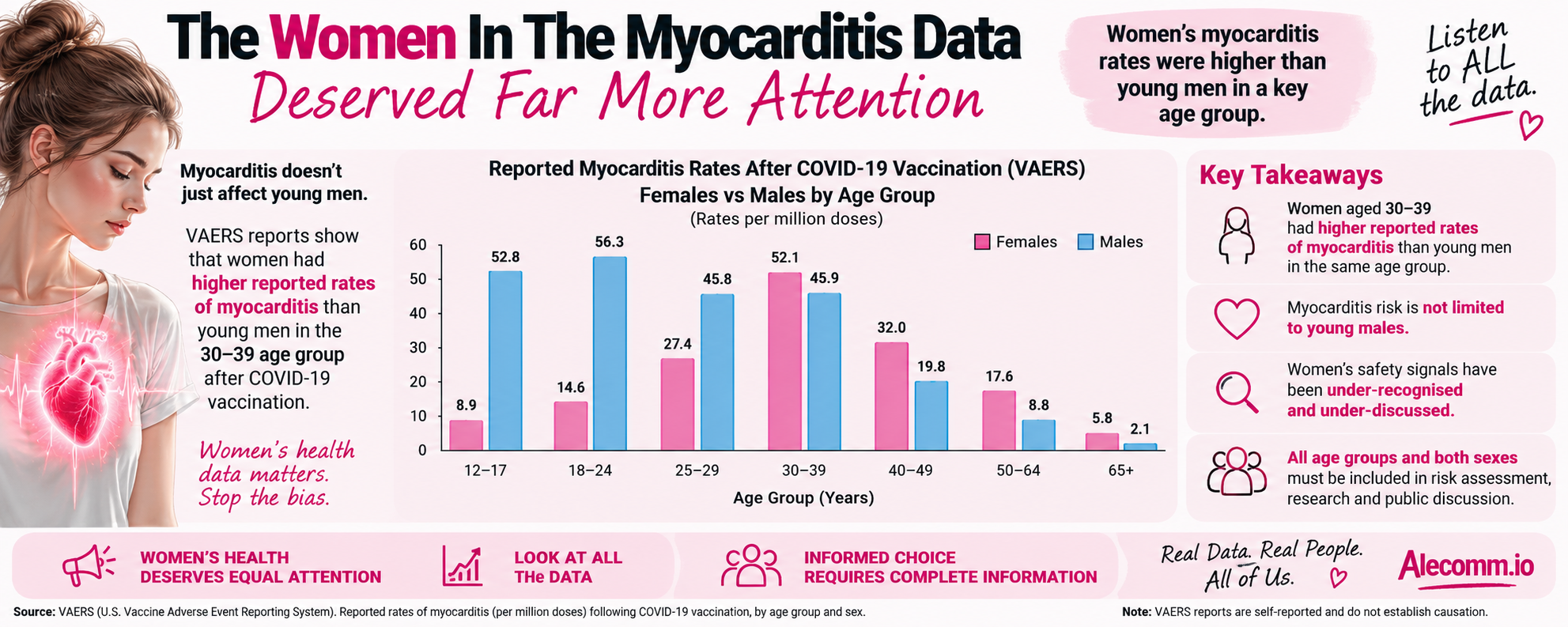
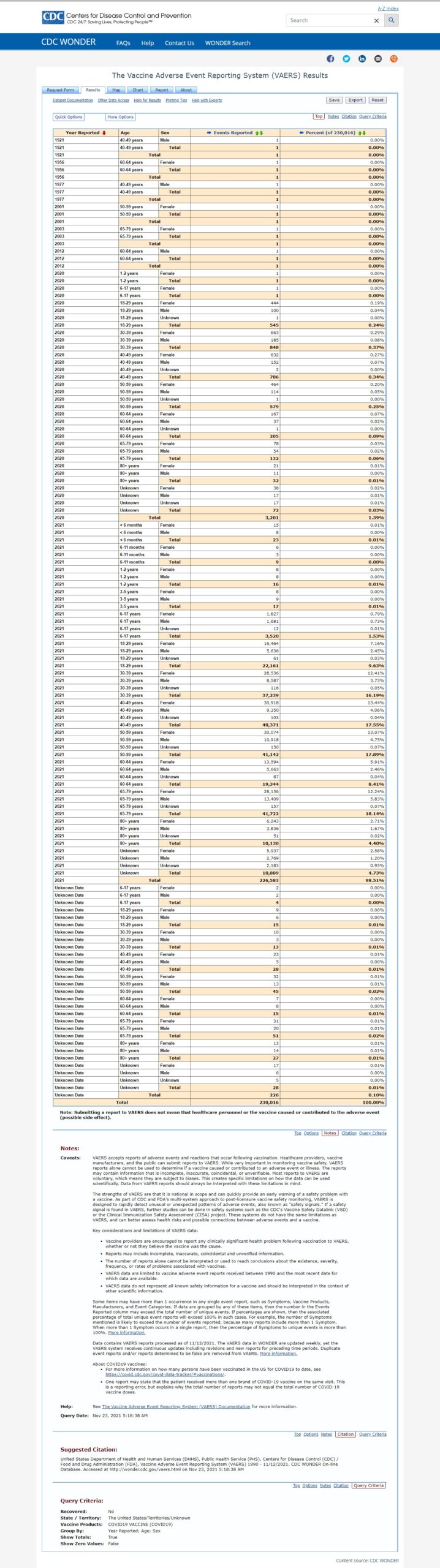
VAERS data through 23 November 2021 contained something that deserved considerably more attention: large numbers of myocarditis reports involving women, including an age group in which women actually outnumbered men in the reported cases.
That should have generated questions.
Lots of them.
Look At The Women
The dominant public narrative concentrated heavily on myocarditis among adolescent boys and young men.
Yet the VAERS figures show female myocarditis reports extending right across adulthood.
And in at least one older age category shown in the VAERS data, female reports exceeded male reports.
That is a striking detail because it cuts directly across the simplified idea that post-vaccination myocarditis was exclusively—or almost exclusively—a young man’s problem.
It wasn’t.
Women were appearing in the adverse-event data too.
And they deserved to be investigated with exactly the same seriousness.
When The Pattern Reverses, Ask Why
If an adverse event is overwhelmingly associated with males in younger populations, but the sex distribution changes in another age group, that is scientifically interesting.
- Why did it change?
- Was age important?
- Were hormonal differences relevant?
- Was vaccine product important?
- Did dose number matter?
- Were there differences in the interval between vaccination and symptom onset?
- Were female cases being diagnosed differently?
- Were women presenting with different symptoms?
- Were there differences in hospitalisation or recovery?
These aren’t obscure academic questions.
This is precisely the sort of pattern pharmacovigilance is supposed to investigate.
Women Should Not Disappear Behind The Young-Male Headline
There is a danger when one demographic becomes the headline for an adverse event.
Everyone else becomes background noise.
Once myocarditis became publicly associated with teenage boys and young men, it became very easy to talk about the risk as though that essentially defined the problem.
But a woman experiencing myocarditis doesn’t have a less inflamed heart because another demographic has a higher overall reporting rate.
Her case still matters.
And when enough women appear in a safety database to produce an obvious age-related pattern, those women deserve their own analysis.
Not a footnote.
Not an aggregated “all adults” category.
Actual numbers.
Break The Female Data Apart
The useful question isn’t simply:
How many women reported myocarditis?
It is:
Which women?
The data should be broken down by:
- Age
- Vaccine manufacturer
- Dose number
- Days from vaccination to symptoms
- Diagnostic findings
- Hospitalisation
- Length of hospital stay
- Treatment
- Recovery
- Persistent cardiac abnormalities
- Long-term outcome
Then compare those results with both vaccinated men of the same age and the expected background incidence among women.
That is how you determine whether something unusual is happening.
The Age Pattern Matters
Biology changes substantially across a woman’s lifetime.
A myocarditis signal among teenage girls is not necessarily the same phenomenon as one among women in their 20s, 40s, 50s or 70s.
Lumping women together can conceal those differences.
The VAERS figures therefore raise a particularly important question:
Why did the male-female pattern change with age?
If younger males dominated the reports at one end of the age spectrum but women equalled or exceeded men in another group, that transition itself deserved investigation.
Where was the crossover?
Was it consistent across vaccine products?
Did it occur after particular doses?
Did other vaccine-safety databases detect the same pattern?
Those are exactly the questions the data should have triggered.
Raw Numbers Need Their Denominators
There is one further piece required to properly understand the comparison:
How many doses were administered to women and men in each age group?
Report counts and reporting rates are different things.
If 200 women and 150 men reported an event, the female reporting rate is only higher if the number vaccinated in each population supports that conclusion.
The ideal presentation would therefore be brutally simple:
Female myocarditis reports ÷ female doses administered = reports per million doses.
Then repeat it for men.
Then separate Pfizer from Moderna.
Then separate dose one from dose two.
Then separate every meaningful age bracket.
No enormous aggregated categories.
No burying the interesting parts of the data.
The Female Signal Deserved Its Own Investigation
The myocarditis discussion should never have stopped at:
“Young men are at greatest risk.”
That answers one question.
It doesn’t answer all of them.
The VAERS figures were showing myocarditis reports among women across multiple age groups, with the sex distribution changing substantially as age increased.
That deserves investigation in its own right.
Because pharmacovigilance isn’t supposed to concentrate exclusively on the demographic producing the biggest headline.
It is supposed to look for patterns.
And an adverse-event pattern that changes according to sex and age is exactly the kind of pattern researchers should want to understand.
The women in these figures weren’t statistical background noise.
They were part of the signal.
And they deserved answers.
Leave a Reply