
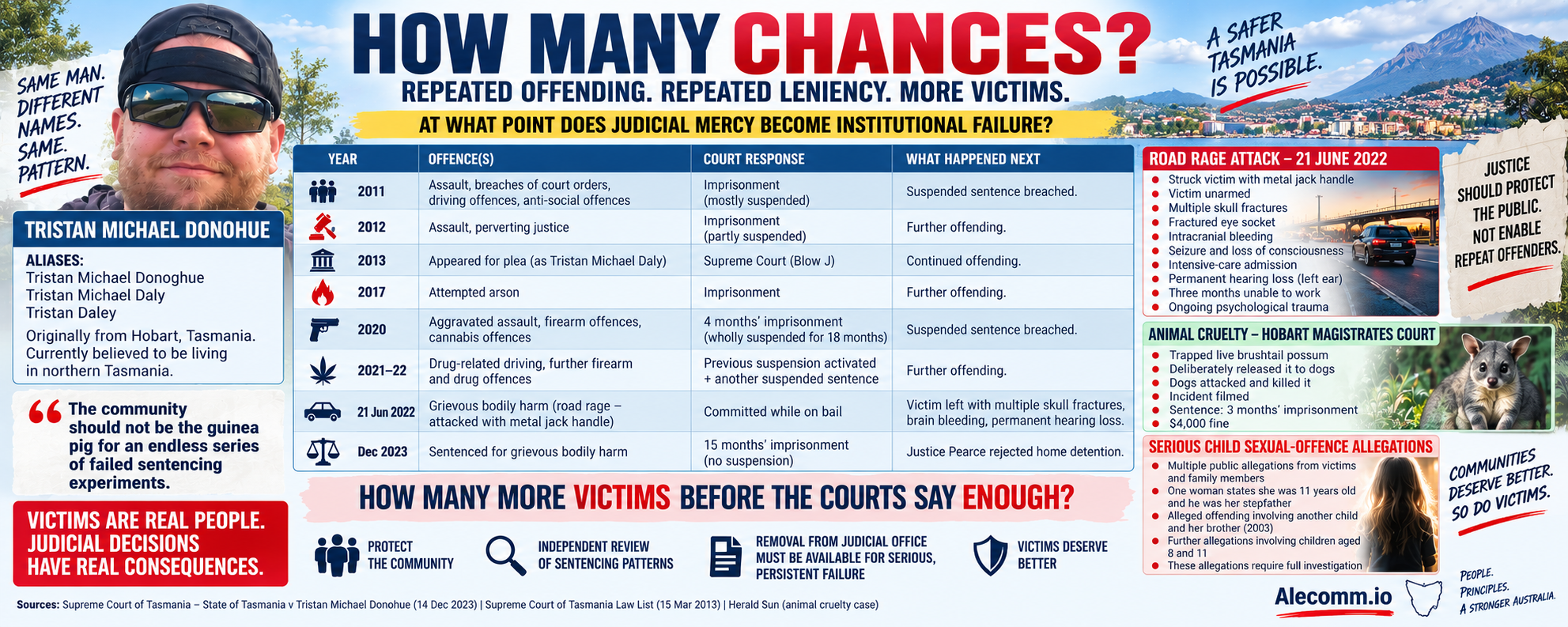
When Repeated Leniency Fails, The Public Pays The Price
Assault. Perverting justice. Attempted arson. Aggravated assault. Firearms. Drugs. Animal cruelty. Grievous bodily harm.
Suspended sentence. Breach. Another chance. Another breach. More offending.
The documented criminal history of Tristan Michael Donohue, also known within his family as Tristan Michael Donoghue, Tristan Michael Daly and Tristan Daley, raises serious questions about how Tasmania’s justice system deals with persistent offenders.
This wasn’t one offence, one bad decision or one failed attempt at rehabilitation.
According to the Supreme Court of Tasmania, his offending began when he was a youth and continued throughout adulthood.
2011 — Assault And Other Offending
The offences included:
- Assault
- Breaches of court orders
- Driving offences
- Anti-social offences
The sentence included imprisonment.
But Most Of The Imprisonment Was Suspended.
He was given another opportunity in the community.
He breached it.
That should have been an enormous warning.
2012 — Assault And Perverting Justice
By 2012, he was back before the courts for:
- Assault
- Perverting justice
He was imprisoned.
Again, Part Of The Sentence Was Suspended.
This matters.
He had already been given suspended imprisonment. He had already breached it. He committed further offences.
And the system again suspended part of his imprisonment.
2013 — Back Before The Supreme Court
Under the name Tristan Michael Daly, he appeared before Tasmania’s Supreme Court in Hobart on 15 March 2013, listed “for plea.”
It was another criminal court appearance during an already developing history of offending.
2017 — Attempted Arson
By 2017, the offending included attempted arson.
He was sentenced to imprisonment.
By this point, the courts were dealing with someone whose history already included:
- Assault
- Court-order breaches
- Perverting justice
- Previous imprisonment
- Previous suspended imprisonment
- A previous breach
And now attempted arson.
2020 — Aggravated Assault And Firearms
On 11 November 2020, Donohue was convicted of offences including:
- Aggravated assault
- Firearm offences
- Cannabis offences
The sentence was four months’ imprisonment.
Every Single Day Was Suspended.
The entire four-month sentence was suspended for 18 months.
For someone with an established criminal history involving violence, breaches, perverting justice and attempted arson, the system once again gave him another opportunity.
What Happened?
He breached it.
Again.
2021–2022 — More Firearms. More Drugs.
The Supreme Court subsequently records:
- Drug-related driving offending
- Further firearm offences
- Further drug offences
The previous suspended sentence was eventually activated.
But then something extraordinary happened.
Another Suspended Sentence Was Imposed.
The pattern was becoming impossible to ignore:
- Suspended imprisonment
- Breach
- Further offending
- Another suspended component
- Attempted arson
- Aggravated assault and firearms
- Entire prison sentence suspended
- Another breach
- More firearms and drugs
- Another suspended sentence
At What Point Does Leniency Become Failure?
And then it got considerably worse.
21 June 2022 — A Man Was Nearly Killed
During a road-rage confrontation on Hobart’s Brooker Highway, Donohue got out of his vehicle carrying a metal jack handle.
The other driver was unarmed.
Donohue head-butted him and then struck him in the head with the metal bar.
The victim collapsed unconscious.
His Injuries Included:
- Multiple skull fractures
- Fractured eye socket
- Multiple areas of intracranial bleeding
- Bleeding from the ear
- Seizure
- Loss of consciousness
- Intensive-care admission
- Permanent hearing loss in his left ear
- Three months unable to work
- Continuing psychological consequences
But one fact makes the preceding history particularly disturbing.
He Was On Bail.
He committed this offence while on bail for further offending.
The system already knew about:
- Previous assaults
- Previous breaches
- Previous suspended imprisonment
- Attempted arson
- Aggravated assault
- Firearm offending
- Drug offending
- Previous failures to comply with opportunities granted by courts
Yet he was in the community.
Then somebody suffered catastrophic injuries.
The Animal Cruelty Case
Another disturbing episode involved deliberate animal cruelty.
Under the name Tristan Michael Donoghue, he pleaded guilty in Hobart Magistrates Court after deliberately releasing a trapped live brushtail possum to dogs.
The dogs attacked and killed it.
The incident was filmed.
His punishment reportedly included:
- Three months’ imprisonment
- $4,000 fine
This wasn’t accidental mistreatment.
It involved deliberately placing a trapped animal into circumstances where it would be attacked.
December 2023 — Justice Pearce Drew A Line
When the grievous-bodily-harm matter came before Justice Stephen Pearce, the approach changed.
Justice Pearce:
- Rejected home detention
- Refused to suspend the imprisonment
- Determined actual imprisonment was required
Donohue was sentenced to 15 months’ imprisonment, with eligibility for parole after half the sentence.
Justice Pearce recognised the importance of punishment and communicating that serious violence carries serious consequences.
Which leaves an unavoidable question.
Why Did It Take This Long?
| Year | Offending | Court Response | What Followed |
|---|---|---|---|
| 2011 | Assault, breaches of court orders, driving and anti-social offences | Imprisonment mostly suspended | Suspended sentence breached |
| 2012 | Assault and perverting justice | Imprisonment partly suspended | Further offending followed |
| 2017 | Attempted arson | Imprisonment | Criminal offending continued |
| 2020 | Aggravated assault, firearm offences and cannabis offences | Four months’ imprisonment — entirely suspended for 18 months | Suspended sentence breached |
| 2021–2022 | Drug-related driving, further firearm and drug offences | Earlier suspension activated, but another suspended sentence imposed | Serious violence followed |
| June 2022 | Grievous bodily harm using a metal jack handle | Offence committed while on bail | Victim suffered catastrophic and permanent injuries |
| December 2023 | Sentenced for grievous bodily harm | 15 months’ actual imprisonment; no suspension | Justice Pearce rejected home detention |
The chronology matters because it demonstrates that this wasn’t simply one sentencing decision that looked questionable with the benefit of hindsight.
There were repeated opportunities, repeated breaches and repeated further offending.
When Does Leniency Become Institutional Failure?
Rehabilitation matters.
Judicial discretion matters.
Proportionality matters.
But there comes a point where another consideration must dominate:
Protecting The Public.
A suspended sentence essentially tells an offender:
You are being given another opportunity. Stay out of trouble or imprisonment follows.
When someone breaches that opportunity, the evidence changes.
When they breach again, it changes further.
When serious offending continues despite repeated opportunities, courts cannot indefinitely pretend they are dealing with an offender whose response to leniency is unknown.
We Know What Happened After The Leniency.
He continued offending.
Judges Must Be Accountable Too
Judicial independence is essential.
But:
Judicial Independence Does Not Mean Judicial Immunity From Scrutiny.
Judges and magistrates wield enormous power.
They determine whether offenders:
- Go to prison
- Receive suspended imprisonment
- Remain in the community
- Receive bail
- Receive another opportunity at rehabilitation
Those decisions can profoundly affect people who never set foot inside the courtroom.
With That Power Must Come Accountability.
One controversial sentence should obviously not destroy a judicial career.
But persistent patterns are another matter entirely.
Where a judicial officer demonstrates a sustained pattern of extraordinarily lenient sentencing involving serious repeat offenders, there should be independent examination of that record.
And where serious and persistent judicial failure is established:
Removal From Judicial Office Must Be Available.
Not because politicians dislike a particular judgment.
Not because social media demands revenge.
But because judicial accountability matters just as much as judicial independence.
Victims Pay The Price
When another sentencing experiment fails, it isn’t the judicial officer who suffers the next assault.
It isn’t the courtroom.
It isn’t the legal profession.
It Is Another Victim.
- A person loses their hearing.
- A family deals with trauma.
- A child lives with abuse.
- An animal is tortured.
- Someone spends months recovering.
- Someone lives permanently with what happened.
The Consequences Don’t Disappear When The Courtroom Empties.
Serious Child Sexual-Offence Allegations
There are also extremely serious allegations extending beyond the convictions documented above.
People identifying themselves as victims and family members have publicly alleged historical child sexual offending involving Donohue/Daly.
The statements provided include:
- One woman stating that she was 11 years old and that he was her stepfather.
- Another person stating that offending involving herself and her brother was dealt with in 2003.
- Family statements referring to alleged recent proceedings involving children aged 8 and 11.
These particular allegations are being kept separate from the verified conviction history until the corresponding court records are located.
But allegations this serious — particularly involving multiple people identifying themselves publicly as victims or relatives — demand proper investigation.
This Is Bigger Than Tristan Donohue
This case raises a much broader question.
How many opportunities should a repeat offender receive?
Once?
Twice?
Three times?
Four?
At what point does the demonstrated failure of previous leniency become relevant to protecting everybody else?
The documented sequence is difficult to ignore:
- Leniency → Breach
- Leniency → Further offending
- Another chance → More offending
- Another suspended sentence → More offending
- Bail → Grievous bodily harm
How Many Chances Does One Offender Get Before Protecting The Next Victim Becomes The Priority?
Rehabilitation is important.
But rehabilitation that repeatedly doesn’t rehabilitate cannot become an endless justification for exposing the public to further risk.
Judicial discretion deserves respect.
Judicial Failure Deserves Scrutiny.
And when repeated leniency is repeatedly followed by further serious offending, examining the criminal is only half the job.
It Is Time To Examine The System That Kept Giving Him Another Chance.
Sources And References
Supreme Court of Tasmania, State of Tasmania v Tristan Michael Donohue, Pearce J, 14 December 2023.
Supreme Court of Tasmania Law Lists, Hobart, 15 March 2013 — Tristan Michael Daly appearing before Justice Blow for plea.
Herald Sun — Hobart Magistrates Court animal-cruelty proceedings involving Tristan Michael Donoghue.
Leave a Reply