
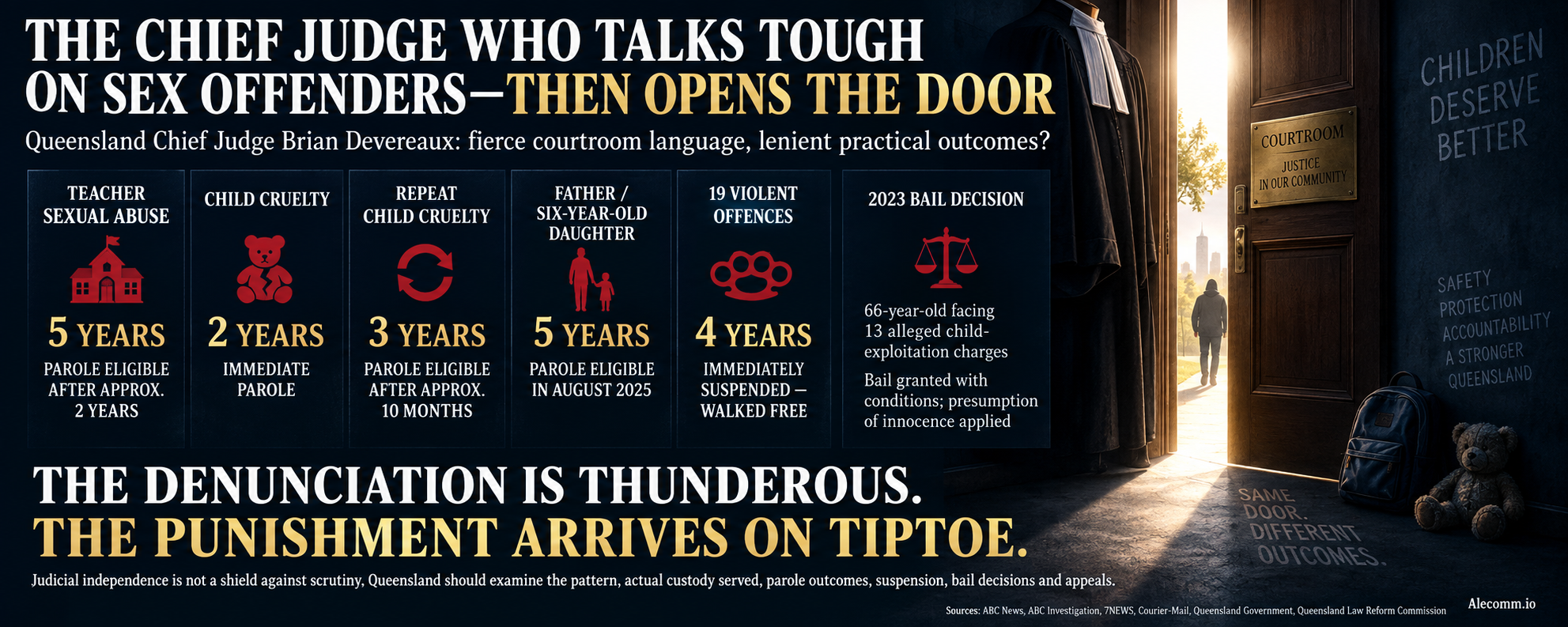
Queensland Chief Judge Brian Devereaux has developed a remarkable courtroom routine: describe the abuse as appalling, acknowledge the devastation inflicted upon children, announce a sentence that sounds serious—and then arrange for the offender to walk free or become eligible for release remarkably early.
The words are fierce.
The consequences are not.
Again and again, Chief Judge Brian Devereaux condemns child abuse in language that would make the public believe the hammer is finally about to fall.
Then comes the actual order:
- Immediate parole
- An immediately suspended sentence
- Parole after a fraction of the headline sentence
- Another release under supervision
- Another warning to behave
The denunciation is thunderous.
The punishment arrives on tiptoe.
The Teacher Who Sexually Abused A 12-Year-Old
Former teacher Kellie Ann-Marie Whiteside groomed and sexually abused a student from the age of 12.
The court heard that Whiteside:
- Groomed the child for months
- Encouraged her to watch pornography
- Supplied her with alcohol
- Committed sexual acts at school
- Used public toilets, a sporting facility and the family home
- Continued the abusive relationship for years
- Exploited her authority as a teacher
Whiteside pleaded guilty to maintaining a sexual relationship with a child—an offence carrying a maximum penalty of 20 years’ imprisonment.
Devereaux imposed five years.
That sounds substantial until the important detail arrives:
Whiteside became eligible for parole after approximately two years.
Devereaux accepted her admissions, guilty plea, remorse and rehabilitative efforts.
An ABC investigation reported that those rehabilitative efforts included approximately five hours of psychology treatment.
Five hours.
That was apparently enough to help demonstrate rehabilitation after years of grooming and sexually exploiting a child.
When Devereaux said he accepted that Whiteside “really regretted” what she had done, the victim’s supporters reportedly shook their heads in disbelief.
They understood what the courtroom language attempted to soften:
The offender’s remorse was being weighed in hours. The victim’s damage would be measured in decades.
“A Trail Of Misery”—Followed By Immediate Parole
Then there was Claudean Uamaki-Mu, the former My Kitchen Rules contestant who pleaded guilty to two counts of cruelty to children.
The court heard that she subjected two girls to years of physical and psychological abuse.
The conduct included:
- Pushing and striking the children
- Hitting one girl with a cane
- Swearing at and terrorising them
- Leaving one victim with complex PTSD
- Leaving another with an eating disorder, alcohol dependency and suicidal thoughts
One victim told the court that she lived with flashbacks and remained constantly alert to danger.
Another said:
“Some mornings I wake up in tears because I’m still alive.”
Devereaux did not minimise the damage.
He called the treatment:
- “Appalling”
- “Criminal”
- A “trail of misery”
- Conduct that left the children in a “state of terror”
Then he sentenced Uamaki-Mu to two years’ imprisonment and granted her immediate parole.
She walked free from court.
Read that sequence again:
- Years of abuse
- Two child victims
- Complex PTSD
- Suicidal thoughts
- A “trail of misery”
- A “state of terror”
- Immediate release
Uamaki-Mu had also faced numerous more serious charges, including 12 counts of rape and two counts of sexual assault, but those charges were discharged and were not convictions before Devereaux. That prosecutorial collapse deserves its own investigation.
But Devereaux was responsible for the sentence imposed on the offences to which she pleaded guilty.
His language said terror. His order said go home.
The Repeat Child Abuser Who Could Seek Parole After Ten Months
Rebecca Beverley Naawi starved a five-year-old girl, beat her with a wooden spoon and shaved her head.
The child was left with:
- Bruising to her legs and face
- A scar on her head
- The psychological consequences of deliberate starvation
- The knowledge that an adult responsible for her care had said she wanted her to starve
Naawi had previously been convicted of child cruelty involving the severe neglect of another child.
This was not an isolated collapse.
This was not conduct completely out of character.
This was repetition.
Devereaux expressly told her:
“You have done it again. It is not out of character for you.”
He sentenced her to three years’ imprisonment.
She became eligible for parole after approximately ten months.
The judge recognised that she had abused another child before.
He recognised that the latest cruelty was deliberate.
He recognised that she had done it again.
Then he made it possible for her to seek release before completing a single year.
What, precisely, is the purpose of recognising repeat child abuse if the sentence treats repetition as little more than an aggravating footnote?
The Father Who Abused His Six-Year-Old Daughter
Another man appeared before Devereaux after abusing his own six-year-old daughter.
The court heard that the father:
- Exposed the child to pornography
- Told her to select a pornographic video
- Committed a sexual act with a sex toy in front of her
- Threatened her into silence
- Produced child-abuse material
- Distributed sexualised images of children
- Shared 27 images
- Discussed obtaining further material
This was not passive possession.
It involved direct exploitation of his own six-year-old daughter and the deliberate circulation of material involving children.
Devereaux described the offending against the girl as a severe breach of trust. He reportedly characterised the distribution component as being at the lower end of the scale.
The man received five years’ imprisonment, with 447 days of presentence custody credited, and became eligible for parole in August 2025.
A father turned his six-year-old daughter into material for sexual exploitation, yet part of the offending could still be judicially described as “lower end.”
Lower than what?
How depraved must the exploitation of a child become before the language stops searching for a softer shelf on which to place it?
Nineteen Violent Offences—Then Release
In February 2026, Devereaux sentenced a 45-year-old man over a four-month campaign of violence and cruelty against two teenage relatives.
The reported conduct included:
- Beatings with objects
- Forced humiliation
- Threats of drowning
- Forcing a boy to stand in a river
- Assaulting a girl over trivial accusations
- Nineteen violent offences
The children described lasting damage to their mental health, self-worth and daily lives.
Devereaux reportedly called the offending “pure cruelty.”
The man received four years’ imprisonment. More than 600 days were recognised as time already served, and the remaining sentence was immediately suspended for four years.
He walked free.
Once again:
- Savage judicial description
- Horrific victim impact
- A respectable-sounding headline sentence
- Release from the courtroom
At some point, the public is entitled to stop listening to the adjective and start examining the order.
Bail For A Man Facing Thirteen Child-Exploitation Charges
In 2023, Devereaux granted bail to a 66-year-old man facing 13 charges connected with alleged child sexual exploitation.
The accusations included:
- Grooming
- Indecent treatment of a child
- Making child-exploitation material
- Distributing child-exploitation material
- Possessing child-exploitation material
- Alleged involvement in a network procuring children for sexual exploitation
The accused had already spent two years in presentence custody. The prosecution did not oppose bail, and stringent conditions were proposed.
Devereaux accepted that the conditions sufficiently reduced the risk.
That decision did not involve a convicted offender, and the presumption of innocence remained applicable.
But it reveals something important about Devereaux’s confidence in supervision, restrictions and carefully written conditions.
The same confidence appeared again in Cairns.
Then Came “Behave Yourself”
A Cairns teenager reportedly accumulated:
- 108 convictions
- 25 bail breaches during the year
- Another serious accusation
- A demonstrated history of ignoring court orders
Devereaux’s reported response was:
“I expect you to be really well supervised and to behave yourself.”
There it was again.
Supervision.
Conditions.
Expectations.
Another carefully worded hope that this release would somehow succeed where the previous ones had failed.
The teenager’s record was not a warning about what might happen.
The record was proof of what had already happened—repeatedly.
Yet even after 108 convictions and 25 reported bail breaches, Devereaux returned to the same exhausted formula:
- Release
- Supervise
- Warn
- Hope
- Repeat
That is not a functioning safeguard.
It is a revolving door with a judge stationed beside it, delivering stern farewell speeches.
This Is Bigger Than One Appalling Decision
One questionable outcome can be defended as an exceptional case.
A collection begins to reveal an approach.
Across these cases, the same sequence repeatedly appears:
- The offending is described in ferocious language.
- The lifelong damage suffered by victims is acknowledged.
- The breach of trust is condemned.
- The judge announces a substantial-sounding prison term.
- Parole eligibility, suspension or immediate release guts the practical effect.
The public hears five years.
The offender hears parole after two.
The public hears three years.
The offender hears eligible after ten months.
The public hears two years’ imprisonment.
The offender walks straight out of court.
This is punishment by press release and leniency by fine print.
The Chief Judge Has No Excuse Of Inexperience
Brian Devereaux is not a new judicial officer finding his feet.
He has:
- Served as Queensland’s Public Defender
- Sat on the District Court since 2009
- Served as Chief Judge since 2020
- Participated in Queensland Law Reform Commission work
- Contributed to the review of sexual-consent laws and the excuse of mistake of fact
- Held influence over Queensland’s administration of serious criminal justice
He understands exactly what parole eligibility means.
He understands exactly what an immediately suspended sentence means.
He understands exactly what repeated bail breaches demonstrate.
He understands the difference between the headline sentence and the punishment actually served.
These are not accidental outcomes. They are judicial choices.
Queensland Must Examine The Pattern
The question is no longer whether Devereaux can deliver a harsh lecture.
He clearly can.
The question is whether his orders protect children, respect victims and impose consequences proportionate to the conduct he so forcefully condemns.
Queensland should examine:
- Every child-sex sentence imposed by Devereaux
- Every child-cruelty sentence involving suspension or immediate parole
- The actual custody served—not merely headline sentences
- The weight given to guilty pleas, remorse and minimal rehabilitation
- Repeat offenders released after earlier interventions failed
- Bail decisions involving chronic noncompliance
- Appeals against his sentences
- Differences between prosecution submissions and the orders ultimately imposed
Judicial independence is not a shield against scrutiny.
A robe is not an invisibility cloak.
And grave language is not punishment.
When a judge repeatedly describes terror, misery and cruelty—then opens the door—the public has every right to ask whose interests the court is actually protecting.
Sources And References
- ABC News: Former Teacher Kellie Whiteside Jailed For Sexually Abusing Student
- ABC Investigation: A Secret Lived In Plain Sight
- 7NEWS: Claudean Uamaki-Mu Walks Free After Pleading Guilty To Child Cruelty
- ABC News: Rebecca Naawi Sentenced For Child Cruelty
- ABC News: Man Facing Child-Exploitation Charges Granted Bail
- Courier-Mail: Father Sentenced Over Abuse Of Six-Year-Old Daughter
- Courier-Mail: Nineteen-Offence Child-Cruelty Campaign
- Queensland Government: Appointment Of Chief Judge Devereaux
- Queensland Law Reform Commission: Devereaux’s Membership And Sexual-Consent Review
Leave a Reply