
 Concerns About Political Pressure, Foreign Influence And The Trump Administration
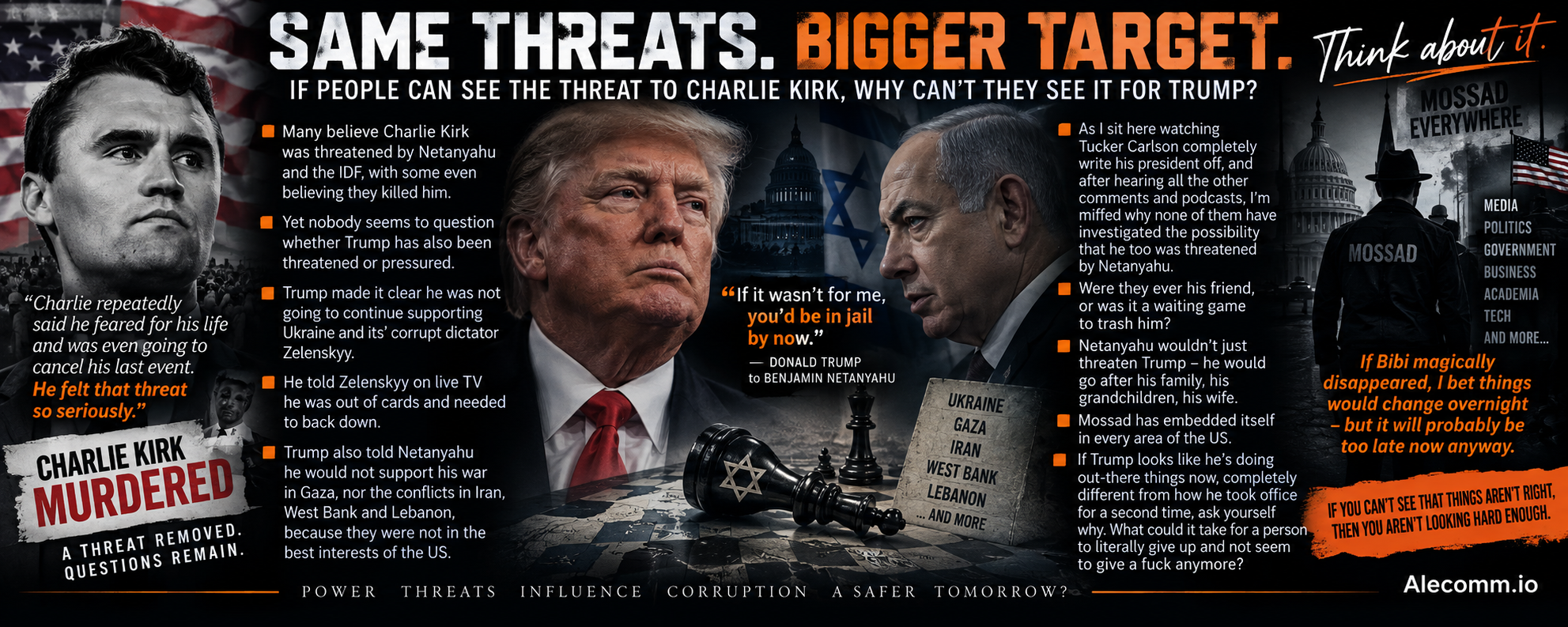
I have become increasingly concerned by what appears to be a substantial and, in some respects, unexplained shift in President Donald Trump’s foreign-policy posture, particularly in relation to Israel and Ukraine.
My concern is not based on a single speech, meeting or policy decision.
It arises from the cumulative pattern.
Trump’s Original Foreign-Policy Position
Trump entered his second presidency having repeatedly argued that the United States should not continue financing wars that did not directly serve the interests of the American people.
His public exchanges with President Volodymyr Zelenskyy made that position particularly clear.
Trump openly challenged Zelenskyy, told him that Ukraine no longer held the strategic leverage it appeared to believe it possessed, and repeatedly emphasised that the United States should not remain indefinitely committed to funding the conflict.
His position toward Israel also appeared, at various points, to be considerably more restrained than the position now being advanced by his administration.
Trump had publicly indicated that he did not intend to provide unlimited support for wars that were not demonstrably beneficial to the United States.
Against that background, the subsequent change in rhetoric and policy deserves closer examination.
The Scripted Netanyahu Appearance
One recent appearance particularly struck me as unusual.
During a meeting involving Benjamin Netanyahu, Trump delivered highly supportive remarks concerning Netanyahu, Israel and the permanence of United States support while reading carefully prepared material.
That may appear insignificant in isolation.
However, Trump is an exceptionally experienced public speaker who has built much of his political career around speaking spontaneously, answering questions without scripts and departing from prepared remarks.
For that reason, highly controlled language on such a politically sensitive subject naturally raises questions about:
Who drafted the message?
Why was the wording considered necessary?
Did the language accurately reflect Trump’s own position?
None of this proves coercion.
It does, however, make the possibility of political pressure worthy of serious examination.
Charlie Kirk And His Expressed Fears
My concerns have also been influenced by the circumstances surrounding Charlie Kirk.
Kirk had become increasingly critical of Israeli policy and had spoken about fearing for his own safety.
In my view, when a prominent political figure publicly or privately expresses genuine fear connected with his political position and is subsequently murdered, those statements should not simply be dismissed because mainstream media organisations have not independently certified every element of his concerns.
His own statements are evidence of what he believed and feared at the time.
That does not, by itself, establish who was responsible for his death.
It does mean that the source of those fears, any threats he believed he had received, and any individuals or organisations associated with those concerns deserve serious investigation.
The Nature Of Covert Pressure
The broader issue is the nature of covert political and intelligence pressure.
If a sophisticated intelligence service wished to influence, intimidate or coerce a political leader, it would be unreasonable to assume that such pressure would necessarily occur through easily discoverable written threats or communications.
The purpose of covert activity is precisely to avoid attribution.
For that reason, the absence of publicly available evidence of a threat does not establish that no pressure occurred.
It simply means that the public may not have access to whatever intelligence, communications, intermediaries or security information might exist.
Nor do I assume that a person who believed themselves or their family to be under threat would automatically report the matter publicly.
If a threat extended to a spouse, children or grandchildren, disclosure could itself be perceived as increasing the danger.
The argument that a political leader would necessarily announce such a threat publicly therefore seems overly simplistic to me.
Why Trump’s Family Matters
This is particularly relevant when considering Trump.
The President of the United States is one of the most protected individuals in the world.
His family, however, necessarily occupies a much wider and more difficult security environment.
If a foreign intelligence service possessed the capacity to monitor, approach or intimidate members of a president’s extended family, that would create an entirely different psychological and strategic pressure than a direct threat to the president himself.
That possibility should not be treated as established fact.
It should, however, be considered as one possible explanation when analysing dramatic and otherwise difficult-to-explain changes in behaviour or policy.
Political Influence And AIPAC
My concern is heightened by the enormous political influence surrounding United States policy toward Israel.
AIPAC and other pro-Israel political organisations openly work to support candidates who strongly back the United States–Israel relationship and to oppose candidates they regard as hostile to it.
The influence of this network is not speculative. It is openly acknowledged.
Senator Ted Cruz, for example, has publicly described his role in Congress in terms of being one of Israel’s strongest defenders.
Hearing an American senator speak so explicitly about defending the interests of another country inevitably raises questions about where the boundary lies between supporting an ally and allowing foreign-policy priorities to become politically insulated from proper scrutiny.
Defence, Intelligence And Political Interconnection
There is also a substantial defence relationship between the United States and Israel.
Israeli defence companies operate extensively within the United States, participate in major military contracts and are embedded in highly sensitive defence supply chains.
Again, none of that is inherently improper.
However, when defence industries, political lobbying, intelligence cooperation, campaign financing and foreign policy become deeply interconnected, democratic oversight becomes especially important.
The Questions That Should Be Asked
That is why I believe the appropriate question is not simply whether somebody can produce a document proving that Donald Trump was threatened.
The more important questions are broader.
Why has his foreign-policy position changed so significantly?
Who has had access to him during that period?
Who has influenced the language he now uses?
Which advisers, donors, governments and organisations have benefited from those changes?
What discussions occurred privately before major policy reversals?
What intelligence assessments exist regarding threats against the President or his family?
And are members of Congress genuinely willing to investigate foreign influence when powerful political organisations can financially support their allies and target their opponents?
These questions should not be dismissed as conspiracy theories simply because the answers may be uncomfortable.
Equal Scrutiny For Every Foreign Government
Investigating foreign influence, political pressure and intelligence activity is a normal and necessary function of democratic government.
The United States routinely investigates Russian, Chinese, Iranian and other foreign influence operations.
Israel should not be exempt from equivalent scrutiny merely because it is considered an ally.
The same evidentiary standards should apply to every foreign government.
This Is About Accountability
My concern is ultimately not about hostility toward Israel or toward Jewish people.
It is about accountability.
No foreign government should possess sufficient political, financial, military or intelligence influence to constrain the independent decision-making of an elected American president.
If Donald Trump has freely chosen his current policies, then that should withstand scrutiny.
If substantial political pressure has influenced those decisions, that should also be exposed.
And if threats or coercion have occurred against the President, his family, Charlie Kirk or any other political figure, then those circumstances should be investigated without fear or favour.
At present, I do not claim to know exactly what has occurred behind closed doors.
What I do believe is that the visible contradictions are significant enough that asking these questions is entirely reasonable.
Something Has Changed
Something has changed.
The public deserves to know why.
#WarCriminal #Netanyahu #IsraeliPM #Trump #Threats #Coercion
Leave a Reply