
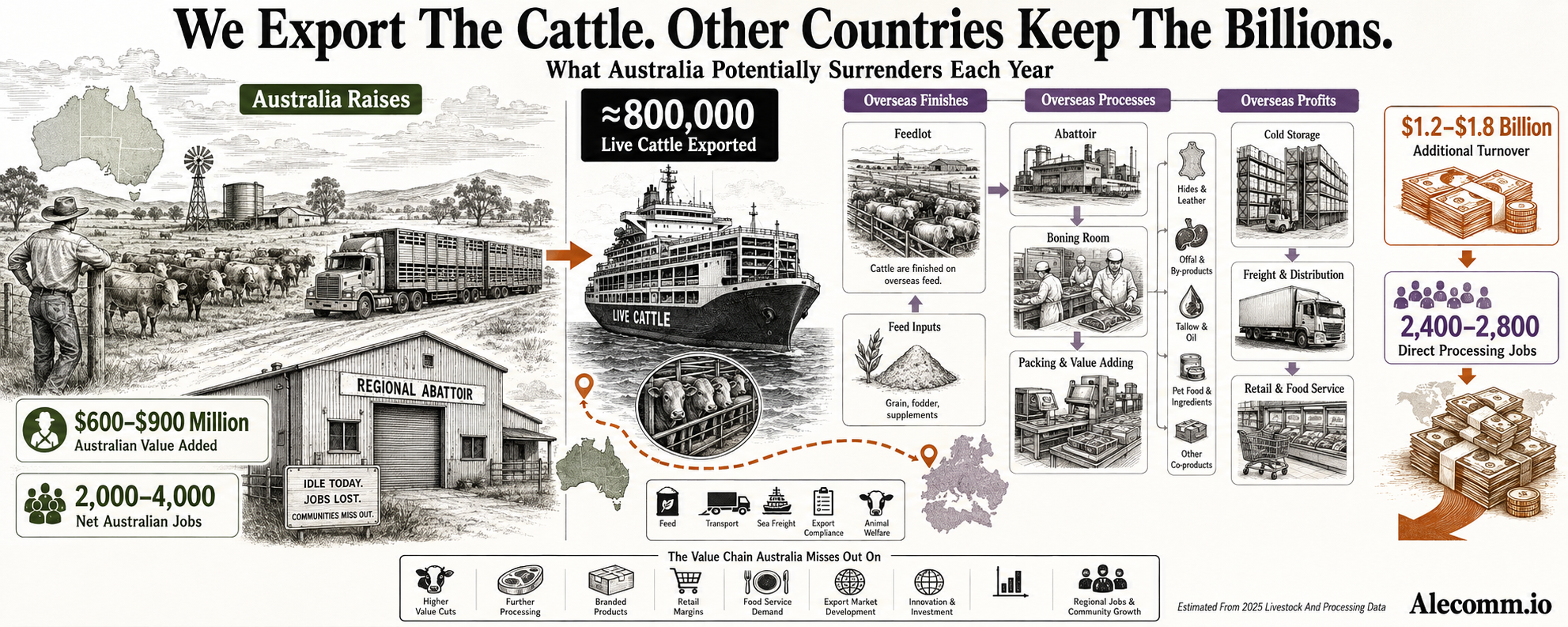
Australia exported approximately 800,000 live cattle in 2025. The Government proudly counted the $1.03 billion received at the port—but ignored the finishing, processing, manufacturing and regional employment that left with them.
Australia does the hard part.
Australian farmers breed the cattle, manage the land, carry the drought risk, pay the finance costs, maintain the genetics and meet some of the strictest production requirements in the world.
Then, just as the serious value-adding begins, we put the cattle on a ship.
The Government calls it an export success.
It is also an industrial giveaway.
Once those cattle leave Australia, foreign businesses capture the feedlot margin, slaughtering, boning, packaging, refrigeration, rendering, hides, offal, transport, wholesaling and retail sales.
Australia receives the price of the live animal.
The importing country receives the animal—and everything it can become.
The Number Government Celebrates
LiveCorp reported that Australia exported 804,111 cattle worth approximately $1.03 billion in 2025.
Department of Agriculture figures record a slightly lower total of 792,077 cattle because the two organisations collect and classify export data differently.
Either way, the conclusion is the same:
Australia exported approximately 800,000 live cattle in one year.
Using LiveCorp’s figures, the average value received was:
$1.03 Billion ÷ 804,111 Cattle = Approximately $1,281 Per Animal
That is the amount recorded when the animal left Australia.
It does not include the value created when the animal is:
- Finished to slaughter weight
- Processed through an abattoir
- Boned and divided into individual cuts
- Chilled or frozen
- Packaged and branded
- Converted into offal products
- Processed into hides and leather
- Rendered into fats, meals and industrial products
- Used in pet food or pharmaceutical manufacturing
- Transported, stored, marketed and sold
The $1.03 billion export figure records only the raw material leaving the country.
It does not measure what Australia surrendered afterwards.
The Missing $740 Million
Most Australian cattle sent to Indonesia are feeder cattle.
They are shipped while relatively young and light, placed into Indonesian feedlots for approximately 100 days, brought to slaughter weight and then processed locally.
Vietnam generally purchases cattle closer to slaughter weight, finishes them for a shorter period and then processes them in Vietnamese facilities.
In both countries, the cattle become more valuable after leaving Australia.
Australian figures show just how large that increase can be.
During 2025, Australian cattle producers received approximately $20.43 billion from 9.28 million cattle sold to domestic processors.
That averages:
$20.43 Billion ÷ 9.28 Million Cattle = Approximately $2,201 Per Finished Animal
The average live-export value was approximately $1,281.
The indicative difference was therefore:
$2,201 − $1,281 = Approximately $920 Per Animal
Across 804,000 cattle:
804,000 × $920 = Approximately $740 Million
That is around $740 million in additional finishing-stage turnover potentially occurring outside Australia.
This is not pure profit. Finishing cattle requires feed, land, water, labour, transport, finance and time.
But that is precisely the point.
Those costs support:
- Feed growers and manufacturers
- Transport operators
- Stock workers
- Contractors
- Veterinarians
- Equipment suppliers
- Rural merchants
- Regional businesses
- Australian wages
When the cattle are finished overseas, the associated spending, employment and economic activity also occur overseas.
The Real Money Begins At The Abattoir
The value does not stop increasing when an animal reaches slaughter weight.
That is where the larger manufacturing chain begins.
Processing creates employment and commercial activity through:
- Slaughtering
- Boning and trimming
- Quality grading
- Chilling and freezing
- Vacuum packaging
- Cold storage
- Export certification
- Freight and distribution
- Offal recovery
- Hide processing
- Rendering
- Pet-food production
- Pharmaceutical ingredients
- Wholesale distribution
- Hospitality and retail sales
The animal is transformed into dozens of separate products, each with its own market and value.
Australia exports one live animal.
The importing country sells everything from the premium steaks to the tongue, liver, hide, fat, blood, bone and rendered material.
The animal leaves once.
The economic value is collected repeatedly.
What Domestic Processing Is Worth
Research commissioned by the Australian Meat Processor Corporation found that Australia’s red-meat processing industry generated approximately:
- $25.45 billion in direct sales
- 39,500 direct full-time-equivalent jobs
- 189,000 jobs across the wider supply chain
- $29.6 billion in total Australian value added
Those figures cover beef, lamb, mutton and goat processing, so they cannot all be attributed to cattle.
However, beef represents the largest share of Australia’s red-meat production and processing activity.
Using beef’s estimated share of processing activity, combined with the number of cattle already processed domestically, provides a credible benchmark for estimating what another 800,000 cattle could support.
The result is substantial:
Between 2,400 And 2,800 Direct Australian Meat-Processing Jobs
Those are direct jobs inside abattoirs and processing establishments.
They do not include the additional workers required in:
- Feedlotting
- Livestock transport
- Refrigeration
- Packaging
- Inspection
- Plant maintenance
- Rendering
- Warehousing
- Export logistics
- Administration
- Wholesale distribution
Allowing for those industries produces a cautious gross estimate of:
Between 3,500 And 5,500 Australian Full-Time-Equivalent Jobs
What About Existing Live-Export Jobs?
Live exports already support Australian employment. That must be recognised.
A 2022 industry-commissioned economic study estimated that the live-cattle export trade directly employed 1,527 people and supported between 4,573 and 6,573 jobs when indirect and induced employment was included.
But those figures include producers, landholders, transport operators and workers in industries that would not automatically disappear if cattle were redirected to Australian processing.
- The farmers would still produce the cattle.
- Stock workers would still handle them.
- Transport operators would still move them.
- Veterinarians, agents, contractors and rural suppliers would still be required.
Some port, export-yard, inspection and shipping-related work would be reduced or redirected. But it would be dishonest to pretend that every job currently connected to live exports would vanish.
It would also be dishonest to count every new processing job without accounting for some displaced export activity.
After allowing for that displacement, the most reasonable estimate is:
Between 2,000 And 4,000 Net Additional Australian Jobs
These would largely be permanent jobs in regional communities—not temporary announcements, short-term grants or another government “strategy” that produces a glossy report and bugger-all else.
The Missing Economic Value
The finishing-stage difference alone could represent approximately $740 million in additional activity.
Processing, manufacturing, packaging, by-products, refrigeration, logistics and wholesale distribution add further value.
Combining these stages produces an estimated:
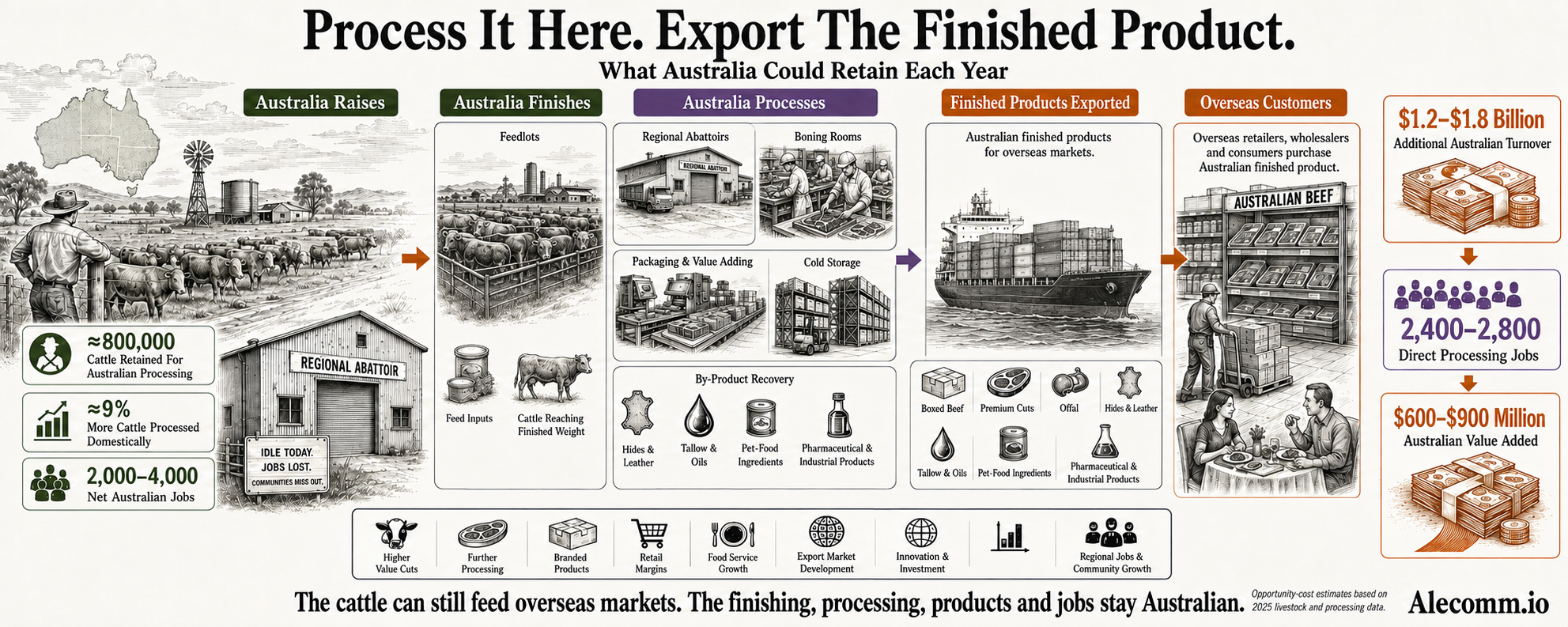
$1.2 Billion To $1.8 Billion In Additional Annual Australian Turnover
Under this estimate, the approximately $1.03 billion received from exporting the cattle live could potentially become part of a domestically finished and processed product chain worth approximately:
$2.2 Billion To $2.8 Billion
The additional activity would come from:
- Australian cattle finishing
- Australian processing
- Australian packaging
- Australian refrigeration
- Australian transport
- Australian manufacturing
- Australian offal recovery
- Australian rendering
- Australian hides
- Australian export logistics
- Australian wages
That does not mean the entire $1.2 billion to $1.8 billion would become profit.
Turnover includes purchases and transactions between businesses. Counting the entire amount as profit or GDP would be economic nonsense—and would give industry lobbyists an easy excuse to dismiss the entire argument.
The stronger measure is gross value added.
Gross value added measures the wages, business earnings and economic production retained after purchased inputs are removed.
Using national red-meat turnover and value-added ratios produces an estimated domestic opportunity of:
$600 Million To $900 Million In Additional Australian Value Added Every Year
That is the figure the Government should be publishing.
It does not.
Even A Partial Shift Would Be Enormous
Australia does not need to redirect every live-export animal to achieve a significant economic result.
Processing 25 Per Cent In Australia
Approximately 200,000 cattle could generate:
- $300 million to $450 million in additional turnover
- $150 million to $225 million in Australian value added
- Approximately 600 to 700 direct processing jobs
Processing 50 Per Cent In Australia
Approximately 400,000 cattle could generate:
- $600 million to $900 million in additional turnover
- $300 million to $450 million in Australian value added
- Approximately 1,200 to 1,400 direct processing jobs
Processing 75 Per Cent In Australia
Approximately 600,000 cattle could generate:
- $900 million to $1.35 billion in additional turnover
- $450 million to $675 million in Australian value added
- Approximately 1,800 to 2,100 direct processing jobs
Processing 100 Per Cent In Australia
Approximately 800,000 cattle could generate:
- $1.2 billion to $1.8 billion in additional turnover
- $600 million to $900 million in Australian value added
- Approximately 2,400 to 2,800 direct processing jobs
- Approximately 2,000 to 4,000 net additional Australian jobs
Even redirecting one-quarter of the trade would justify serious regional investment.
Australia Is Missing The Capacity
Processing an additional 804,000 cattle annually would require more than 3,200 cattle to be processed during each of 250 operating days.
That is roughly equivalent to:
- Three or four large abattoirs processing 800 to 1,000 cattle per day
- Eight regional plants processing approximately 400 cattle per day
- A wider network of large processors, independent regional abattoirs and modular facilities
Australia could not redirect every live-export animal into the existing system tomorrow.
Domestic processors already handled a record 9.28 million cattle in 2025. Retaining another 800,000 animals would require an expansion of approximately nine per cent above existing annual slaughter volumes.
That would require:
- New and reopened regional abattoirs
- Reliable and affordable energy
- Secure water supplies
- Skilled processing workers
- Worker accommodation
- Cold-storage infrastructure
- Competitive freight
- Export accreditation
- Long-term overseas markets for boxed beef
- Markets for offal, hides and rendered products
- That is not an argument against domestic processing.
- It Is An Admission That Australia Has Failed To Build The Infrastructure.
- Governments have allowed regional processing capacity to disappear and then pointed to live exports as though there were no alternative.
- Farmers are told they must rely on foreign feedlots and processors because Australia does not possess sufficient competitive capacity of its own.
That is not a solution.
It is the consequence of policy failure.
Farmers Must Not Be Sacrificed
Live exports cannot simply be stopped before domestic alternatives exist.
Northern producers depend upon live-export competition. Removing that market without replacement buyers and infrastructure could reduce cattle prices and hammer the farmers already carrying the cost of government neglect.
The answer is not an overnight ban.
The answer is to build a genuine alternative.
Australia should establish additional domestic capacity while preserving producer competition during the transition.
That means:
- Building regional processing facilities
- Reopening viable closed abattoirs
- Supporting producer-owned and cooperative plants
- Establishing mobile and modular processing
- Reducing energy and freight costs
- Training and housing regional workforces
- Developing premium markets for Australian grass-fed beef
- Expanding offal, hide and by-product manufacturing
- Retaining live-export access until domestic capacity is commercially operational
- Farmers should gain more buyers—not lose them.
- Government Publishes Only Half The Ledger
- Every government report on live exports should publish two figures.
- The first is the value received when the cattle leave Australia.
- The second is the estimated Australian value that could have been created by finishing and processing those cattle domestically.
The report should disclose:
- The live-export value
- The estimated finished livestock value
- The potential processed-beef value
- The estimated value of offal and co-products
- The direct processing jobs represented by the volume
- The wider regional employment opportunity
- The domestic value added potentially surrendered
- The infrastructure required to retain that activity
Instead, the Government publishes one side of the ledger.
It announces that live cattle exports earned approximately $1.03 billion.
It says nothing about the possible:
- $1.2 billion to $1.8 billion in additional turnover
- $600 million to $900 million in Australian value added
- 2,400 to 2,800 direct processing jobs
- 2,000 to 4,000 net additional Australian jobs
The Government counts the cattle leaving.
It does not count the jobs leaving with them.
The Value Australia Never Sees
These figures are not a precise accounting loss.
They represent the estimated annual opportunity cost of allowing other countries to finish, process and commercialise Australian livestock.
That distinction makes the argument stronger.
Australia receives substantial income from live exports. Northern producers currently depend upon the competition they provide. Any transition must protect farmers, preserve cattle prices and establish replacement processing capacity first.
But protecting farmers does not require pretending that exporting raw productive assets is the highest-value economic strategy available.
- The live-export cheque is visible.
- The abattoirs that were never built are not.
- The processing shifts that were never worked are not.
- The products that were never manufactured are not.
- The regional wages that were never paid are not.
But the lost opportunity is still real.
- Australia raises the cattle.
- Other countries finish them.
- Other countries process them.
- Other countries manufacture the products.
- Other countries keep the jobs.
And our Government celebrates when the ship leaves the harbour.
Sources And References
LiveCorp — Australian Livestock Export Industry Statistics
Australian Department Of Agriculture — Livestock Exports By Market
Meat & Livestock Australia — 2025 Cattle Slaughter, Beef Production And Producer Receipts
Australian Meat Processor Corporation — Economic Contribution Of Red-Meat Processing
Meat & Livestock Australia — Red-Meat Industry Turnover, Value Added And Employment
Australian Bureau Of Agricultural And Resource Economics And Sciences — Beef And Cattle Outlook
Leave a Reply