
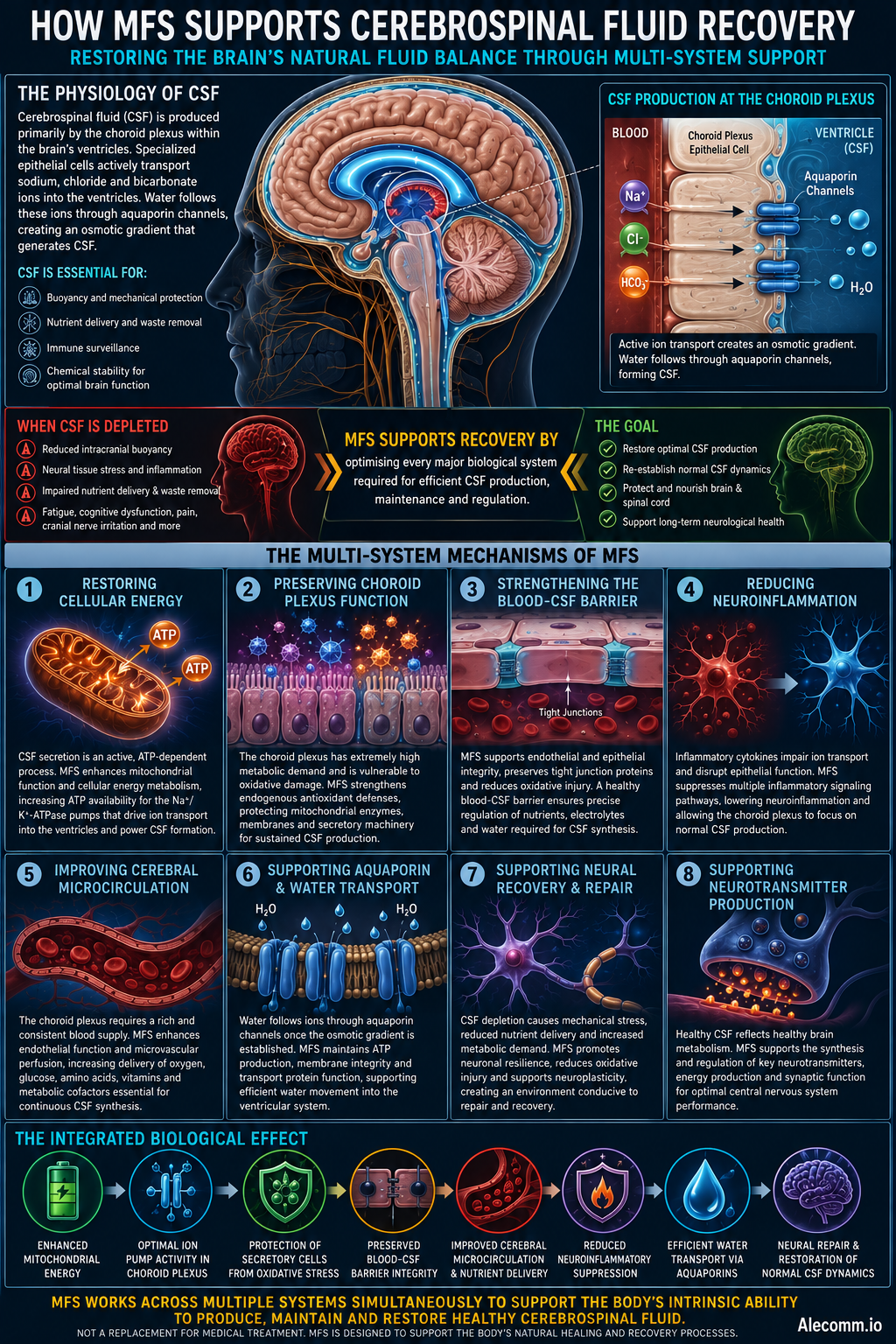
Cerebrospinal fluid is produced primarily by specialised epithelial cells within the choroid plexus of the brain. These cells continuously transport sodium, chloride and bicarbonate into the ventricles, creating an osmotic gradient that draws water through aquaporin channels to form CSF. This is one of the most energy-demanding secretory processes in the body.
MFS supports this process by optimising every major biological system required for efficient CSF production.
Restoring Cellular Energy
CSF secretion depends on continuous ATP production.
By enhancing mitochondrial efficiency and cellular energy metabolism, MFS provides greater ATP availability for the Na⁺/K⁺-ATPase pumps that actively transport ions into the ventricles. Greater ATP availability allows the choroid plexus to maintain the electrochemical gradients that drive water movement and CSF formation.
Preserving Choroid Plexus Function
The choroid plexus has one of the highest metabolic rates in the brain and is highly susceptible to oxidative damage.
MFS strengthens endogenous antioxidant systems, reducing oxidative stress within these cells while protecting mitochondrial enzymes, membrane transport proteins and secretory machinery. Preserving the health and function of these specialised epithelial cells enables sustained physiological CSF production.
Strengthening The Blood-CSF Barrier
The blood-CSF barrier regulates every nutrient, electrolyte and water molecule entering newly formed CSF.
MFS supports endothelial and epithelial integrity by reducing oxidative injury, preserving tight junction proteins and maintaining the specialised barrier responsible for normal fluid exchange. A healthier blood-CSF barrier allows more efficient regulation of the environment required for CSF synthesis.
Reducing Neuroinflammation
Inflammatory cytokines impair ion transport, disrupt epithelial polarity and reduce secretory efficiency.
By suppressing multiple inflammatory signalling pathways simultaneously, MFS reduces neuroinflammation throughout the central nervous system. Lower inflammatory activity allows the choroid plexus to redirect energy toward physiological CSF production rather than inflammatory responses.
Improving Cerebral Microcirculation
Every component required to manufacture CSF arrives through the rich capillary network supplying the choroid plexus.
By improving endothelial function and cerebral microvascular perfusion, MFS enhances delivery of oxygen, glucose, amino acids, vitamins and metabolic cofactors required for continuous CSF synthesis.
Supporting Aquaporin Function
Water enters the ventricular system through aquaporin water channels after ion transport establishes the osmotic gradient.
By maintaining ATP production, preserving membrane integrity and supporting normal cellular transport mechanisms, MFS helps maintain the osmotic forces that drive water into the ventricles during CSF formation.
Supporting Neural Recovery
Loss of CSF places mechanical stress on the brain, meninges and cranial nerves while reducing nutrient delivery and increasing metabolic demand.
MFS promotes neuronal resilience by improving mitochondrial function, reducing oxidative injury, limiting secondary neuroinflammation and supporting neuroplasticity. This creates an environment favourable for neurological recovery as normal CSF dynamics are restored.
Supporting Neurotransmitter Production
Healthy CSF reflects healthy central nervous system metabolism.
By supporting neurotransmitter synthesis, neuronal energy metabolism and synaptic function, MFS helps restore the neurochemical environment required for optimal brain function and normal central nervous system physiology.
Integrated Biological Effect
MFS supports CSF physiology by simultaneously:
- Increasing mitochondrial ATP production.
- Enhancing ion pump activity within the choroid plexus.
- Protecting secretory epithelial cells from oxidative injury.
- Preserving blood-CSF barrier integrity.
- Improving cerebral microvascular perfusion.
- Reducing neuroinflammatory suppression of CSF secretion.
- Supporting aquaporin-mediated water transport.
- Promoting neuronal repair and restoration of normal central nervous system function.
Working through these complementary mechanisms, MFS supports the complete biological infrastructure responsible for producing, maintaining and restoring healthy cerebrospinal fluid dynamics, allowing the brain’s own physiological processes to operate with greater efficiency.
Leave a Reply