
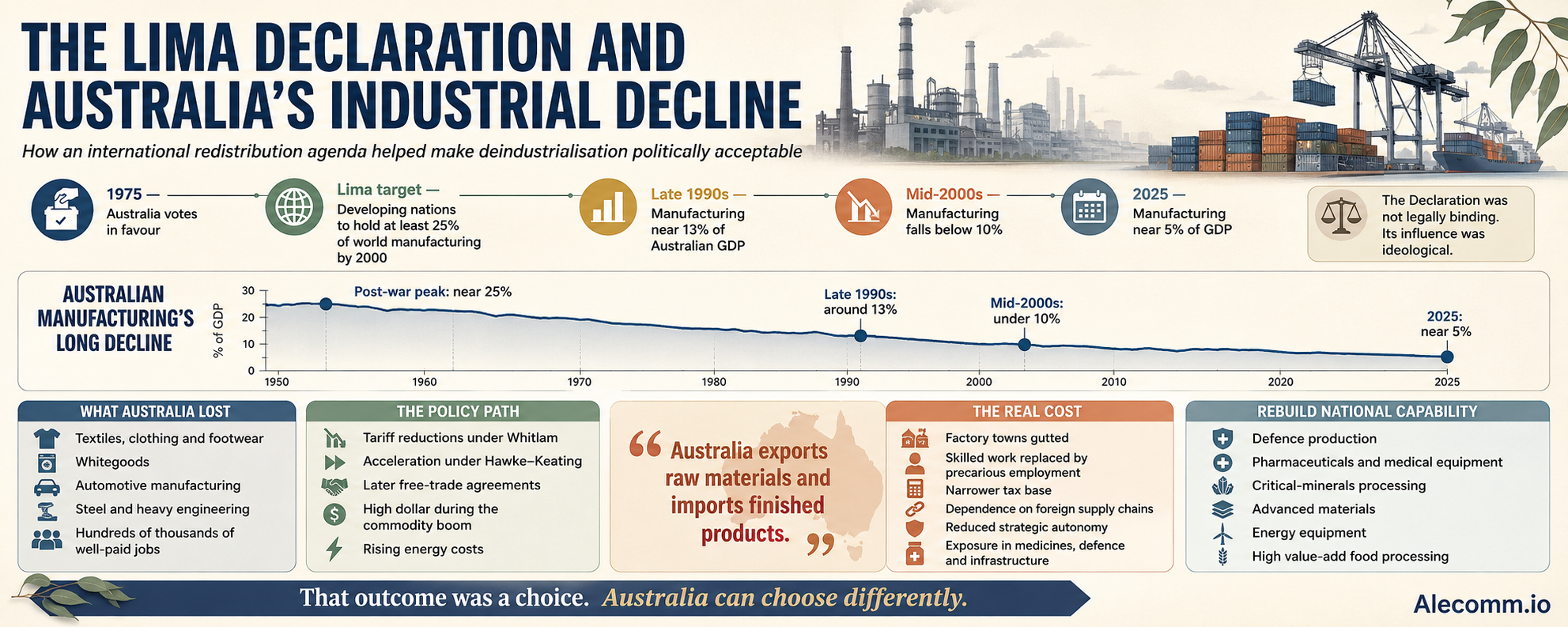
In March 1975, the United Nations Industrial Development Organization (UNIDO) adopted the Lima Declaration and Plan of Action. Its explicit goal was the deliberate redistribution of world manufacturing capacity so that developing countries would lift their share from roughly 7–10 percent to at least 25 percent by the year 2000. Developed nations were urged to open their markets, lower barriers, restructure their own industries, and transfer productive capacity offshore.
Australia, under the Whitlam government, voted in favour. The document was not a treaty and carried no legal force. Australia lodged reservations. Yet the Declaration supplied the international moral cover for a profound shift in Australian policy: the idea that protecting domestic manufacturing was selfish, outdated, and contrary to global equity. From that moment, successive governments treated the hollowing-out of Australian industry as an acceptable, even progressive, outcome.
What Followed
Manufacturing’s share of Australian GDP stood near 25 percent at its post-war peak and remained substantial in the mid-1970s. It then entered a long, steady collapse:
- By the late 1990s → around 13 percent
- By the mid-2000s → under 10 percent
- In 2025 → near 5 percent — one of the lowest figures in the OECD
Hundreds of thousands of well-paid jobs disappeared. Entire sectors — textiles, clothing, footwear, whitegoods, much of automotive, significant parts of steel and heavy engineering — were allowed to wither or leave.
The proximate causes were policy choices made in Canberra: progressive tariff reductions beginning under Whitlam, accelerated under Hawke–Keating, and locked in by later free-trade agreements. A high dollar during the commodity boom and rising energy costs compounded the damage. But the underlying philosophy was already visible in 1975. Preferential access for developing-country manufactures, structural adjustment, and the redeployment of “less competitive” industries were no longer contested ideas. They became the accepted framework. Australian workers and regional communities paid the price.
The Real Cost
Australia did not become a high-wage, high-skill manufacturing nation that specialised in complex goods while poorer countries handled simple assembly. It became a country that exports raw materials and imports finished products.
That model delivers short-term consumer gains and strong primary-export revenues. It also leaves the nation strategically exposed. When global supply chains fracture, Australia discovers it cannot readily produce the medicines, equipment, components, or materials it needs. Sovereignty is diminished when a country cannot make the things essential to its own defence, health, and infrastructure.
The social cost is equally clear:
- Factory closures gutted towns
- Stable, skilled employment was replaced by more precarious service-sector work
- The tax base narrowed
- The nation became more dependent on the goodwill and production of others
This was not inevitable technological change. It was a series of political decisions taken under the influence of an international agenda that ranked global industrial redistribution above Australian industrial strength.
Putting Australia First
The correct response is not nostalgia for 1970s tariff walls. It is a hard-headed commitment to national capability.
Australia should maintain and rebuild manufacturing in strategic sectors:
- Defence-related production
- Pharmaceuticals and medical equipment
- Critical minerals processing
- Advanced materials
- Energy equipment
- High value-add food processing
Energy policy must deliver reliable, competitively priced power rather than pricing industry out of existence. Procurement should favour Australian suppliers where capability exists or can be developed. Trade agreements should be judged by their net effect on Australian productive capacity, not by abstract liberalisation scores.
Foreign development goals and UN declarations do not override the duty of Australian governments to secure the long-term prosperity and resilience of the Australian people.
The Lima Declaration did not legally force factories to close. It helped create the climate in which closing them became acceptable. The results are measurable and damaging: a thinner industrial base, weaker strategic autonomy, and more fragile communities than were necessary.
That outcome was a choice. It can be reversed by choosing differently — by putting Australian industry, Australian workers, and Australian sovereignty first.
Leave a Reply