
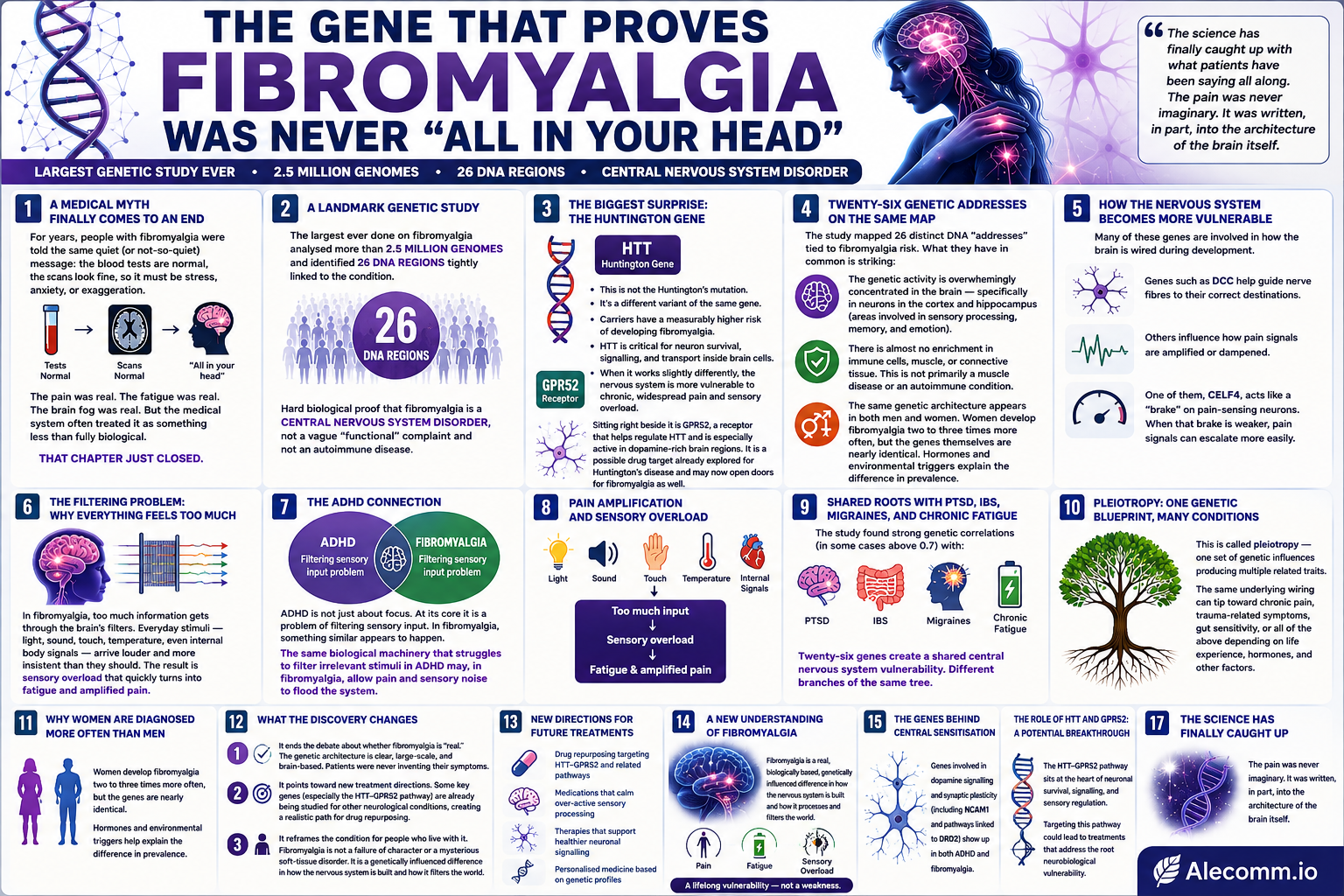
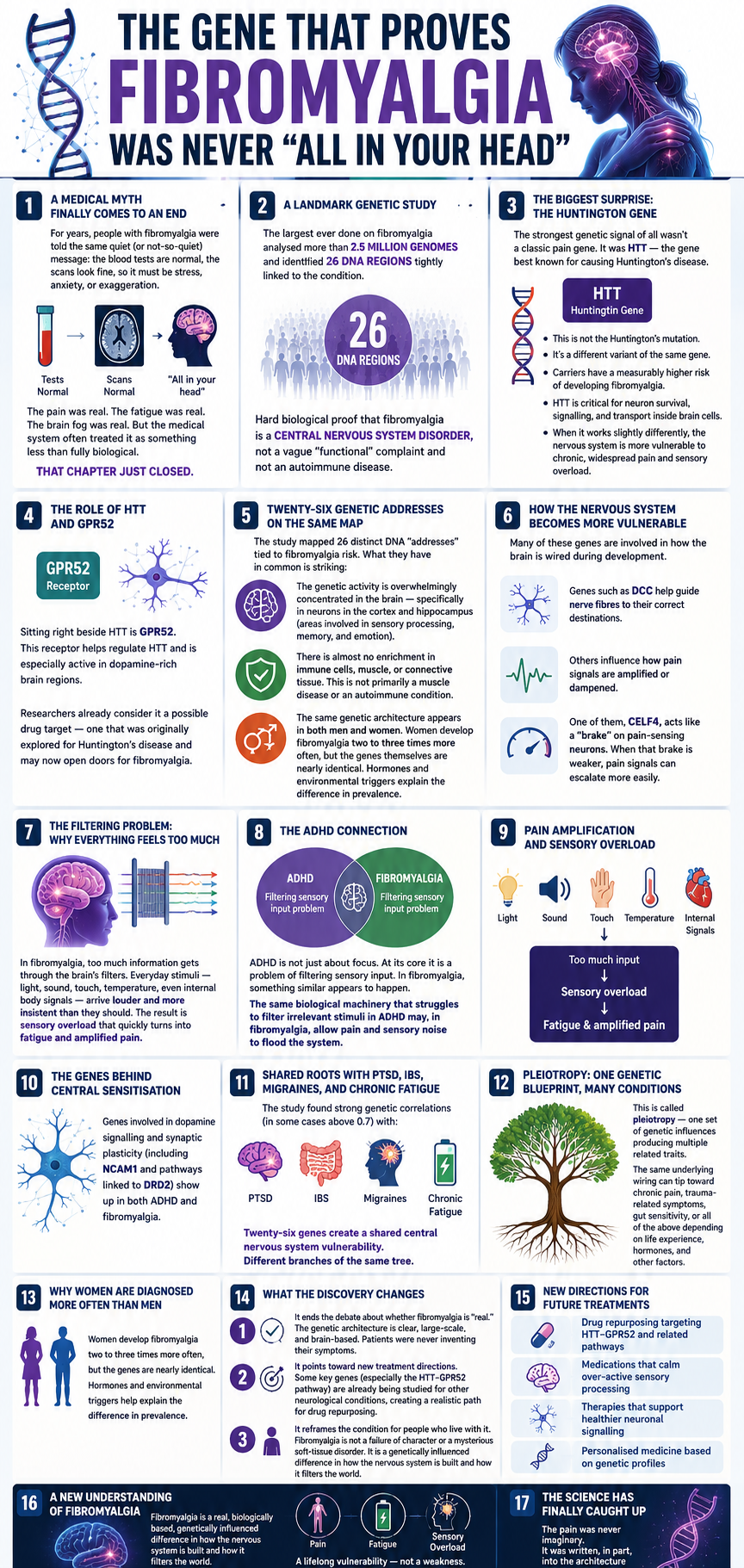
For years, people with fibromyalgia were told the same quiet (or not-so-quiet) message: the blood tests are normal, the scans look fine, so it must be stress, anxiety, or exaggeration. The pain was real to them. The fatigue was real. The brain fog was real. But the medical system often treated it as something less than fully biological.
That chapter just closed.
A landmark genetic study — the largest ever done on fibromyalgia — analysed more than 2.5 million genomes and identified 26 DNA regions tightly linked to the condition. The findings, presented in a recent lecture and published in a major journal, deliver something patients have waited decades for: hard biological proof that fibromyalgia is a central nervous system disorder, not a vague “functional” complaint and not an autoimmune disease.
The Biggest Surprise: The Huntington Gene
The strongest genetic signal of all wasn’t a classic pain gene. It was HTT — the gene best known for causing Huntington’s disease.
This is not the Huntington’s mutation. It’s a different variant of the same gene. Carriers of this version have a measurably higher risk of developing fibromyalgia. HTT is critical for neuron survival, signalling, and the transport of materials inside brain cells. When it works slightly differently, the nervous system appears more vulnerable to the kind of chronic, widespread pain and sensory overload that define fibromyalgia.
Sitting right beside it is another gene, GPR52. This receptor helps regulate HTT and is especially active in dopamine-rich brain regions. Researchers already consider it a possible drug target — one that was originally explored for Huntington’s disease and may now open doors for fibromyalgia as well.
Twenty-Six Addresses On The Same Map
The study didn’t just find one gene. It mapped 26 distinct DNA “addresses” tied to fibromyalgia risk. What they have in common is striking:
- The genetic activity is overwhelmingly concentrated in the brain — specifically in neurons in the cortex and hippocampus (areas involved in sensory processing, memory, and emotion).
- There is almost no enrichment in immune cells, muscle, or connective tissue. This is not primarily a muscle disease or an autoimmune condition.
- The same genetic architecture appears in both men and women. Women develop fibromyalgia two to three times more often, but the genes themselves are nearly identical. Hormones and environmental triggers appear to explain the difference in prevalence.
Many of these genes are involved in how the brain is wired during development. Genes such as DCC help guide nerve fibres to their correct destinations. Others influence how pain signals are amplified or dampened. One of them, CELF4, acts like a “brake” on pain-sensing neurons. When that brake is weaker, pain signals can escalate more easily.
The Filtering Problem: Why It Feels Like Everything Is Too Much
One of the most illuminating connections is with ADHD.
ADHD is not just about focus. At its core it is a problem of filtering sensory input. In fibromyalgia, something similar appears to happen: too much information gets through the brain’s filters. Everyday stimuli — light, sound, touch, temperature, even internal body signals — arrive louder and more insistent than they should. The result is sensory overload that quickly turns into fatigue and amplified pain.
The genetic data supports this. Genes involved in dopamine signalling and synaptic plasticity (including NCAM1 and pathways linked to DRD2) show up in both conditions. The same biological machinery that struggles to filter irrelevant stimuli in ADHD may, in fibromyalgia, allow pain and sensory noise to flood the system.
Shared Roots With PTSD, IBS, And More
The genetics also explain something clinicians have long observed: fibromyalgia rarely travels alone. The study found strong genetic correlations (in some cases above 0.7) with post-traumatic stress disorder, irritable bowel syndrome, migraines, and chronic fatigue. Twenty-six genes create a shared central nervous system vulnerability. Different branches of the same tree.
This is called pleiotropy — one set of genetic influences producing multiple related traits. It means the same underlying wiring can tip toward chronic pain, trauma-related symptoms, gut sensitivity, or all of the above depending on life experience, hormones, and other factors.
What This Changes
First, it ends the debate about whether fibromyalgia is “real.” The genetic architecture is clear, large-scale, and brain-based. Patients were never inventing their symptoms.
Second, it points toward new treatment directions. Because some of the key genes (especially the HTT–GPR52 pathway) are already being studied for other neurological conditions, there is a realistic path for drug repurposing. Approaches that calm over-active sensory processing or support healthier neuronal signalling suddenly have a clearer biological rationale.
Third, it reframes the condition for the people who live with it. Fibromyalgia is not a failure of character or a mysterious soft-tissue disorder. It is a genetically influenced difference in how the nervous system is built and how it filters the world — one that creates a lifelong vulnerability to pain, fatigue, and sensory overload.
The science has finally caught up with what patients have been saying all along. The pain was never imaginary. It was written, in part, into the architecture of the brain itself.
References
Clauw, D. J. (2014). Fibromyalgia: A clinical review. JAMA, 311(15), 1547–1555. https://doi.org/10.1001/jama.2014.3266
Bair, M. J., & Krebs, E. E. (2020). Fibromyalgia. Annals of Internal Medicine, 172(5), ITC33–ITC48. https://doi.org/10.7326/AITC202003030
Häuser, W., Ablin, J., Fitzcharles, M.-A., et al. (2015). Fibromyalgia. Nature Reviews Disease Primers, 1, Article 15022. https://doi.org/10.1038/nrdp.2015.22
Kerrebijn, I., Bjornsdottir, G., et al. (2025). The genetic architecture of fibromyalgia across 2.5 million individuals. medRxiv. https://doi.org/10.1101/2025.09.18.25335914
Kerrebijn, I., Bjornsdottir, G., et al. (2026). The genetic architecture of fibromyalgia across 2.5 million individuals. Nature Medicine. Advance online publication. https://doi.org/10.1038/s41591-026-04492-6
Sarzi-Puttini, P., Giorgi, V., Marotto, D., & Atzeni, F. (2020). Fibromyalgia: An update on clinical characteristics, aetiopathogenesis and treatment. Nature Reviews Rheumatology, 16(11), 645–660. https://doi.org/10.1038/s41584-020-00506-w
Leave a Reply