
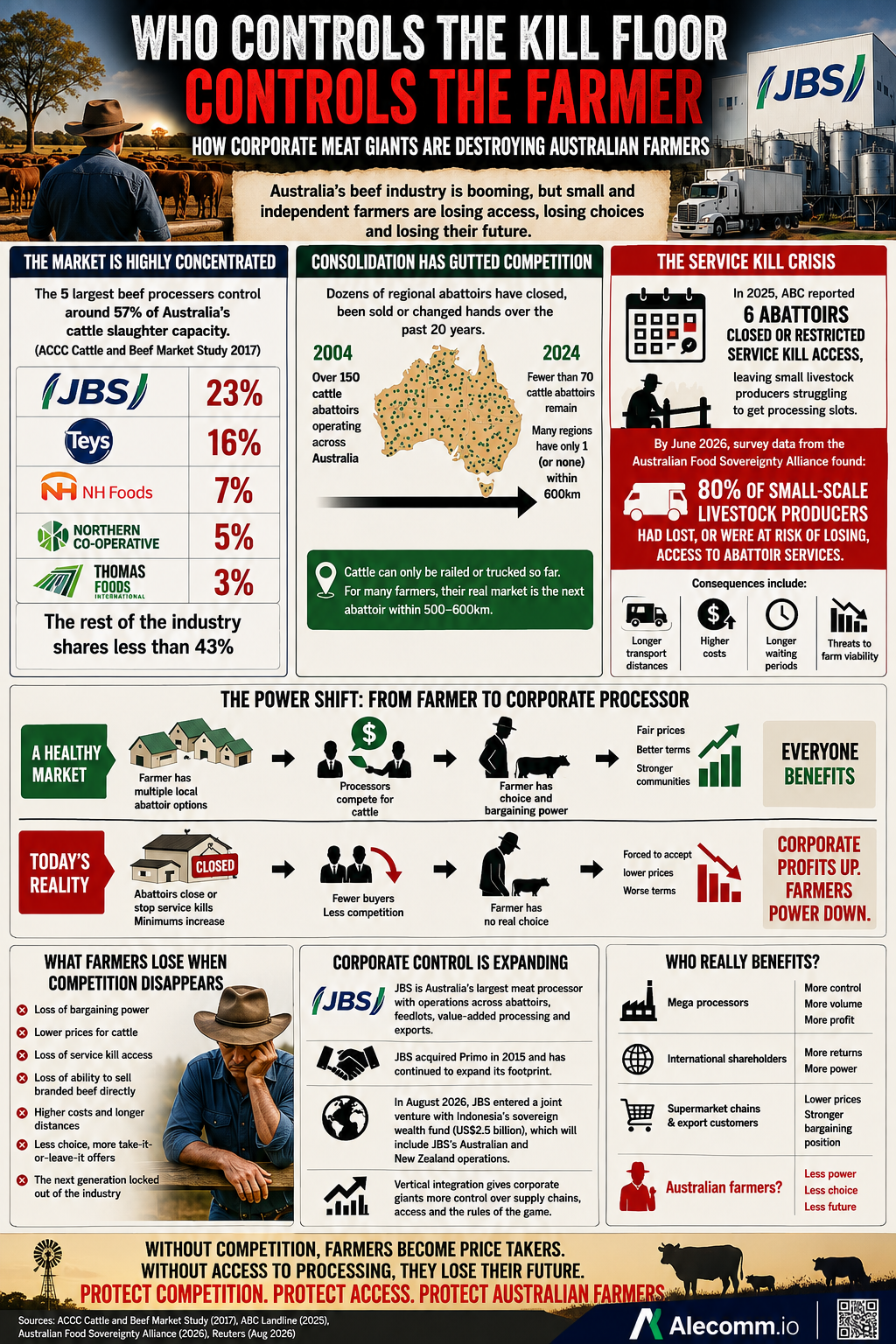
Australia is producing enormous quantities of beef. Cattle slaughter is high, exports are strong, and the world’s largest meat corporations continue to regard Australia as an exceptionally valuable source of protein.
On the surface, that sounds like good news for Australian cattle farmers.
Look underneath it and a much more troubling transformation is occurring.
The problem is not that Australia has stopped processing cattle. The problem is who increasingly controls the processing, who can access it, and what happens to farmers when independent alternatives disappear.
Large processors such as JBS Australia have enormous advantages of scale, capital, export access, logistics, feedlot integration, processing infrastructure and international distribution. There is nothing inherently wrong with a company being large or efficient.
The danger begins when scale becomes concentration, concentration reduces practical competition, and farmers discover that the market technically contains multiple buyers but only one or two are economically realistic buyers for their cattle.
This is not merely a JBS story. It is a warning about the industrial structure Australia is allowing to develop around one of its most important agricultural industries.
JBS Is Already Australia’s Largest Meat Processor
JBS is not simply another abattoir operator.
The ACCC has described JBS as Australia’s largest meat and food processing company. Its Australian operations extend across abattoirs, feedlots, value-added processing, branded products and other parts of the protein supply chain.
The scale of Australia’s processing concentration was already apparent when the ACCC conducted its cattle and beef market study.
At that time, the ACCC estimated:
- JBS — approximately 23% of Australian slaughter capacity
- Teys Australia — approximately 16%
- NH Foods — approximately 7%
- Northern Co-operative — approximately 5%
- Thomas Foods International — approximately 3%
The five largest processors collectively accounted for approximately 57% of Australian slaughter capacity.
Those figures are historical rather than a claim about exact 2026 market shares, but they demonstrate that concentration in cattle processing is not a theoretical future problem.
It has been developing for years.
The Farmer Cannot Negotiate With A Slaughterhouse That Is Too Far Away
National market-share figures also understate the problem.
Cattle processing is inherently regional.
The ACCC itself recognised this when examining JBS’s acquisition of Primo. It considered the distance cattle could economically travel and noted market evidence that cattle commonly travelled up to approximately 600 kilometres from farm to abattoir.
That means a farmer’s real market is not Australia.
It is the processors within economically viable trucking distance of the farm.
Imagine a cattle producer once had four competing processors:
- 80 kilometres away
- 140 kilometres away
- 230 kilometres away
- 350 kilometres away
Now suppose two disappear and another stops accepting smaller consignments.
There may still be dozens of cattle processors nationally.
For that farmer, however, competition has collapsed.
The remaining processor knows it.
The farmer knows it.
And the cattle still have to go somewhere.
Every Independent Processor Lost Changes The Balance Of Power
This is why the disappearance of regional abattoirs matters far beyond the number of cattle they slaughter.
Every independent processor represents another potential destination for livestock.
Another bidder.
Another set of specifications.
Another processing option.
Another negotiation.
Another escape route when a producer dislikes the price or conditions being offered elsewhere.
Remove those alternatives and bargaining power progressively moves down the supply chain from the farmer toward the processor.
That can influence much more than the headline cattle price.
Processors establish grids and commercial requirements involving:
- Carcass weights
- Fat measurements
- Dentition
- Breed requirements
- Delivery periods
- Quality specifications
- Discounts
- Minimum consignments
- Transport arrangements
- Contract conditions
A farmer confronted with an unattractive offer has meaningful negotiating power only when there is somewhere else to take the cattle.
Competition isn’t the number of company logos on an industry chart. Competition is the number of economically realistic alternatives available to the farmer standing at the farm gate.
Australia Was Warned About Further Consolidation
The concerns are not new.
When JBS proposed acquiring Primo in 2014–15, farmers, competing abattoirs and other industry participants raised concerns with the ACCC that the transaction could reduce competition for cattle in northern NSW and Queensland.
The ACCC ultimately allowed the acquisition because it concluded sufficient alternative competition existed at the time.
But its chairman, Rod Sims, made an important observation.
The regulator said it was wary of the potential impact of further consolidation of abattoirs and that future acquisitions would receive additional scrutiny.
That warning deserves revisiting more than a decade later.
Because competition assessments are snapshots.
A market containing seven alternatives today can justify approving an acquisition.
But what happens when another disappears five years later?
Then another changes ownership.
Then another stops service kills.
Then another closes.
Each decision might appear individually defensible.
Collectively they can fundamentally restructure an industry.
The Service-Kill Crisis Exposes The Weakness
The clearest warning is coming from Australia’s small livestock producers.
These farmers aren’t necessarily trying to sell cattle to a processor.
Many operate a completely different business model.
They raise their cattle, pay an abattoir to slaughter and process them, and retain ownership of the product so they can sell their own beef directly to consumers, restaurants, farmers’ markets and independent retailers.
That requires service-kill capacity.
Without it, the farmer can still sell the animal to a major processor.
But that destroys the farmer’s direct-to-consumer business model.
The farmer stops being the owner of a differentiated beef product and becomes simply another supplier of livestock into the industrial chain.
That is a profound difference.
A Slaughterhouse Doesn’t Have To Close To Disappear From A Farmer’s Market
This is one of the most important points in the entire debate.
- An abattoir can remain open.
- Its employees can continue working.
- Its slaughter numbers can increase.
- National beef production can rise.
- Exports can break records.
And yet that same processing capacity can effectively disappear for small independent farmers.
The operator only needs to stop service kills, increase minimum consignments, prioritise larger contracted suppliers or change the economics sufficiently that small producers can no longer participate.
On a government spreadsheet, the slaughter capacity still exists.
At the farm gate, it is gone.
Hardwicks Provides A Warning
Victoria’s Hardwicks operation illustrates what can happen when ownership and commercial priorities change.
Kilcoy Global Foods acquired Hardwicks in 2021.
Hardwicks subsequently stopped accepting organic service kills in 2023 and later announced the cessation of small-scale service kills from December 2024.
The issue became significant enough to reach the Victorian Parliament through a petition warning about the consequences for small livestock producers.
This doesn’t establish that corporate ownership automatically causes service-kill withdrawal.
It does demonstrate something more important:
Maintaining total slaughter capacity is not the same thing as maintaining competitive access to slaughter capacity.
A plant can remain extremely productive while becoming irrelevant to an entire class of smaller producer.
Small Farmers Cannot Compete With Industrial Volume
Large processors are built around throughput.
That makes economic sense.
A facility capable of processing hundreds or thousands of cattle wants predictable livestock flows, standardised specifications and maximum utilisation of expensive infrastructure.
The independent farmer with four, ten or twenty cattle is an entirely different customer.
Their needs can involve segregation, individual traceability, carcass identification, specialised cutting and returning the meat to the producer.
From the perspective of a massive industrial processor, this can be inefficient.
From the perspective of Australian agriculture, however, that small farmer represents something valuable:
Competition.
They compete with supermarket supply chains.
They create regional brands.
They supply independent butchers.
They sell directly to Australian households.
They keep agricultural revenue circulating through regional communities.
And they provide consumers with alternatives to highly concentrated industrial supply chains.
Lose their processing access and Australia doesn’t simply lose a few small farmers.
It loses competitors.
The Independent Farmer Gets Converted Into A Commodity Supplier
This is where processing concentration changes the entire agricultural business model.
A farmer selling branded beef directly might capture value from:
- Breeding
- Raising the animal
- Pasture management
- Finishing
- Branding
- Provenance
- Direct marketing
- Retailing the finished beef
Remove service-kill access and much of that disappears.
Instead:
Farmer raises cattle → large processor buys cattle → processor captures processing value → processor or customer captures branding value → wholesale and retail chains capture downstream margins.
The farmer remains essential.
But the farmer’s position within the value chain shrinks.
The animal cannot exist without the farmer.
Yet ownership of the infrastructure required to transform that animal into a retail product determines who can participate in the more valuable stages downstream.
Bigger Processors Can Become Stronger While Farmers Become Weaker
This explains the apparent contradiction in Australian beef.
Australia can simultaneously have:
- Record beef production
- Strong exports
- Highly profitable large processors
- Enormous international demand
and
Small farmers unable to obtain slaughter slots.
There is no contradiction.
The cattle are being processed.
They are simply increasingly being processed through the channels best suited to industrial-scale production.
National throughput tells us how much beef Australia produces.
It tells us almost nothing about who possesses the economic power within that system.
Corporate Acquisition Creates A Ratchet Effect
Once an independent processor disappears, recreating that competition is extraordinarily difficult.
Starting a cattle abattoir requires enormous expenditure and regulatory compliance.
A new entrant needs land, planning approval, wastewater treatment, water supply, refrigeration, livestock handling facilities, slaughter equipment, food-safety systems, veterinary arrangements, skilled workers, environmental approvals and potentially export accreditation.
Meanwhile, an established multinational processor already possesses enormous infrastructure, established customers and global distribution.
That creates a ratchet.
An independent plant can disappear relatively quickly.
Replacing it can take years — if anybody can raise the capital to replace it at all.
Consequently, consolidation can be effectively permanent.
JBS Demonstrates The Power Of Vertical Integration
The issue becomes still more significant when processors participate in multiple stages of the food chain.
JBS’s Australian presence has expanded beyond simply buying cattle and operating beef abattoirs.
Its Australian interests have included processing facilities, feedlots, value-added production, smallgoods and other protein businesses.
Its acquisition of Primo was approved in 2015.
The ACCC later examined JBS’s proposed acquisition of Rivalea in the pork industry and specifically raised concerns about vertical integration and the possibility that ownership of processing infrastructure could affect third-party service-kill access.
That particular case concerned pigs rather than cattle, but the economic principle is extremely important.
The regulator itself recognised that ownership across different parts of a supply chain can create incentives to alter competitors’ access to critical processing infrastructure.
That lesson should not be forgotten when examining beef.
Now Australia’s JBS Operations Are Part Of An Even Bigger International Transaction
The scale is becoming increasingly global.
In August 2026, Reuters reported that JBS entered a joint venture with an arm of Indonesia’s sovereign wealth fund, with US$2.5 billion to be invested and JBS’s existing Australian and New Zealand operations intended to come under the joint venture.
That deserves serious Australian scrutiny.
Australia’s cattle, land and farmers remain here.
But ownership and strategic control of the infrastructure connecting those cattle to global consumers can increasingly sit inside enormous multinational corporate structures.
This isn’t an argument that foreign investment is automatically harmful.
It is an argument that strategic food-processing infrastructure deserves the same serious competition scrutiny Australia would apply to other nationally important infrastructure.
The Next Generation Of Farmers Faces An Even Bigger Barrier
There is another long-term consequence.
Imagine a young Australian wants to build a premium cattle business.
They don’t want 20,000 cattle.
They want 100.
They intend to raise exceptional animals, sell locally, build a brand and gradually expand.
- They can find land.
- They can raise the cattle.
- They can find customers.
- They can build a website.
- They can establish a brand.
- They can have restaurants wanting the product.
But if they cannot get cattle processed economically, none of the rest matters.
The processing bottleneck becomes a barrier to agricultural entrepreneurship.
That should concern anybody who claims to support Australian farmers.
Regional Australia Pays The Price
Small and medium processors also generate regional economic activity.
Their significance isn’t measured only by the number of people standing on the kill floor.
Their existence supports:
- Truck drivers
- Farm workers
- Butchers
- Refrigerated freight operators
- Equipment suppliers
- Maintenance contractors
- Veterinarians
- Packaging businesses
- Restaurants
- Independent retailers
- Farmers’ markets
- Regional food brands
When processing centralises into fewer enormous facilities, economic activity centralises with it.
A regional town can lose an abattoir while Australia’s national slaughter statistics barely move.
The cattle simply travel somewhere else.
The economic activity leaves town with them.
Farmers Eventually Become Price Takers
This is the endpoint Australia should be trying to avoid.
A healthy cattle market requires tension between buyers.
Processors should have to compete for cattle.
Farmers should be able to reject poor offers.
Independent producers should be able to bypass large processors and take their own product to consumers.
Regional processors should be able to compete with multinational corporations.
New businesses should be able to enter.
If processing becomes sufficiently concentrated, that competitive tension weakens.
The farmer becomes increasingly dependent upon whatever terms the remaining processors offer.
And once the cattle are ready, waiting indefinitely isn’t an option.
Pasture changes.
Weight changes.
Seasonal conditions change.
Feed costs continue.
Cash flow matters.
The processor knows cattle are a perishable economic asset even while they are still standing in the paddock.
That creates an inherent negotiating imbalance when alternative buyers disappear.
This Is Not An Argument Against Big Processors
Australia needs large processors.
They provide enormous slaughter capacity, export accreditation, sophisticated food-safety systems, international market access and the ability to process Australia’s cattle at scale.
The problem is not big versus small.
Australia needs both.
The problem is allowing the big end of the industry to become so dominant that the small and independent end becomes commercially impossible.
A resilient system should contain:
- Large export processors
- Medium independent processors
- Regional abattoirs
- Service-kill facilities
- Micro-abattoirs
- On-farm processing where appropriate
Each serves a different part of the market.
Destroying one layer because another is more efficient is not efficiency.
It is removing redundancy and competition.
Australia Needs To Measure Concentration Properly
Government should stop looking only at national slaughter capacity.
A serious examination should map every cattle-processing facility and establish:
- Who owns it.
- Who previously owned it.
- Its daily cattle capacity.
- Whether it accepts independent producers.
- Whether it provides service kills.
- Minimum cattle numbers.
- Typical waiting periods.
- Whether cattle are purchased or returned to producers.
- Whether the plant is export accredited.
- The number of competing plants within 100, 250 and 500 kilometres.
- Every closure over the past 20 years.
- Every acquisition over the past 20 years.
- The change in regional cattle-buying concentration following each closure or acquisition.
Only then will Australia know what has actually happened to competition.
The Question Is Who Will Own The Gate
Australian farmers perform the difficult part.
They buy or breed the cattle.
They maintain the land.
They manage drought.
They pay for fencing.
They carry feed costs.
They deal with disease.
They absorb weather risk.
They manage livestock every day.
They carry animals for years before receiving their return.
But between the paddock and the consumer stands one indispensable piece of infrastructure:
The abattoir.
Whoever controls access to that infrastructure controls an extraordinarily powerful gate in the Australian food system.
If Australia allows progressively fewer corporations to control that gate, farmers can remain nominally independent while becoming increasingly dependent upon corporations downstream.
That is why the disappearance of regional slaughter capacity, withdrawal of service kills, corporate acquisitions and increasing processor concentration cannot be considered separate issues.
They are different parts of the same structural problem.
Australia can continue producing record amounts of beef while gradually destroying the independent infrastructure that gives Australian farmers genuine choices about where their cattle go, how their beef reaches consumers and how much of the value they create remains in their own hands.
The cattle can keep moving.
The exports can keep rising.
The giant processing plants can keep getting busier.
And underneath those impressive national statistics, the independent Australian farmer can quietly lose the ability to compete.
That is not a healthy agricultural market.
That is consolidation.
And once the alternatives are gone, getting them back will be vastly harder than protecting them now.
Sources And References
Australian Competition and Consumer Commission, Cattle and Beef Market Study — Final Report, March 2017. ACCC Cattle and Beef Market Study
Australian Competition and Consumer Commission, Cattle and Beef Market Study — Interim Report. ACCC Interim Report
Australian Competition and Consumer Commission, ACCC Will Not Oppose JBS’s Proposed Acquisition of Primo, 6 February 2015. ACCC JBS-Primo Decision
Australian Competition and Consumer Commission, JBS USA Holdings Inc — Proposed Acquisition of Primo Smallgoods. ACCC Public Merger Register
Australian Competition and Consumer Commission, JBS’ Proposed Acquisition of Rivalea Raises Preliminary Competition Concerns, 16 September 2021. ACCC JBS-Rivalea Competition Concerns
Reuters, Meat Packer JBS Agrees Joint Venture With Indonesian Wealth Fund Arm, 7 August 2026.
Leave a Reply