Australia Has Handed The Executive Government A Power That Should Terrify Every Voter
Yes. Australian law can now be used to prohibit a political organisation.
Not because a court has convicted the organisation of a crime. Not after its members have been allowed to examine the evidence. Not after an independent judge has determined that prohibition is necessary.
The executive government can initiate the destruction of an organisation through regulation while the legislation expressly states that the responsible Minister does not have to provide procedural fairness.
That is not speculation. It is written into section 114A.4 of the Criminal Code Act 1995.
The immediate target is White Australia, formerly associated with the National Socialist Network. Its ideology is repugnant to most Australians. But constitutional safeguards do not exist only for respectable organisations, popular opinions or people invited onto the ABC.
Rights that disappear whenever the government selects an odious target are not rights. They are temporary permissions.
The real question before the High Court is therefore much larger than Thomas Sewell, White Australia or neo-Nazism:
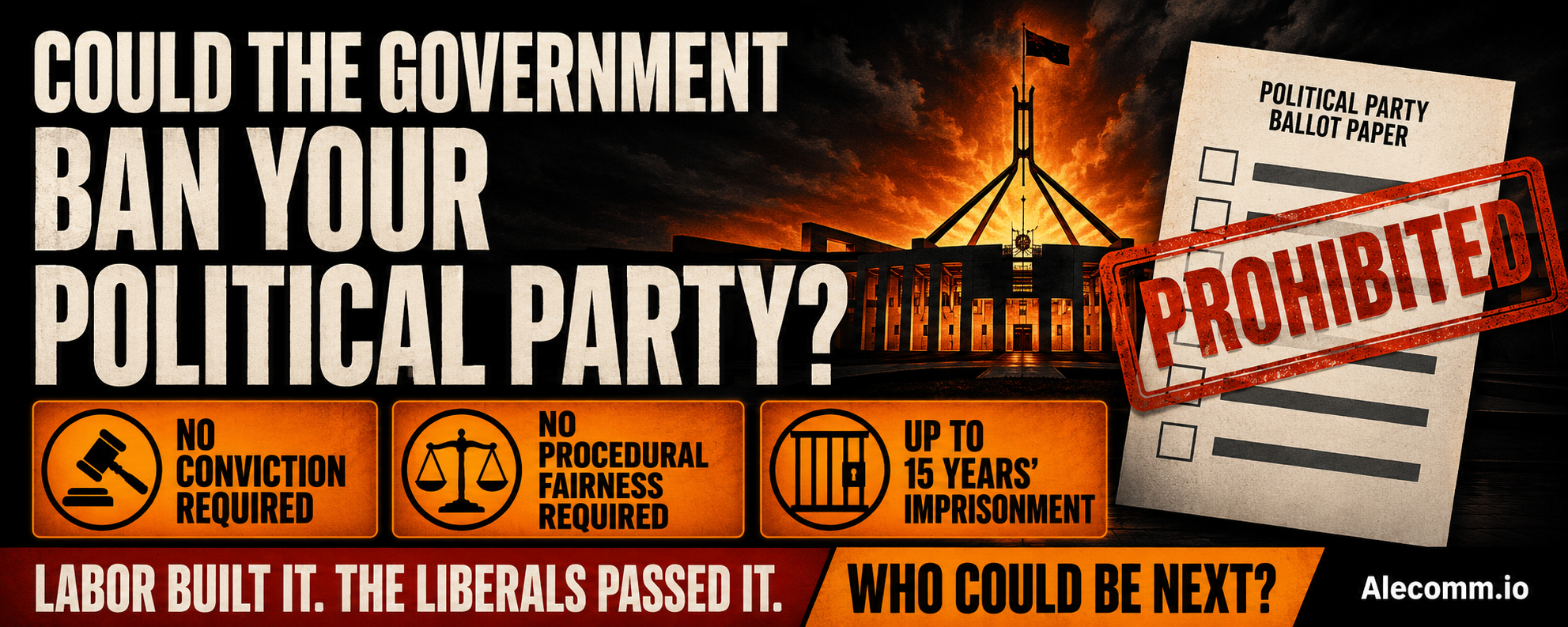
Can the Commonwealth executive effectively eliminate a political organisation, criminalise its continued operation and silence its political participation without first proving its allegations before a court?
That question should be setting off alarms across Australia.
What The Albanese Government Actually Passed
The Combatting Antisemitism, Hate and Extremism (Criminal and Migration Laws) Act 2026 inserted an entirely new prohibited-hate-group regime into the Commonwealth Criminal Code.
Under this regime, an “organisation” includes a body corporate or an unincorporated body. There is no blanket exemption for registered or aspiring political parties, protest movements, activist organisations, religious bodies, trade unions or civil-society campaigns.
Before an organisation is prohibited, the AFP Minister must be satisfied on reasonable grounds that it has engaged in, prepared, planned or assisted conduct constituting a prescribed hate crime, or advocated such conduct, and that prohibition is reasonably necessary to protect the community from physical, psychological, social or economic harm.
The government cannot lawfully prohibit an organisation merely because it is unpopular or because a Minister dislikes its policies. The statutory criteria must be engaged.
But then come the provisions Australians were apparently not supposed to examine too closely:
- No person needs to have been convicted of a hate crime before the Minister reaches that conclusion.
- The Minister is expressly relieved from observing procedural fairness.
- The organisation does not have a guaranteed right to see the allegations, examine the evidence or answer the case before the prohibition takes effect.
- Past conduct can be considered when deciding whether the organisation should be listed.
- The regulation continues indefinitely unless it is actively revoked or otherwise overturned.
Once the regulation takes effect, the consequences are crushing:
- Directing the organisation can attract 15 years’ imprisonment.
- Recruiting for the organisation can attract 15 years’ imprisonment.
- Providing support or resources can attract 15 years’ imprisonment.
- Funding-related conduct can attract 10 years’ imprisonment.
- Membership can attract seven years’ imprisonment.
The prosecution must still prove the elements of any offence in court. Mere sympathy with a prohibited organisation is not automatically the membership offence, and a person who takes all reasonable steps to cease membership after learning of the prohibition has a statutory protection.
Nevertheless, the designation activates severe criminal offences and makes continued operation of the organisation practically impossible.
Banking, fundraising, meetings, administration, recruitment, training and continued membership become legally radioactive.
The government does not merely condemn the organisation. It switches off its capacity to exist.
The Government’s Safeguards Are Not A Trial
The government insists that the law contains safeguards. Some do exist, and they must be stated accurately.
The Director-General of ASIO must first provide written advice recommending that the Minister consider the organisation for listing.
- The Attorney-General must agree in writing.
- The Leader of the Opposition must be briefed.
- The Governor-General formally makes the regulation.
Parliament can disallow the regulation, and the Parliamentary Joint Committee on Intelligence and Security can review a listing.
There is also a de-listing process and the possibility of judicial review.
But none of that provides the fundamental protection missing from the regime:
An independent court does not determine the underlying allegations before the organisation is prohibited and its continued operation becomes criminally dangerous.
ASIO advice is executive advice. Ministerial agreement is executive agreement. A briefing given to the Opposition Leader is not consent, much less a judicial hearing. Parliamentary scrutiny after the executive has acted is not natural justice before the damage is done.
The government can also rely upon classified information that the affected organisation may never be permitted to examine or test publicly.
- The distinction matters.
- A court tests evidence.
- A Minister receives advice.
Under this legislation, the political branches are allowed to make a decision with devastating consequences before the targeted organisation receives anything resembling an ordinary hearing.
Parliament Was Warned
This legislation was not passed because nobody noticed the danger.
The Law Council of Australia objected to the provision expressly excluding procedural fairness. It warned that the rule of law requires natural justice and meaningful judicial review.
The Australian Human Rights Commission recommended that procedural fairness be required except where an imminent danger made prior notice genuinely impossible.
Amnesty International warned that the rushed legislation risked capturing lawful expression, peaceful assembly and association.
The NSW Council for Civil Liberties described the regime as an unprecedented extension of executive power with serious potential for misuse.
Constitutional law professor Anne Twomey reminded Australians of the country’s disgraceful history of banning political organisations.
That history includes the persecution of the Industrial Workers of the World, the wartime prohibition of the Communist Party and Jehovah’s Witnesses, and the failed attempt to dissolve the Communist Party in 1950.
In the Jehovah’s Witnesses case, Justice Starke condemned regulations that allowed organisations to be destroyed and stripped of their property on the declaration of the executive government.
The High Court struck down the Communist Party legislation in 1951.
The warning from history is brutally simple:
Never assume that a power created to destroy your enemy will remain confined to your enemy.
Labor Built It And The Liberals Delivered It
The principal political responsibility belongs to the Albanese Government.
Prime Minister Anthony Albanese recalled Parliament and publicly promoted the new prohibited-hate-group framework.
Home Affairs Minister Tony Burke drove the operational regime and now exercises the central ministerial power behind listings.
Attorney-General Michelle Rowland sponsored and defended the legal architecture.
But Labor could not have carried the final legislation through the Senate alone.
Sussan Ley and the Liberal Party supplied the votes.
Ley negotiated directly with Albanese. Liberal Senator Jonathon Duniam was prominently involved in the negotiations. Ley then claimed that the Liberals had “fixed” the bill.
They had not fixed its most dangerous feature.
The final legislation still allowed an organisation to be prohibited without any hate-crime conviction.
It still expressly removed the Minister’s obligation to provide procedural fairness.
It still placed the initiating decision in executive hands.
It still applied broadly to incorporated and unincorporated organisations, without a blanket exemption for political parties.
The Senate passed the legislation by 38 votes to 22, supported by Labor and most Liberal senators.
The Nationals, Greens, One Nation, Fatima Payman, David Pocock, Tammy Tyrrell, Ralph Babet and Liberal Senator Alex Antic opposed the final bill.
The parliamentary record becomes even more damning when the failed amendments are examined.
Labor and most Liberal senators voted against an amendment requiring a prohibited-hate-group regulation to be approved by an absolute majority of both Houses of Parliament.
They voted against a proposed 2029 sunset clause.
They voted against amendments seeking an independent expert review, merits review and stronger recognition of lawful political expression.
Whatever one thinks of the precise drafting of those amendments, the voting record destroys any claim that Parliament was powerless to install stronger oversight.
It chose not to.
Who Publicly Welcomed The Regime?
Political pressure for tougher antisemitism and extremism laws intensified following the horrific Bondi terrorist attack.
Australia’s Special Envoy to Combat Antisemitism, Jillian Segal, had previously produced a far-reaching plan calling for stronger government action across law enforcement, immigration, education, universities, cultural funding and public institutions.
The Albanese Government formally adopted that plan in December 2025.
Segal’s broader plan was not identical to the final prohibited-hate-group provisions. It would therefore be inaccurate to claim that she personally drafted this regime or bears sole responsibility for it.
The legislative responsibility belongs to the government that wrote the provisions and the parliamentarians who enacted them.
However, several influential organisations publicly welcomed the final prohibition framework.
Executive Council of Australian Jewry co-chief executive Peter Wertheim described the new group-banning laws as a measurable improvement.
Zionist Federation of Australia president Jeremy Leibler praised the bipartisan agreement, although he argued that the overall reforms did not go far enough.
These organisations were entitled to advocate for stronger protection against antisemitism. The Bondi murders and other attacks demanded an effective response.
But supporting the objective does not excuse the mechanism.
The horror of a terrorist atrocity cannot be used to place permanent political powers beyond proper scrutiny.
The people ultimately accountable are those who wrote the provisions, negotiated their passage, rejected stronger safeguards and voted them into law.
White Australia Is The Test Case — Not The Limit Of The Power
White Australia was listed as a prohibited hate group on 15 May 2026 following ASIO advice. The regulation took effect on 16 May 2026.
The government says White Australia was effectively the National Socialist Network operating under a new name.
Tony Burke accused the organisation of “phoenixing” and said the prohibition would prevent it from organising, meeting and conducting rallies.
White Australia and Thomas Sewell then commenced High Court proceedings, arguing that:
- The Commonwealth lacks constitutional power to enact the regime.
- The legislation impermissibly burdens the implied freedom of governmental and political communication.
- The legislation confers punitive power upon the executive contrary to the constitutional separation of powers.
The High Court refused an application temporarily suspending the prohibition.
That decision did not determine whether the legislation is constitutionally valid. It dealt with whether an injunction should operate before the full constitutional challenge was heard.
The substantive proceeding is White Australia Party Inc & Anor v Commonwealth of Australia & Anor, Case M50/2026.
The Free Speech Union of Australia has applied to appear as amicus curiae.
It proposes to argue that exceptionally severe burdens on political communication and political participation should require correspondingly powerful constitutional justification.
That is the issue every Australian should care about.
The High Court does not have to approve of White Australia’s beliefs to recognise that executive prohibition of a political organisation demands the most exacting constitutional scrutiny imaginable.
Could One Nation Be Next?
The government cannot lawfully prohibit One Nation, an environmental movement or a religious organisation simply because it dislikes the organisation.
The statutory criteria must still be engaged. ASIO advice must be received. The Attorney-General must agree. The Minister must claim reasonable grounds for the listing.
- That qualification is important.
- But it does not eliminate the danger.
Political organisations frequently contain factions, local branches, reckless members and inflammatory speakers.
- Protest movements use confrontational rhetoric.
- Religious organisations contain disputed interpretations and radical splinter groups.
- Environmental activists sometimes defend destructive direct action.
- Governments regularly accuse political opponents of causing social, psychological or economic harm.
Once the legal machinery exists, the argument will no longer be about whether Australia should permit political organisations to be banned.
That argument has already been surrendered.
The argument will instead concern which organisation satisfies the statutory language, what conduct can be attributed to that organisation, and how much classified information the executive is allowed to rely upon.
Today the target is a neo-Nazi organisation. Tomorrow’s target will be selected by tomorrow’s government.
Labor supporters should imagine this power in the hands of a hard-right administration.
Conservatives should imagine it being used against an anti-immigration party, a Christian organisation or a citizens’ movement opposing government policy.
Environmentalists should imagine a government treating aggressive climate activism as preparation for serious property offences.
Trade unionists should remember that Australia once used prohibition laws against the Industrial Workers of the World.
Nobody should be foolish enough to believe that political power will forever be exercised only by people they trust.
The Real Democratic Test
The strongest constitutional protections are needed precisely when the target is unpopular.
It is easy to defend speech with which everyone agrees.
It is easy to protect organisations nobody wants banned.
It is easy to praise due process when the accused organisation is sympathetic.
The test arrives when the defendant is offensive, extreme and politically toxic.
If natural justice can be removed for that defendant, the government has established the principle that natural justice is optional.
If a political organisation can be prohibited before a court determines the allegations, the government has established the principle that political existence depends upon executive tolerance.
If Parliament can expose membership, recruitment, funding and support to severe criminal penalties following an executive designation, Australia has moved dangerously close to government-licensed political participation.
This case is not about whether Australians should embrace neo-Nazism. They should not.
It is about whether Australians will permit the executive government to decide which political organisations are allowed to exist.
Anthony Albanese, Tony Burke and Michelle Rowland created this regime.
Sussan Ley and most Liberal parliamentarians carried it across the line.
Labor and Liberal senators then rejected parliamentary approval, a sunset clause and additional political-expression safeguards.
They own the result.
A government powerful enough to silence the organisation you hate is powerful enough to silence the organisation you need.
Sources And References
- Federal Register of Legislation. Criminal Code Act 1995, Part 5.3B.
legislation.gov.au/C2004A04868/latest - Attorney-General’s Department. Prohibited Hate Groups.
ag.gov.au/crime/prohibited-hate-groups - Australian National Security. White Australia.
nationalsecurity.gov.au/what-australia-is-doing/prohibited-hate-groups/listed-prohibited-hate-groups/white-australia - High Court of Australia. White Australia Party Inc & Anor v Commonwealth of Australia & Anor, Case M50/2026.
hcourt.gov.au/cases-and-judgments/cases/current/case-no-m502026 - High Court of Australia. White Australia Party Inc & Anor v Commonwealth of Australia & Anor [2026] HCASJ 17.
hcourt.gov.au/cases-and-judgments/judgments/single-justice-judgments/white-australia-party-inc-anor-v-commonwealth-australia-anor - Free Speech Union of Australia. Could The Government Ban Your Political Party?
freespeechunion.au/stopalbo/ - Australian Human Rights Commission. Combatting Antisemitism, Hate and Extremism Bill 2026.
humanrights.gov.au/our-work/submissions/rights-and-freedoms/combatting-antisemitism%2C-hate-and-extremism-bill-2026 - Law Council of Australia. Submission On The Combatting Antisemitism, Hate and Extremism Bill 2026.
lawcouncil.au/publicassets/1b45fe02-75f2-f011-94c2-005056acd090/4772%20-%20S%20-%20Combatting%20Antisemitism%20%20Hate%20and%20Extremism%20Bill%202026.pdf - NSW Council for Civil Liberties. NSWCCL Urges Against Prohibited Hate Organisation Powers.
nswccl.org.au/media_statement_hate_groups_legislation - Amnesty International Australia. Rushed Hate And Extremism Bill Lacks Critical Safeguards.
amnesty.org.au/rushed-hate-and-extremism-bill-missed-the-opportunity-for-more-comprehensive-protections-and-lacks-critical-safeguards/ - They Vote For You. Senate Final Vote: Bill Passed 38–22.
theyvoteforyou.org.au/divisions/senate/2026-01-20/22 - They Vote For You. Senate Vote: Parliamentary Approval Amendment Rejected.
theyvoteforyou.org.au/divisions/senate/2026-01-20/19 - They Vote For You. Senate Vote: Independent Review And Lawful Political Expression Amendments Rejected.
theyvoteforyou.org.au/divisions/senate/2026-01-20/16 - They Vote For You. Senate Vote: 2029 Sunset Clause Rejected.
theyvoteforyou.org.au/divisions/senate/2026-01-20/20 - ABC News. Labor “Really Close” To Deal With Liberals On Hate Laws.
abc.net.au/news/2026-01-20/labor-coalition-hate-laws-deal-deadline-looms/106244300 - ABC News. Jewish Leaders Respond As Hate-Law Reform Passes The Senate.
abc.net.au/news/2026-01-21/jewish-groups-react-hate-law-reform-passes-senate/106248826 - Prime Minister of Australia. Parliament To Be Recalled For National Security Legislation.
pm.gov.au/media/parliament-be-recalled-national-security-legislation - Australian Labor Party. Albanese Government Passes Legislation To Combat Antisemitism, Hate And Extremism.
alp.org.au/news/albanese-government-passes-legislation-to-combat-antisemitism-hate-and-extremism/ - Professor Anne Twomey. Banning Organisations Has A Sorry History — Does Australia Really Want To Go Down This Road Again?
theguardian.com/law/commentisfree/2026/jan/14/australia-hate-laws-banning-organisations-sorry-history
Leave a Reply