
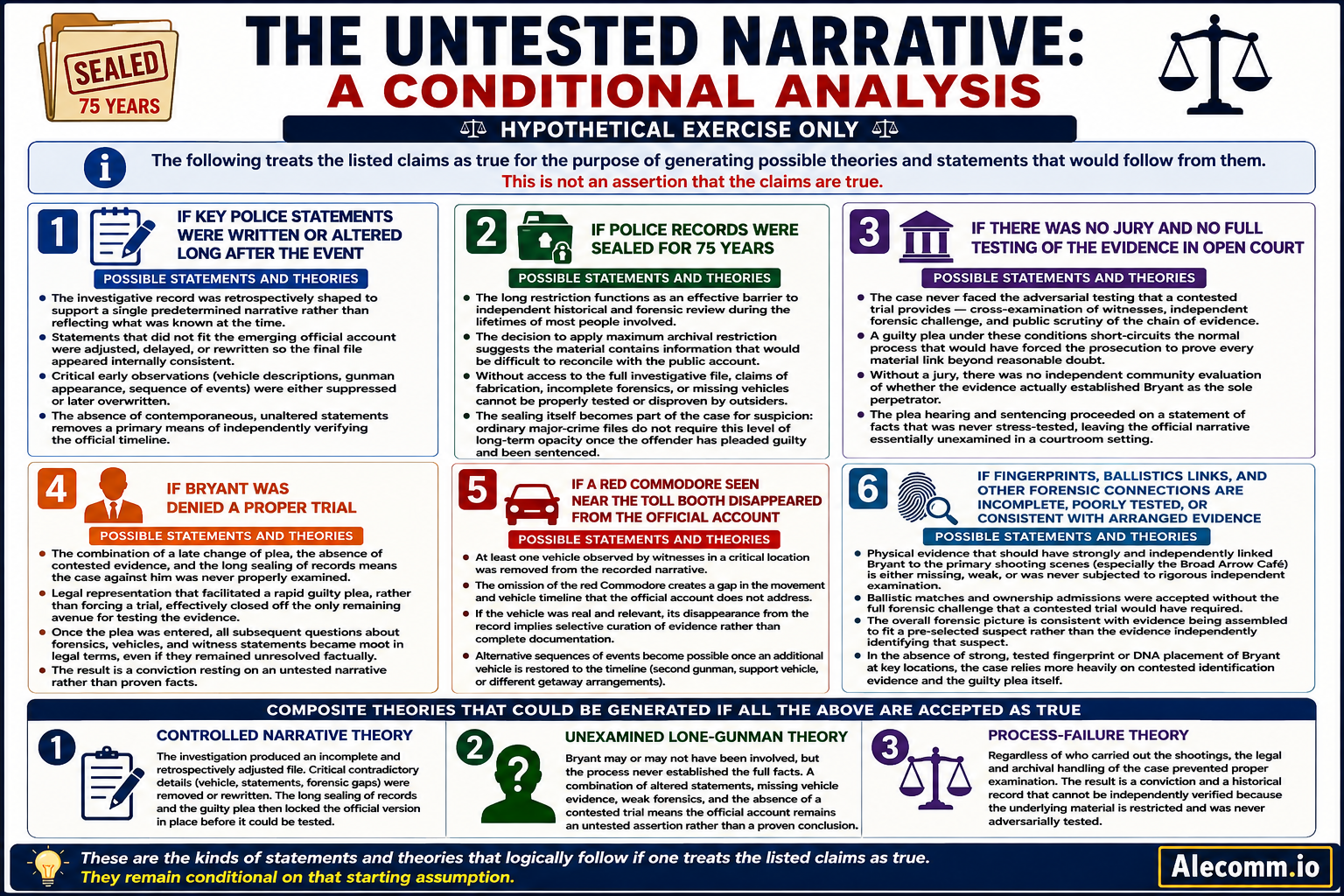
This document is a structured hypothetical analysis. It does not assert that any of the underlying claims are true. Instead, it examines the logical consequences that would follow if those claims were accepted as true for the purpose of analysis. By applying conditional reasoning to each proposition, the document explores how the investigative process, evidentiary record, legal proceedings, and historical narrative might be interpreted under that hypothetical framework. The purpose is not to establish factual conclusions, but to illustrate the theories and implications that could logically arise from the stated assumptions.
If Key Police Statements Were Written or Altered Long After the Event
Possible Statements And Theories
- The investigative record was retrospectively shaped to support a single predetermined narrative rather than reflecting what was known at the time.
- Statements that did not fit the emerging official account were adjusted, delayed, or rewritten so the final file appeared internally consistent.
- Critical early observations (vehicle descriptions, gunman appearance, sequence of events) were either suppressed or later overwritten.
- The absence of contemporaneous, unaltered statements removes a primary means of independently verifying the official timeline.
If Police Records Were Sealed For 75 Years
Possible Statements And Theories
- The long restriction functions as an effective barrier to independent historical and forensic review during the lifetimes of most people involved.
- The decision to apply maximum archival restriction suggests the material contains information that would be difficult to reconcile with the public account.
- Without access to the full investigative file, claims of fabrication, incomplete forensics, or missing vehicles cannot be properly tested or disproven by outsiders.
- The sealing itself becomes part of the case for suspicion: ordinary major-crime files do not require this level of long-term opacity once the offender has pleaded guilty and been sentenced.
If There Was No Jury And No Full Testing Of The Evidence In Open Court
Possible Statements And Theories
- The case never faced the adversarial testing that a contested trial provides — cross-examination of witnesses, independent forensic challenge, and public scrutiny of the chain of evidence.
- A guilty plea under these conditions short-circuits the normal process that would have forced the prosecution to prove every material link beyond reasonable doubt.
- Without a jury, there was no independent community evaluation of whether the evidence actually established Bryant as the sole perpetrator.
- The plea hearing and sentencing proceeded on a statement of facts that was never stress-tested, leaving the official narrative essentially unexamined in a courtroom setting.
If Bryant Was Denied A Proper Trial
Possible Statements And Theories
- The combination of a late change of plea, the absence of contested evidence, and the long sealing of records means the case against him was never properly examined.
- Legal representation that facilitated a rapid guilty plea, rather than forcing a trial, effectively closed off the only remaining avenue for testing the evidence.
- Once the plea was entered, all subsequent questions about forensics, vehicles, and witness statements became moot in legal terms, even if they remained unresolved factually.
- The result is a conviction resting on an untested narrative rather than proven facts.
If A Red Commodore Seen Near The Toll Booth Disappeared From The Official Account
Possible Statements And Theories
- At least one vehicle observed by witnesses in a critical location was removed from the recorded narrative.
- The omission of the red Commodore creates a gap in the movement and vehicle timeline that the official account does not address.
- If the vehicle was real and relevant, its disappearance from the record implies selective curation of evidence rather than complete documentation.
- Alternative sequences of events become possible once an additional vehicle is restored to the timeline (second gunman, support vehicle, or different getaway arrangements).
If Fingerprints, Ballistics Links, And Other Forensic Connections Are Incomplete, Poorly Tested, Or Consistent With Arranged Evidence
Possible Statements And Theories
- Physical evidence that should have strongly and independently linked Bryant to the primary shooting scenes (especially the Broad Arrow Café) is either missing, weak, or was never subjected to rigorous independent examination.
- Ballistic matches and ownership admissions were accepted without the full forensic challenge that a contested trial would have required.
- The overall forensic picture is consistent with evidence being assembled to fit a pre-selected suspect rather than the evidence independently identifying that suspect.
- In the absence of strong, tested fingerprint or DNA placement of Bryant at key locations, the case relies more heavily on contested identification evidence and the guilty plea itself.
Composite Theories That Could Be Generated If All The Above Are Accepted As True
1. Controlled Narrative Theory
The investigation produced an incomplete and retrospectively adjusted file. Critical contradictory details (vehicle, statements, forensic gaps) were removed or rewritten. The long sealing of records and the guilty plea then locked the official version in place before it could be tested.
2. Unexamined Lone-Gunman Theory
Bryant may or may not have been involved, but the process never established the full facts. A combination of altered statements, missing vehicle evidence, weak forensics, and the absence of a contested trial means the official account remains an untested assertion rather than a proven conclusion.
3. Process-Failure Theory
Regardless of who carried out the shootings, the legal and archival handling of the case prevented proper examination. The result is a conviction and a historical record that cannot be independently verified because the underlying material is restricted and was never adversarially tested.
These are the kinds of statements and theories that logically follow if one treats the listed claims as true. They remain conditional on that starting assumption.
Leave a Reply