
China’s Claim To Punish Critics Anywhere On Earth
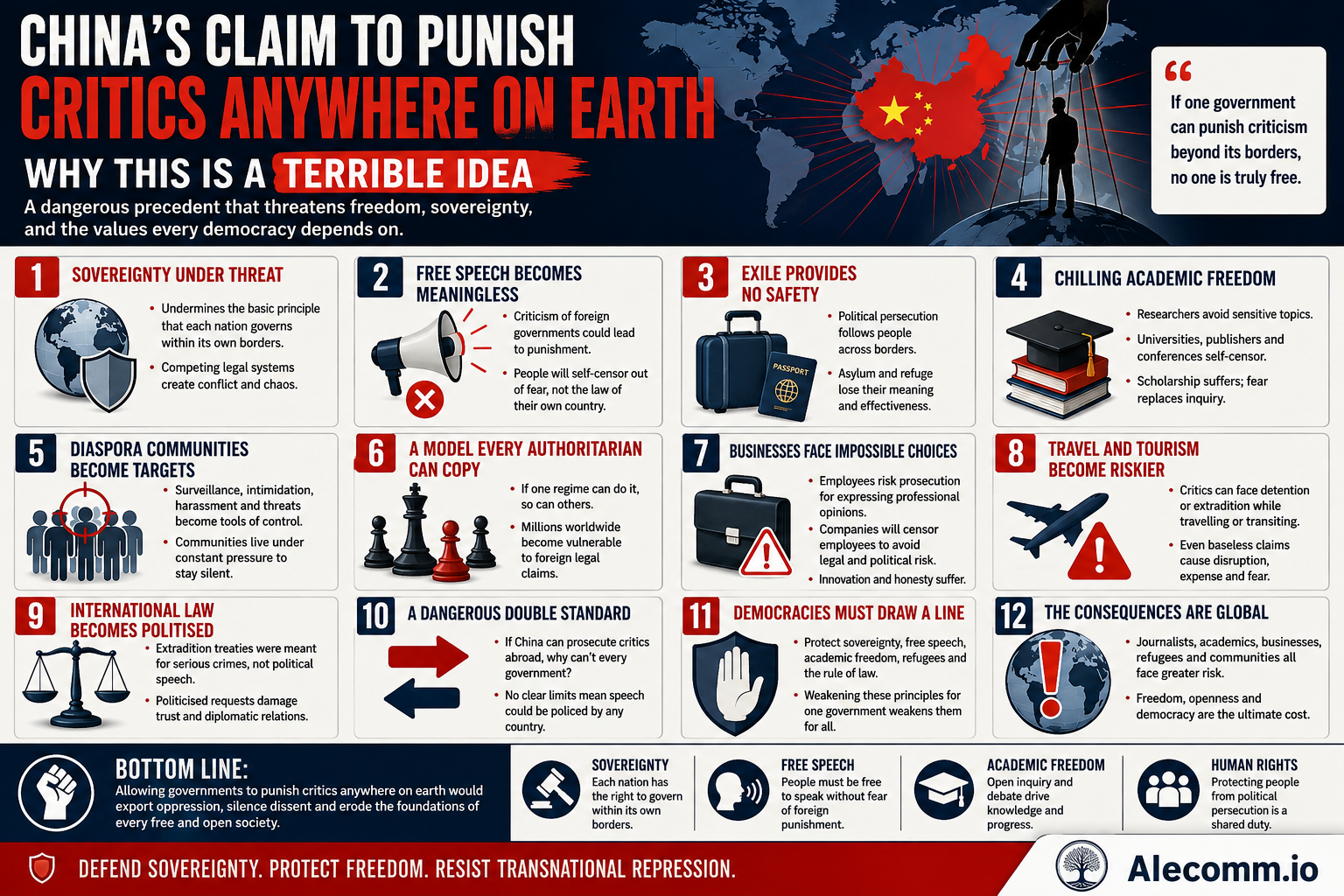
Why This Is A Dangerous Precedent For Every Democracy
China’s reported assertion that it has the authority to pursue, prosecute, or punish critics beyond its own borders represents far more than a diplomatic disagreement. If accepted by the international community, it would fundamentally alter the relationship between sovereign nations, individual liberty, and international law.
The issue extends well beyond China. It establishes a precedent that any authoritarian government could later invoke against journalists, dissidents, academics, activists, politicians, business leaders, or ordinary citizens living in democratic countries.
The End Of Territorial Sovereignty
Modern international law is built upon a simple principle:
Each nation governs within its own borders.
- Australia governs Australia.
- Canada governs Canada.
- Britain governs Britain.
If one country begins asserting the right to punish people living permanently in another country simply because they criticised its government, national sovereignty begins to erode.
The result is competing legal systems attempting to control the same individuals.
That is a recipe for perpetual diplomatic conflict.
Free Speech Becomes Meaningless
Democratic societies recognise that governments should tolerate criticism.
Governments change.
Political opinions change.
Public debate changes.
If foreign governments can punish criticism made on Australian, American or European soil, then free speech effectively becomes conditional upon the approval of foreign authoritarian regimes.
Citizens would begin asking not:
“Is this lawful where I live?”
But instead:
“Which foreign government might punish me?”
That is fundamentally incompatible with democratic values.
Exile Would No Longer Provide Safety
Throughout history, people have fled oppressive governments.
- Political refugees
- Journalists
- Human rights activists
- Religious minorities
- Whistleblowers
The principle has always been straightforward:
Once protected by another sovereign nation, they should no longer remain under the coercive reach of the government they escaped.
If countries are permitted to punish critics indefinitely across borders, asylum loses much of its practical value.
Political persecution simply follows the refugee.
Chilling Academic Freedom
Universities rely upon open discussion.
Researchers frequently examine:
- Government policy
- Human rights
- National security
- Military affairs
- Historical events
If foreign governments threaten prosecution for criticism made overseas, universities inevitably become more cautious.
Researchers begin avoiding sensitive topics.
Publishers hesitate.
Conferences self-censor.
Students remain silent.
The result is not better scholarship.
It is less scholarship.
Research becomes constrained by fear rather than evidence.
Diaspora Communities Become Targets
Many migrants left their countries specifically because they opposed authoritarian governments.
Allowing overseas punishment creates constant pressure upon diaspora communities.
Individuals may face:
- Surveillance
- Intimidation
- Threats against family members
- Harassment
- Pressure to self-censor
Fear becomes an export.
The authoritarian state no longer ends at its borders—it extends into neighbourhoods, universities, workplaces and community organisations across democratic nations.
Every Authoritarian Government Could Copy The Model
Perhaps the greatest danger is not China itself.
It is the precedent.
If one government claims this authority, why not:
- Russia
- Iran
- North Korea
- Myanmar
- Belarus
- Any future authoritarian regime
Each could argue that criticism made overseas violates its domestic laws.
Suddenly millions of people worldwide become vulnerable to legal claims originating from governments they deliberately left behind.
Businesses Would Face Impossible Choices
International companies depend upon employees expressing professional opinions.
Suppose an Australian executive criticises forced labour practices.
Could that executive become a criminal under another country’s laws?
Would multinational corporations begin censoring employees simply to reduce legal risk?
Businesses increasingly avoid uncertainty.
Extraterritorial political punishment creates exactly that.
Tourism And International Travel Become Riskier
Someone may legally criticise a foreign government while living in Australia.
Years later they transit through a third country.
They may suddenly face detention based upon allegations originating elsewhere.
Even if extradition ultimately fails, the disruption, legal expense and uncertainty become punishment in themselves.
This creates a chilling effect long before any courtroom becomes involved.
International Law Becomes Politicised
Extradition treaties were originally designed to deal with recognised crimes such as:
- Murder
- Fraud
- Terrorism
- Organised crime
They were never intended to become mechanisms for suppressing political disagreement.
If criticism becomes treated as an extraditable offence, mutual legal assistance between nations becomes increasingly politicised.
Democratic governments would face constant pressure to reject politically motivated requests.
Diplomatic relationships would deteriorate.
A Double Standard Emerges
If China can prosecute critics living abroad because they criticised China…
Could Australia prosecute Australians living overseas who criticise Canberra?
Could France prosecute journalists in Canada?
Could Brazil prosecute academics living in Britain?
Once accepted as legitimate, there is no obvious limiting principle.
Every government could attempt to export its domestic speech laws worldwide.
The internet would effectively become governed by whichever country claims the broadest jurisdiction.
Democracies Must Respond Carefully
Responding does not require hostility toward China or its people.
It requires defending principles that underpin democratic governance:
- National sovereignty
- Freedom of expression
- Academic independence
- Protection for refugees
- Rule of law
- Territorial jurisdiction
Those principles protect everyone equally regardless of nationality.
Weakening them for one government inevitably weakens them for all.
Conclusion
The danger is not simply that one government seeks greater authority over its critics.
The danger lies in establishing a global precedent that governments may export their domestic political restrictions into every other country on Earth.
If accepted, the practical consequences would extend far beyond diplomacy.
- Journalists would think twice before publishing.
- Academics would avoid controversial research.
- Businesses would censor employees.
- Refugees would remain vulnerable.
- Diaspora communities would live under continuous pressure.
Most importantly, democratic nations would gradually surrender one of their defining characteristics:
The ability of people to speak freely under the protection of their own laws rather than those of foreign governments.
History demonstrates that once states successfully extend power beyond their borders, reversing that expansion becomes extraordinarily difficult. Democracies therefore have a compelling interest in maintaining the long-established principle that political speech occurring lawfully within their territory should be governed by their own legal systems—not by the domestic laws of foreign states.
Sources
- The Conversation. China Is Claiming The Right To Punish Its Critics Anywhere On Earth.
- Council on Foreign Relations. Democracies Are Scrambling To Respond As Transnational Repression Worsens.
- Council on Foreign Relations. China’s Transnational Repression Is Being Met With A Deafening Silence.
- Human Rights Watch. “They Don’t Understand The Fear We Have”: How China’s Long Reach Of Repression Undermines Academic Freedom At Australia’s Universities.
Leave a Reply