
The Swamp Has A Beach House
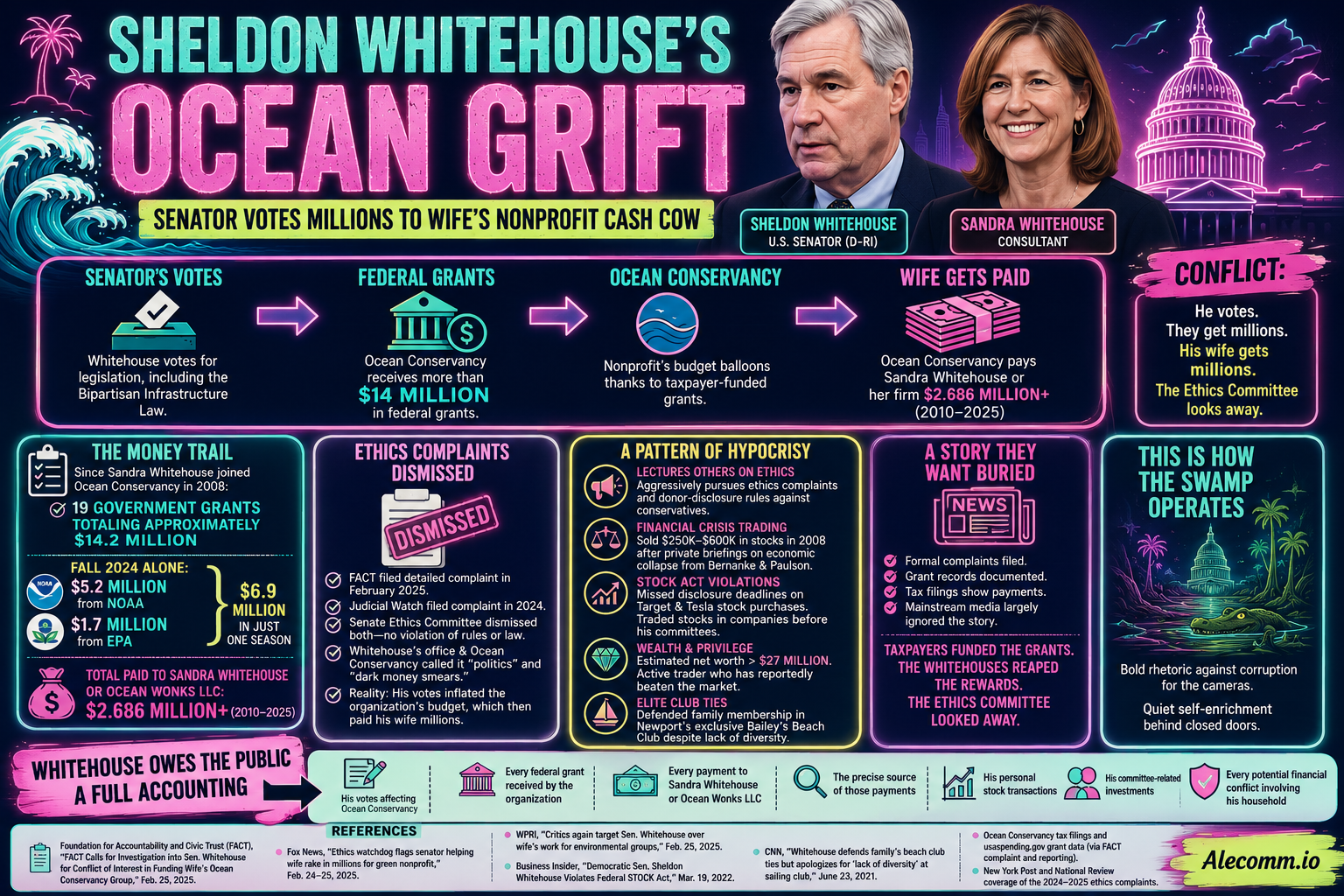
Senator Sheldon Whitehouse has turned his Senate seat into a pipeline for family enrichment.
While posturing as a crusader against corruption and dark money, Whitehouse voted for legislation that directed more than $14 million in federal grants to Ocean Conservancy.
His wife, Sandra Whitehouse, has collected nearly $2.7 million from the same organisation through her consulting firm, Ocean Wonks LLC.
Millions In Grants, Millions Paid To His Wife
Since Sandra Whitehouse joined Ocean Conservancy in 2008 as a senior policy adviser, the organisation has secured 19 government grants totalling approximately $14.2 million.
Nearly half of that money arrived during the fall of 2024 alone:
- $5.2 million from the National Oceanic and Atmospheric Administration
- $1.7 million from the Environmental Protection Agency
That amounted to approximately $6.9 million in federal funding.
Both grants flowed from legislation supported by Senator Whitehouse, including the Bipartisan Infrastructure Law.
Tax records reportedly show that Ocean Conservancy paid Sandra Whitehouse or her firm at least $2.686 million between 2010 and 2025.
The arrangement is difficult to ignore:
Whitehouse voted for legislation that expanded federal funding.
Ocean Conservancy received millions of dollars through that legislation.
Ocean Conservancy then paid millions of dollars to Whitehouse’s wife or her company.
Ethics Complaints Were Dismissed
Ethics watchdogs identified the potential conflict immediately.
In February 2025, the Foundation for Accountability and Civic Trust, known as FACT, filed a detailed ethics complaint documenting how Whitehouse:
“Directly voted for legislation that recently led to $6.9 million of taxpayer funds being paid to an organisation for which his wife works and receives an income from.”
A previous complaint filed by Judicial Watch in 2024 raised similar concerns.
The Senate Ethics Committee dismissed both complaints, claiming that Whitehouse had not violated Senate rules or federal law.
Whitehouse’s office and Ocean Conservancy described the allegations as “politics” and “dark money smears.”
They argued that Sandra Whitehouse’s compensation did not come directly from the specific federal grants.
That defence avoids the central issue.
The grants increased the organisation’s overall funding and financial capacity. That same organisation continued paying Whitehouse’s wife substantial amounts of money.
The question is not merely whether a particular federal dollar travelled directly from a government grant into Sandra Whitehouse’s bank account.
The question is whether a senator used his public position to support legislation that financially benefited an organisation paying his household millions of dollars.
One Standard For His Opponents, Another For Himself
This controversy is not isolated.
Whitehouse has built a political career lecturing others about ethics, corruption and financial influence while aggressively shielding his own conduct from equivalent scrutiny.
He has pursued ethics complaints and donor-disclosure requirements against conservative Supreme Court justices.
He has attacked what he calls “creepy” public-interest law firms and repeatedly condemned the influence of wealthy donors and secretive political funding.
Yet when similar questions are raised about his own family’s financial interests, the Senate protects its own and the controversy quickly disappears.
The hypocrisy is obvious.
Whitehouse demands aggressive disclosure and accountability from his political opponents while dismissing scrutiny of his own household as partisan harassment.
Stock Sales Before The Financial Collapse
Whitehouse’s financial controversies extend well beyond Ocean Conservancy.
During the 2008 global financial crisis, Whitehouse reportedly sold between $250,000 and $600,000 in stock holdings shortly after receiving private briefings from Federal Reserve Chair Ben Bernanke and Treasury Secretary Henry Paulson about the approaching economic collapse.
The timing raised serious questions about whether members of Congress were trading on information unavailable to the general public.
Whitehouse later violated the STOCK Act by failing to disclose personal stock purchases involving Target and Tesla within the required reporting period.
Investigations also found that he traded shares in companies that appeared before committees on which he served.
His estimated net worth has reportedly exceeded $27 million, supported partly by an active investment portfolio that has outperformed the broader market.
A senator who lectures the public about corruption should be able to explain how his household repeatedly benefited from transactions, investments and organisations connected to his official responsibilities.
The Exclusive Club Controversy
Whitehouse has also faced scrutiny over his family’s membership in exclusive private clubs.
He defended his family’s association with Bailey’s Beach Club in Newport, Rhode Island, after reports questioned the club’s lack of racial diversity.
Whitehouse initially resisted calls to leave the club and later offered a limited apology regarding the “lack of diversity” at a related sailing organisation.
The controversy reinforced the image of a senator who publicly condemns entrenched privilege while privately enjoying its benefits.
A Story The Media Allowed To Disappear
The Ocean Conservancy controversy was documented through formal ethics complaints, government grant records, tax filings and public reporting.
Yet it never received the sustained national coverage it deserved.
Major media outlets largely treated the allegations as partisan noise rather than examining them as a serious case involving political power, taxpayer funding and direct household financial benefit.
The basic facts demanded far greater scrutiny:
- Taxpayers funded the grants
- Whitehouse supported the legislation
- Ocean Conservancy received the money
- Ocean Conservancy paid Whitehouse’s wife millions of dollars
- The Senate Ethics Committee dismissed the complaints
The Whitehouses reaped the financial rewards.
The Ethics Committee looked away.
The media moved on.
This Is How The Swamp Operates
This is how the political swamp protects itself.
Publicly, politicians deliver bold speeches about corruption, transparency and accountability.
Privately, taxpayer money flows through legislation, grants, contractors, consultants and nonprofit organisations connected to political families.
When questioned, officials insist there is no direct link, no technical violation and therefore nothing worth investigating.
That is not accountability.
It is institutionalised plausible deniability.
Sheldon Whitehouse owes the public a complete accounting of:
- His votes affecting Ocean Conservancy
- Every federal grant received by the organisation
- Every payment made to Sandra Whitehouse or Ocean Wonks LLC
- The precise source of those payments
- His personal stock transactions
- His committee-related investments
- Every potential financial conflict involving his household
The public deserves more than another carefully worded dismissal.
Taxpayers funded the grants.
The organisation paid his wife.
The Senate protected its own.
References
Foundation for Accountability and Civic Trust. (2025, February 25). FACT calls for investigation into Sen. Whitehouse for conflict of interest in funding wife’s Ocean Conservancy group.
Fox News. (2025, February 24–25). Ethics watchdog flags senator helping wife rake in millions for green nonprofit.
WPRI. (2025, February 25). Critics again target Sen. Whitehouse over wife’s work for environmental groups.
Business Insider. (2022, March 19). Democratic Sen. Sheldon Whitehouse violates federal STOCK Act.
CNN. (2021, June 23). Whitehouse defends family’s beach club ties but apologises for “lack of diversity” at sailing club.
Ocean Conservancy. (2010–2025). Federal tax filings and organisational financial disclosures.
USAspending.gov. (2024–2025). Federal grant data relating to Ocean Conservancy.
New York Post. (2024–2025). Coverage of ethics complaints involving Senator Sheldon Whitehouse and Ocean Conservancy.
National Review. (2024–2025). Coverage of ethics complaints involving Senator Sheldon Whitehouse and his wife’s environmental consulting work.
Leave a Reply