
Screwworm: The Perfect Agricultural Sabotage?
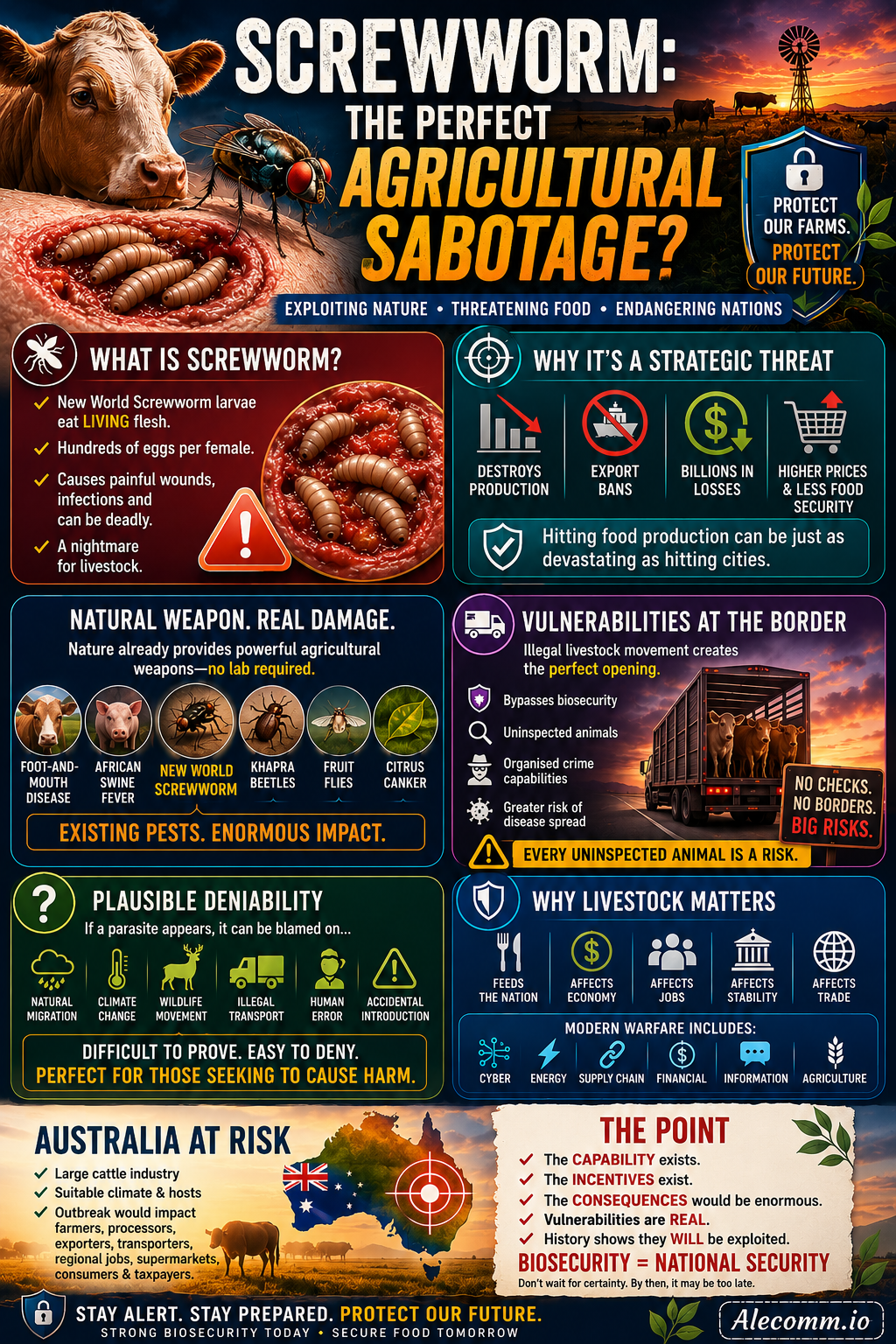
Imagine for a moment that you wanted to cripple a nation’s food supply without firing a single shot.
You wouldn’t need missiles.
You wouldn’t need bombs.
You wouldn’t even need sophisticated biological engineering.
You would simply need to exploit nature itself.
One of the most terrifying examples already exists.
The New World Screwworm
Unlike ordinary maggots that feed on dead tissue, New World Screwworm larvae consume living flesh. A single female fly can lay hundreds of eggs in an open wound. Within hours, those larvae begin eating healthy muscle, enlarging wounds, causing infection, immense suffering and, in severe cases, death.
For cattle producers, it is a nightmare.
For any nation whose economy depends upon livestock, it represents something far greater.
It represents a potential strategic vulnerability.
The Question Nobody Wants To Ask
Public discussion almost always assumes outbreaks are accidental.
Perhaps they are.
But should we automatically assume that?
History repeatedly demonstrates that agriculture has always been viewed as a legitimate strategic target.
Throughout history, nations have poisoned wells, destroyed crops, infected livestock and blockaded food supplies. Modern military planners openly study food security because they understand a simple truth:
Destroying food production can be just as devastating as destroying cities.
So why would anyone dismiss the possibility that agriculture itself could become a target again?
It Doesn’t Need To Be A Laboratory Bioweapon
When people hear the word “bioweapon,” they immediately picture genetically engineered viruses.
That may be the wrong way to think about it.
Nature has already produced highly effective agricultural killers.
- Foot-and-Mouth Disease
- African Swine Fever
- New World Screwworm
- Khapra Beetles
- Fruit Flies
- Citrus Canker
None require genetic modification to become economically devastating.
If someone intentionally introduced an existing agricultural pest into vulnerable livestock populations, the damage could rival that of many engineered biological agents.
The result would be the same:
- Destroyed production
- Massive eradication campaigns
- Export bans
- Billions of dollars in losses
- Higher food prices
- Reduced food security
The Cartel Question
One aspect that deserves serious discussion is illegal livestock movement.
Drug cartels have already demonstrated extraordinary logistical capability.
They move:
- Drugs
- Weapons
- Cash
- People
Authorities have also documented illegal cattle trafficking in some regions.
Once legitimate veterinary inspection is bypassed, biosecurity weakens dramatically.
Whether the motivation is profit, corruption or something more sinister, every uninspected animal crossing a border increases the opportunity for dangerous livestock diseases and parasites to spread.
That alone should concern every farmer.
Plausible Deniability
Perhaps the most dangerous feature of an agricultural pest is its deniability.
If a missile destroys a farm, everyone knows it was an attack.
If a parasite appears, it can always be described as:
- Natural migration
- Climate change
- Wildlife movement
- Human error
- Illegal transport
- Accidental introduction
Every one of those explanations may be entirely genuine.
But if an introduction were ever deliberate, distinguishing it from natural spread could prove extraordinarily difficult.
That ambiguity itself creates a strategic advantage for anyone seeking to cause economic harm while avoiding attribution.
Why Livestock Matters
Food production is national security.
Countries that cannot reliably feed themselves become increasingly dependent upon imports.
Food prices affect inflation.
Inflation affects governments.
Governments affect political stability.
Modern conflict is no longer fought only with tanks and aircraft.
It is fought through:
- Cyber attacks
- Energy disruption
- Supply chain interference
- Financial warfare
- Information warfare
- Agricultural disruption
Agriculture fits naturally within that list.
If an adversary wished to weaken a nation’s economy while avoiding conventional military confrontation, targeting livestock would be one conceivable avenue.
Australia Should Be Paying Attention
Australia possesses one of the world’s largest and most valuable cattle industries.
Northern Australia also provides suitable environmental conditions for New World Screwworm should it ever become established.
An outbreak would not simply affect farmers.
It would affect:
- Processors
- Transport companies
- Export markets
- Regional employment
- Supermarkets
- Consumers
- Taxpayers
The economic consequences would ripple throughout the entire country.
That reality alone justifies treating biosecurity as a frontline national security issue.
The Point
None of this proves that any current screwworm outbreak was deliberately caused.
Nor does it prove the involvement of governments, criminal organisations or foreign actors.
What it does demonstrate is something equally important:
- The capability exists.
- The incentives exist.
- The economic consequences would be enormous.
- Illegal livestock movement creates vulnerabilities that deserve close scrutiny.
History teaches that vulnerabilities eventually attract those willing to exploit them.
The question is not whether screwworm is capable of causing catastrophic economic damage.
That is already beyond dispute.
The question is whether governments are prepared to consider every plausible pathway by which that damage could occur—including those that are uncomfortable to discuss.
Because waiting until certainty arrives may be waiting until it is already too late.
References
Blair, A. (Guest). (2026, June). The Screwworm Bioweapon & The Cartels (No. 86) [Audio podcast episode]. In Going Rogue with Lara Logan. https://www.youtube.com/watch?v=qgUR_bISVoI — Discusses illegal livestock movement, border vulnerabilities, organised crime involvement, and the possibility of deliberate introduction.
U.S. Department of Agriculture, Animal and Plant Health Inspection Service. (n.d.-a). New World Screwworm Prevention for Animals. https://www.aphis.usda.gov/livestock-poultry-disease/cattle/ticks/screwworm — Explains the biology of New World Screwworm, including its life cycle, reproductive behaviour, animal susceptibility, the fact that its larvae consume living tissue, and recommended prevention measures.
U.S. Department of Agriculture, Animal and Plant Health Inspection Service. (n.d.-b). NWS Response Playbook [PDF]. https://www.aphis.usda.gov/sites/default/files/nws-response-playbook.pdf — Details emergency response planning, surveillance, eradication strategies, export implications, economic consequences, and national preparedness for a New World Screwworm outbreak.
U.S. Department of Agriculture, Animal and Plant Health Inspection Service. (n.d.-c). Eradicating New World Screwworm with Sterile Insect Technique [Fact sheet]. https://www.aphis.usda.gov/sites/default/files/factsheet-eradicating-nws-sit.pdf — Describes the Sterile Insect Technique (SIT), how it successfully eradicated New World Screwworm from North America, and why it remains the cornerstone of control programs.
U.S. Department of Agriculture, Animal and Plant Health Inspection Service. (2026, June 3). USDA Confirms Presence of New World Screwworm in the United States [Press release]. https://www.aphis.usda.gov/news/agency-announcements/usda-confirms-presence-new-world-screwworm-united-states — Confirms recent detections of New World Screwworm in the United States, outlines the ongoing response, and highlights the continuing biosecurity risks.
Animal Health Australia. (n.d.). Monitoring for Screw-Worm Fly. https://animalhealthaustralia.com.au/monitoring-for-swf/ — Outlines Australia’s surveillance systems, favourable environmental conditions for establishment, livestock industry vulnerability, and the critical importance of maintaining strong national biosecurity.
International Atomic Energy Agency. (1990). Manual for the Control of the Screwworm Fly [PDF]. https://www.iaea.org/sites/default/files/21/06/nafa-ipc-manual-ipc-fao-screwworm-control-manual-1990-english.pdf — Provides comprehensive information on New World Screwworm biology, historical eradication campaigns, Sterile Insect Technique programs, and long-term international control strategies.
World Organisation for Animal Health (WOAH). (n.d.). Chapter 3.1.14: New World Screwworm (Cochliomyia hominivorax). In Terrestrial Animal Health Code. https://www.woah.org/fileadmin/Home/eng/Health_standards/tahm/3.01.14_SCREWW.pdf — Sets international standards for disease recognition, surveillance, reporting obligations, prevention, treatment, and international animal health measures.
Centers for Disease Control and Prevention. (2026). Clinical Overview of New World Screwworm. https://www.cdc.gov/new-world-screwworm/hcp/clinical-overview/index.html — Summarises the human health implications of New World Screwworm infestations, including clinical presentation, diagnosis, treatment, and zoonotic considerations.
Merck Veterinary Manual. (2025). New World Screwworm. https://www.merckvetmanual.com/integumentary-system/flies/new-world-screwworm — Provides detailed veterinary information on pathology, life cycle, diagnosis, treatment, prevention, livestock impacts, and the significant economic consequences associated with New World Screwworm infestations.
Leave a Reply