
Farmers Built The Industry. Corporations Should Not Control The Gate.
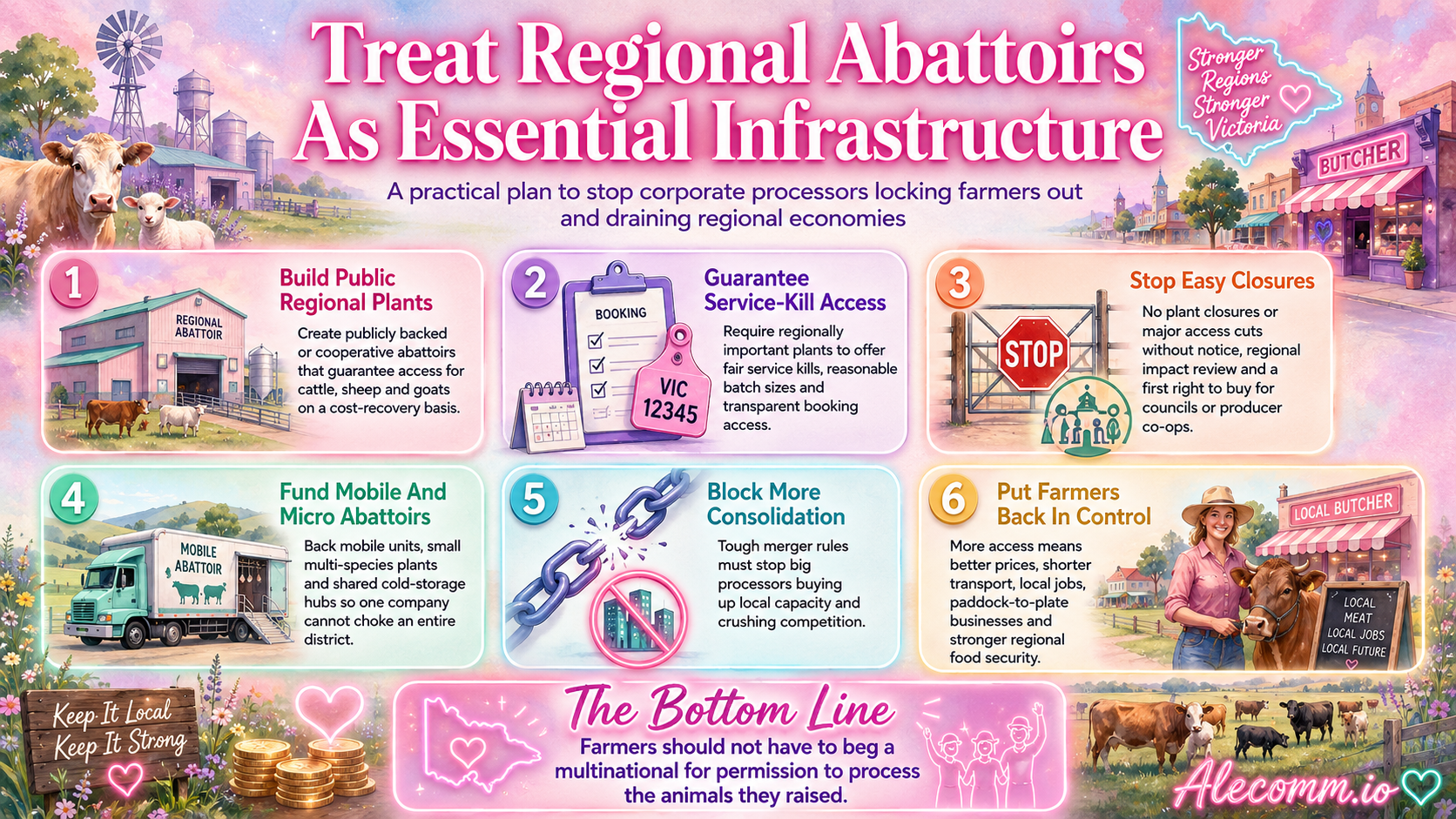
The Solution: Treat Regional Processing As Essential Infrastructure
Australia must stop treating livestock processing as an ordinary private industry that corporations can buy, close, consolidate or withdraw from smaller farmers whenever it suits them.
Without lawful and affordable processing access, farmers cannot sell directly, operate paddock-to-plate businesses, supply local butchers or retain the value of the animals they raised.
Regional slaughter and meat processing must therefore be treated as essential agricultural infrastructure.
Build A Public And Cooperative Processing Network
Victoria should establish a publicly backed regional processing network made up of:
- State or council-owned abattoirs
- Producer cooperatives
- Community-owned multi-species plants
- Mobile slaughter units
- Micro-abattoirs
- Shared boning, packaging and cold-storage hubs
These facilities should guarantee access for cattle, sheep, goats and pigs, including smaller consignments and service kills.
They should operate on a cost-recovery basis, rather than being designed to squeeze the maximum possible profit out of farmers.
Guarantee Service-Kill Access By Law
Regionally important abattoirs should be legally required to provide reasonable service-kill access.
That must include:
- Published service-kill days
- Reasonable minimum batch sizes
- Transparent prices
- Fair booking systems
- Clear waiting times
- Equal treatment regardless of farm size
- Adequate notice before services are changed
- Protection against sudden cancellations
A plant that dominates processing within a practical transport area should not be allowed to shut smaller farmers out.
If it controls essential regional capacity, it must carry a public-access obligation.
Stop Closures And Access Cuts Without Consequences
A corporation should not be able to close a regional abattoir, mothball it or withdraw small-batch access without a formal public process.
Before any closure or major reduction in service, the owner should be required to:
- Provide at least 12 months’ notice.
- Publish a regional economic and processing-access assessment.
- Explain how affected farmers will retain viable access.
- Offer the facility first to the state, council or a producer cooperative.
- Repay government grants and assistance where service commitments are broken.
- Preserve the site’s equipment and processing approvals during any sale process.
Where closure would leave a processing desert, government should have the power to temporarily maintain operations, appoint another operator or acquire the facility.
Fund Small-Scale Processing Properly
Small regional facilities should not be expected to compete for capital on the same terms as multinational processors.
Governments should establish dedicated funding streams for:
- Establishment grants
- Concessional loans
- Cooperative finance
- Loan guarantees
- Equipment upgrades
- Mobile processing units
- Shared cold storage
- Boning and packaging facilities
- Feasibility studies
- Planning and licensing costs
This funding should be tied to guaranteed farmer access, local employment and minimum operating periods.
Public money must purchase a public benefit.
Replace One-Size-Fits-All Regulation
Food safety must remain strong, but regulation should be proportionate to the size and risk of the operation.
A small mobile unit processing limited numbers should not face the same fixed compliance burden as a multinational export plant processing thousands of animals each week.
Australia should introduce:
- Tiered licensing
- Risk-proportionate compliance standards
- Simplified approvals for micro-abattoirs
- Pilot pathways for new processing models
- Coordinated state and local planning approvals
- Clear regulatory guidance before capital is committed
- Lower-cost inspection systems where safety is not compromised
Small processors should be held to strong safety standards without being regulated out of existence.
Develop A Regional Processing Workforce
New plants are useless without trained workers.
Government, TAFE and industry should create dedicated regional training pathways covering:
- Slaughtering
- Boning
- Butchery
- Food safety
- Inspection
- Refrigeration
- Plant maintenance
- Packaging
- Small-plant management
Training should be delivered regionally and supported through subsidised courses, apprenticeships and workplace placements.
Additional support should include regional housing assistance, relocation incentives, retention payments and recognition of experienced workers.
Create Producer Aggregation Networks
One small farmer may not have enough animals to meet a processor’s batch requirements, but several local farmers often do.
Regional aggregation services should coordinate:
- Shared booking dates
- Combined consignments
- Transport
- Livestock scheduling
- Paperwork
- Cold storage
- Local distribution
This can improve efficiency without forcing farmers to surrender ownership of their livestock, brands or customers.
Aggregation must remain an option, however, not an excuse for slaughterhouses to impose unreasonable minimums.
Build Shared Regional Meat Hubs
Processing does not end at slaughter.
Farmers also need affordable access to:
- Chillers
- Freezers
- Boning rooms
- Packaging
- Labelling
- Distribution
- Transport
- Online sales systems
- Retail and wholesale market connections
Governments should fund shared regional meat hubs where independent farmers can use this infrastructure without handing control to a multinational processor.
That allows farmers to retain more of the finished product’s value instead of remaining low-margin suppliers of live animals.
Use Public Procurement To Create Reliable Demand
Hospitals, schools, defence facilities, prisons, aged-care services and government-funded caterers should prioritise Australian meat sourced through regional producers and processors.
Long-term procurement contracts would provide new plants with dependable demand while keeping public money circulating through Australian farming communities.
Contracts should favour:
- Australian-born and raised livestock
- Regional processing
- Transparent provenance
- Independent farmers
- Producer cooperatives
- Local employment
- Whole-carcass utilisation
Government should not spend taxpayers’ money on imported meat while Australian farmers are being locked out of their own processing system.
Publish A National Processing Access Register
Farmers should not have to ring dozens of plants merely to discover whether they accept service kills.
A public national register should show:
- Every licensed abattoir
- Ownership
- Species processed
- Service-kill availability
- Minimum batch sizes
- Approximate waiting times
- Current booking status
- Fees
- Closures and temporary shutdowns
- Planned changes to access
This would expose processing shortages, ownership concentration and regional lockouts before they become full-scale crises.
Create A Regional Processing Commissioner
Farmers need an independent authority that can act when a dominant plant abuses its position.
A Regional Processing Commissioner should have the power to:
- Investigate refusals of access
- Review unreasonable minimum consignments
- Examine sudden cancellations
- Order temporary access where regional dependence exists
- Audit compliance with public-funding agreements
- Publish regional capacity information
- Penalise misleading claims about availability
- Refer anti-competitive conduct to the ACCC
At present, nobody is properly responsible for ensuring farmers retain practical access to essential processing infrastructure.
That gap must be closed.
Block Further Corporate Consolidation
Future slaughterhouse acquisitions must be assessed according to their effect on the surrounding farming region, not merely their national market share.
A plant hundreds of kilometres away is not genuine competition when transport costs, booking delays and livestock stress make it unusable.
Acquisitions should be blocked or heavily conditioned where they would:
- Remove an independent processor
- Reduce service-kill capacity
- Give one corporation control of multiple regional plants
- Increase transport distances
- Leave farmers dependent on one buyer
- Weaken local processing resilience
Approval conditions must be enforceable and permanent.
No more vague promises that disappear after the sale is approved.
Strengthen Local Meat Markets
Regional processing cannot survive if supermarkets and institutional buyers continue favouring standardised, high-volume corporate supply chains.
Government should strengthen:
- Independent butchers
- Farmers’ markets
- Food-service purchasing from local producers
- Direct-to-consumer sales
- Regional branding
- Transparent country-of-origin labelling
- Restaurant and retail provenance disclosure
- Whole-carcass purchasing
Consumers should be able to see exactly where their meat came from and choose Australian farmers and processors.
Put Farmers At The Policy Table
Small and medium producers must have direct representation in every major decision involving processing access.
Not merely peak bodies dominated by large processors and exporters.
Working farmers should have formal seats on:
- Government advisory panels
- Regulatory reviews
- Processing-infrastructure boards
- Grant assessment panels
- Regional development committees
- Competition and merger consultations
The people carrying the risk should have a real say in how the system operates.
What Government Should Do Immediately
The first practical steps should be:
- Purchase guaranteed service-kill capacity from existing plants for two years.
- Legislate reasonable-access obligations for regionally dominant abattoirs.
- Establish publicly backed multi-species facilities in processing deserts.
- Fund mobile and micro-abattoirs.
- Create a national processing-access register.
- Introduce tiered, risk-based regulation for smaller plants.
- Establish regional meat-processing training through TAFE.
- Fund producer aggregation, cold storage, boning and distribution hubs.
- Require public institutions to prioritise Australian and regionally processed meat.
- Prevent plant closures without notice, impact assessment and community purchase rights.
- Block acquisitions that reduce regional competition or service-kill access.
- Establish an independent Regional Processing Commissioner.
The Bottom Line
The answer is not asking JBS, Kilcoy or any other corporate processor to be generous.
The answer is ensuring they no longer have the power to decide whether independent farmers can reach the market.
Australia needs public and cooperative processing capacity, guaranteed service-kill rights, sensible regulation, regional workforce investment, shared infrastructure, tougher merger rules and real consequences for companies that close plants or shut farmers out.
Farmers should never have to beg a multinational for permission to process and sell the animals they raised.
Regional processing belongs at the centre of Australian food security, regional development and national sovereignty.
Sources And References
- Australian Competition and Consumer Commission. Cattle And Beef Market Study: Final Report. March 2017.
- Nous Group. Fragility To Resilience: Local Meat Processing In Australia At A Crossroads. 2026.
- PrimeSafe Victoria. Vehicle-Based Abattoirs Factsheet.
- PrimeSafe Victoria. Abattoir Licence. (PrimeSafe)
- Victorian Government. Meat Industry Act 1993. Current version effective 17 April 2025. (legislation.vic.gov.au)
- Australian Treasury. Mergers And Acquisitions Reform. (Treasury)
Solution to issues raised in “Victorian Slaughterhouses Are Strangling Farmers”
Leave a Reply