
Early SARS Coronavirus Vaccine Animal Trials And Related Safety Concerns
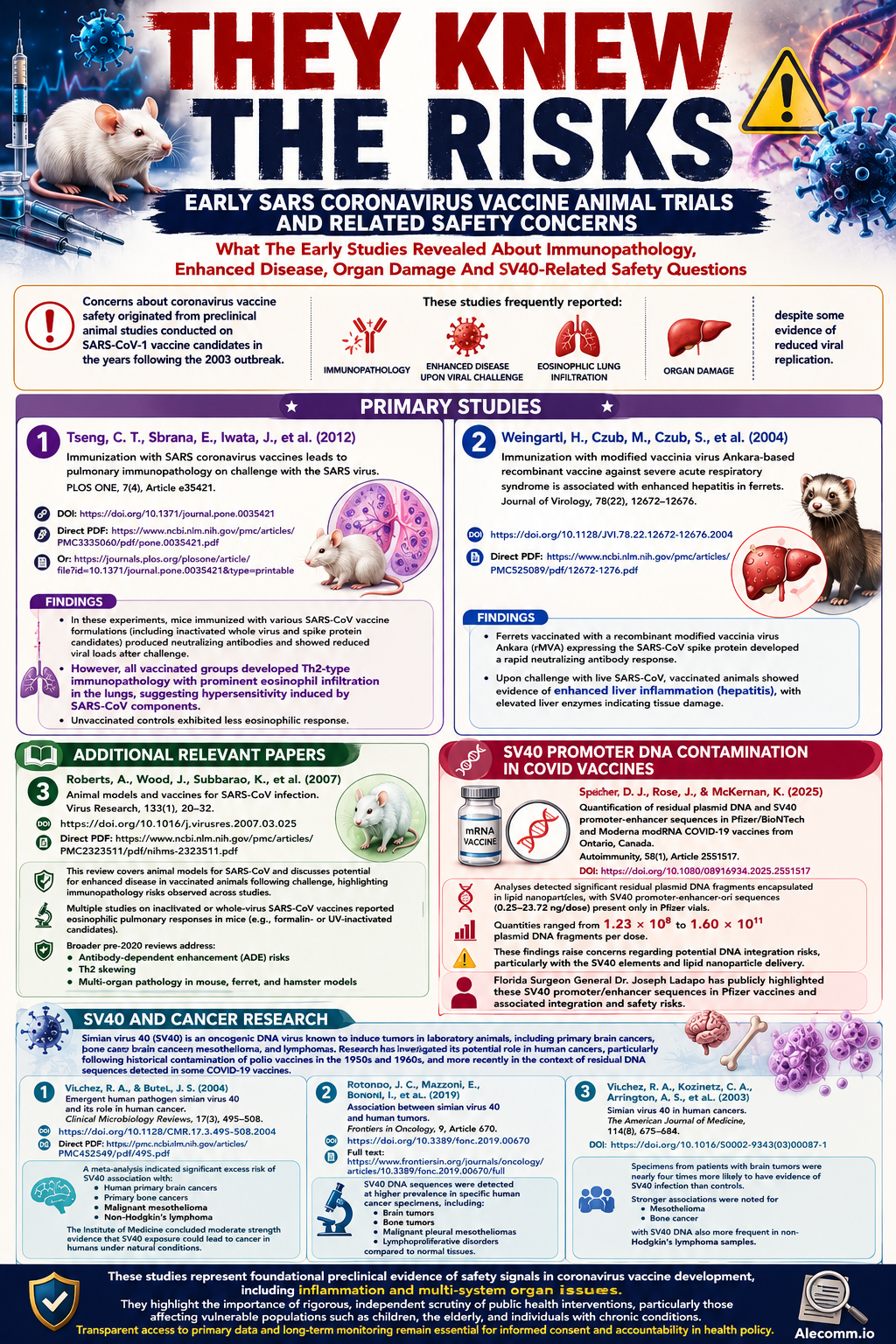
Concerns about coronavirus vaccine safety originated from preclinical animal studies conducted on SARS-CoV-1 vaccine candidates in the years following the 2003 outbreak.
These studies frequently reported:
- Immunopathology
- Enhanced disease upon viral challenge
- Eosinophilic lung infiltration
- Organ damage
despite some evidence of reduced viral replication.
Primary Studies
Tseng, C. T., Sbrana, E., Iwata, J., et al. (2012)
Immunization with SARS coronavirus vaccines leads to pulmonary immunopathology on challenge with the SARS virus
PLOS ONE, 7(4), Article e35421.
DOI
https://doi.org/10.1371/journal.pone.0035421
Direct PDF
https://www.ncbi.nlm.nih.gov/pmc/articles/PMC3335060/pdf/pone.0035421.pdf
Alternative PDF
https://journals.plos.org/plosone/article/file?id=10.1371/journal.pone.0035421&type=printable
Findings
In these experiments, mice immunized with various SARS-CoV vaccine formulations (including inactivated whole virus and spike protein candidates) produced neutralizing antibodies and showed reduced viral loads after challenge.
However, all vaccinated groups developed Th2-type immunopathology with prominent eosinophil infiltration in the lungs, suggesting hypersensitivity induced by SARS-CoV components.
Unvaccinated controls exhibited less eosinophilic response.
Weingartl, H., Czub, M., Czub, S., et al. (2004)
Immunization with modified vaccinia virus Ankara-based recombinant vaccine against severe acute respiratory syndrome is associated with enhanced hepatitis in ferrets
Journal of Virology, 78(22), 12672–12676.
DOI
https://doi.org/10.1128/JVI.78.22.12672-12676.2004
Direct PDF
https://www.ncbi.nlm.nih.gov/pmc/articles/PMC525089/pdf/12672-1276.pdf
Findings
Ferrets vaccinated with a recombinant modified vaccinia virus Ankara (rMVA) expressing the SARS-CoV spike protein developed a rapid neutralizing antibody response.
Upon challenge with live SARS-CoV, vaccinated animals showed evidence of enhanced liver inflammation (hepatitis), with elevated liver enzymes indicating tissue damage.
Additional Relevant Papers
Roberts, A., Wood, J., Subbarao, K., et al. (2007)
Animal models and vaccines for SARS-CoV infection
Virus Research, 133(1), 20–32.
DOI
https://doi.org/10.1016/j.virusres.2007.03.025
Direct PDF
https://www.ncbi.nlm.nih.gov/pmc/articles/PMC2323511/pdf/nihms-2323511.pdf
Findings
This review covers animal models for SARS-CoV and discusses potential for enhanced disease in vaccinated animals following challenge, highlighting immunopathology risks observed across studies.
Multiple studies on inactivated or whole-virus SARS-CoV vaccines reported eosinophilic pulmonary responses in mice (e.g., formalin- or UV-inactivated candidates).
Broader pre-2020 reviews address:
- Antibody-dependent enhancement (ADE) risks
- Th2 skewing
- Multi-organ pathology in mouse, ferret, and hamster models
SV40 Promoter DNA Contamination In COVID Vaccines
Speicher, D. J., Rose, J., & McKernan, K. (2025)
Quantification of residual plasmid DNA and SV40 promoter-enhancer sequences in Pfizer/BioNTech and Moderna modRNA COVID-19 vaccines from Ontario, Canada
Autoimmunity, 58(1), Article 2551517.
DOI
https://doi.org/10.1080/08916934.2025.2551517
Findings
Analyses detected significant residual plasmid DNA fragments encapsulated in lipid nanoparticles, with SV40 promoter-enhancer-ori sequences (0.25–23.72 ng/dose) present only in Pfizer vials.
Quantities ranged from:
1.23 × 10⁸ to 1.60 × 10¹¹ plasmid DNA fragments per dose
These findings raise concerns regarding potential DNA integration risks, particularly with the SV40 elements and lipid nanoparticle delivery.
Florida Surgeon General Dr. Joseph Ladapo has publicly highlighted these SV40 promoter/enhancer sequences in Pfizer vaccines and associated integration and safety risks.
SV40 And Cancer Research
Simian virus 40 (SV40) is an oncogenic DNA virus known to induce tumors in laboratory animals, including:
- Primary brain cancers
- Bone cancers
- Malignant mesothelioma
- Lymphomas
Research has investigated its potential role in human cancers, particularly following historical contamination of polio vaccines in the 1950s and 1960s, and more recently in the context of residual DNA sequences detected in some COVID-19 vaccines.
Vilchez, R. A., & Butel, J. S. (2004)
Emergent human pathogen simian virus 40 and its role in human cancer
Clinical Microbiology Reviews, 17(3), 495–508.
DOI
https://doi.org/10.1128/CMR.17.3.495-508.2004
Direct PDF
https://pmc.ncbi.nlm.nih.gov/articles/PMC452549/pdf/495.pdf
Findings
A meta-analysis indicated significant excess risk of SV40 association with:
- Human primary brain cancers
- Primary bone cancers
- Malignant mesothelioma
- Non-Hodgkin’s lymphoma
The Institute of Medicine concluded moderate strength evidence that SV40 exposure could lead to cancer in humans under natural conditions.
Rotondo, J. C., Mazzoni, E., Bononi, I., et al. (2019)
Association between simian virus 40 and human tumors
Frontiers in Oncology, 9, Article 670.
DOI
https://doi.org/10.3389/fonc.2019.00670
Full Text
https://www.frontiersin.org/journals/oncology/articles/10.3389/fonc.2019.00670/full
Findings
SV40 DNA sequences were detected at higher prevalence in specific human cancer specimens, including:
- Brain tumors
- Bone tumors
- Malignant pleural mesotheliomas
- Lymphoproliferative disorders
compared to normal tissues.
Vilchez, R. A., Kozinetz, C. A., Arrington, A. S., et al. (2003)
Simian virus 40 in human cancers
The American Journal of Medicine, 114(8), 675–684.
DOI
https://doi.org/10.1016/S0002-9343(03)00087-1
Findings
Specimens from patients with brain tumors were nearly four times more likely to have evidence of SV40 infection than controls.
Stronger associations were noted for:
- Mesothelioma
- Bone cancer
with SV40 DNA also more frequent in non-Hodgkin’s lymphoma samples.
Summary
These studies represent foundational preclinical evidence of safety signals in coronavirus vaccine development, including inflammation and multi-system organ issues.
They highlight the importance of rigorous, independent scrutiny of public health interventions, particularly those affecting vulnerable populations such as:
- Children
- The elderly
- Individuals with chronic conditions
Transparent access to primary data and long-term monitoring remain essential for informed consent and accountability in health policy.
Leave a Reply