How a Lie Becomes a License: The Machinery That Turns Citizens Against Federal Agents
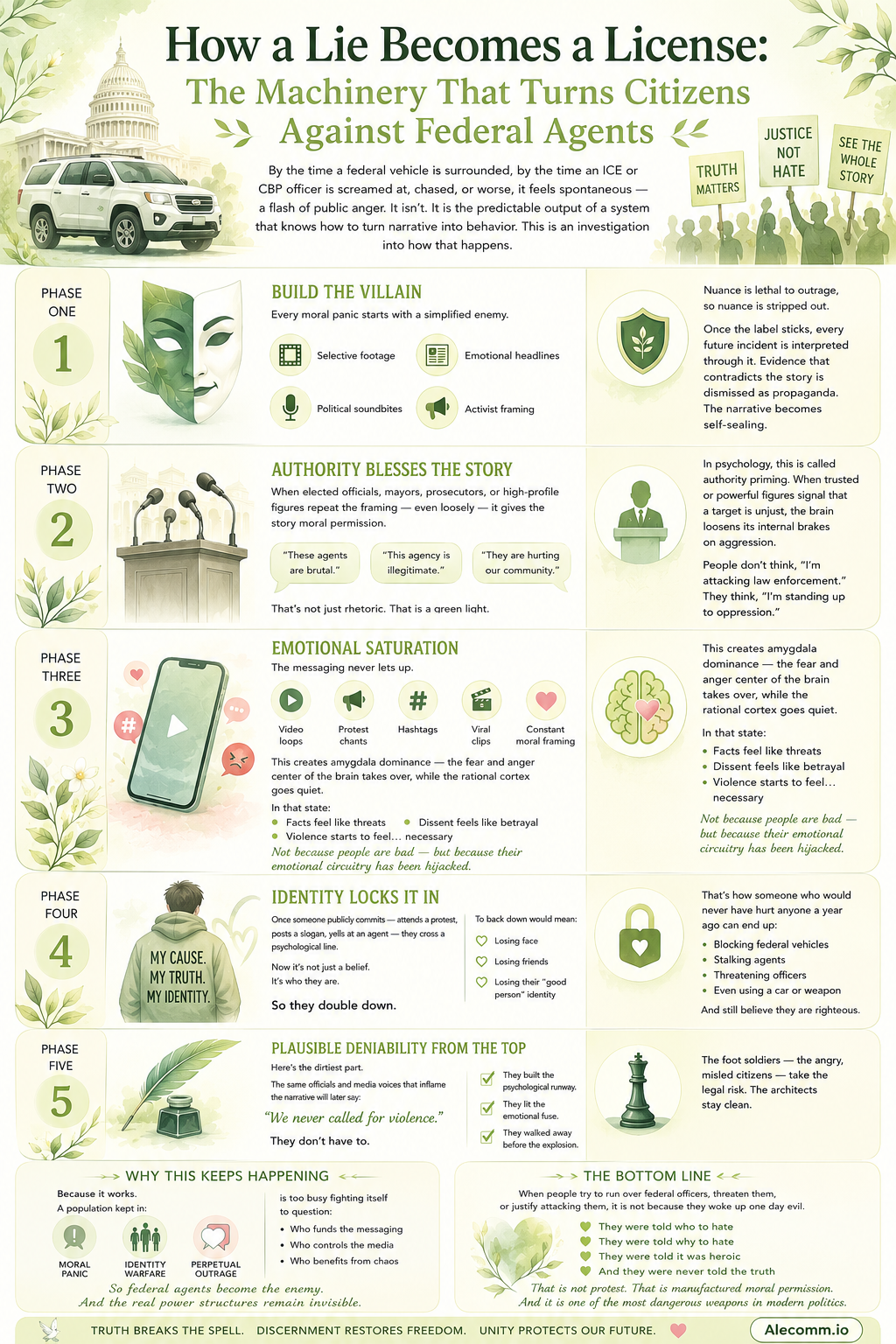
By the time a federal vehicle is surrounded, by the time an ICE or CBP officer is screamed at, chased, or worse, it feels spontaneous — a flash of public anger. It isn’t. It is the predictable output of a system that knows how to turn narrative into behavior.
This is an investigation into how that happens.
Phase One: Build the Villain
Every moral panic starts with a simplified enemy. Real-world agencies with complex mandates — border enforcement, human-trafficking interdiction, counter-smuggling, fugitive operations — are reduced to a single word: “evil.”
That reduction is achieved through:
- Selective footage
- Emotional headlines
- Political soundbites
- Activist framing
Nuance is lethal to outrage, so nuance is stripped out.
Once the label sticks, every future incident is interpreted through it. Evidence that contradicts the story is dismissed as propaganda. The narrative becomes self-sealing.
Phase Two: Authority Blesses the Story
When elected officials, mayors, prosecutors, or high-profile figures repeat the framing — even loosely — it gives the story moral permission.
People hear:
- “These agents are brutal.”
- “This agency is illegitimate.”
- “They are hurting our community.”
That’s not just rhetoric. That is a green light.
In psychology, this is called authority priming. When trusted or powerful figures signal that a target is unjust, the brain loosens its internal brakes on aggression.
People don’t think, “I’m attacking law enforcement.”
They think, “I’m standing up to oppression.”
Phase Three: Emotional Saturation
The messaging never lets up.
- Video loops
- Protest chants
- Hashtags
- Viral clips
- Constant moral framing
This creates amygdala dominance — the fear and anger center of the brain takes over, while the rational cortex goes quiet.
In that state:
- Facts feel like threats
- Dissent feels like betrayal
- Violence starts to feel… necessary
Not because people are bad —
but because their emotional circuitry has been hijacked.
Phase Four: Identity Locks It In
Once someone publicly commits — attends a protest, posts a slogan, yells at an agent — they cross a psychological line.
Now it’s not just a belief.
It’s who they are.
To back down would mean:
- Losing face
- Losing friends
- Losing their “good person” identity
So they double down.
That’s how someone who would never have hurt anyone a year ago can end up:
- Blocking federal vehicles
- Stalking agents
- Threatening officers
- Even using a car or weapon
And still believe they are righteous.
Phase Five: Plausible Deniability From the Top
Here’s the dirtiest part.
The same officials and media voices that inflame the narrative will later say:
“We never called for violence.”
They don’t have to.
They built the psychological runway.
They lit the emotional fuse.
They walked away before the explosion.
The foot soldiers — the angry, misled citizens — take the legal risk.
The architects stay clean.
Why This Keeps Happening
Because it works.
A population kept in:
- Moral panic
- Identity warfare
- Perpetual outrage
is too busy fighting itself to question:
- Who funds the messaging
- Who controls the media
- Who benefits from chaos
So federal agents become the enemy.
And the real power structures remain invisible.
The Bottom Line
When people try to run over federal officers, threaten them, or justify attacking them, it is not because they woke up one day evil.
It is because:
- They were told who to hate
- They were told why to hate
- They were told it was heroic
- And they were never told the truth
That is not protest.
That is manufactured moral permission.
And it is one of the most dangerous weapons in modern politics.
Leave a Reply