The LA Mayor’s Race And The Erosion Of Trust
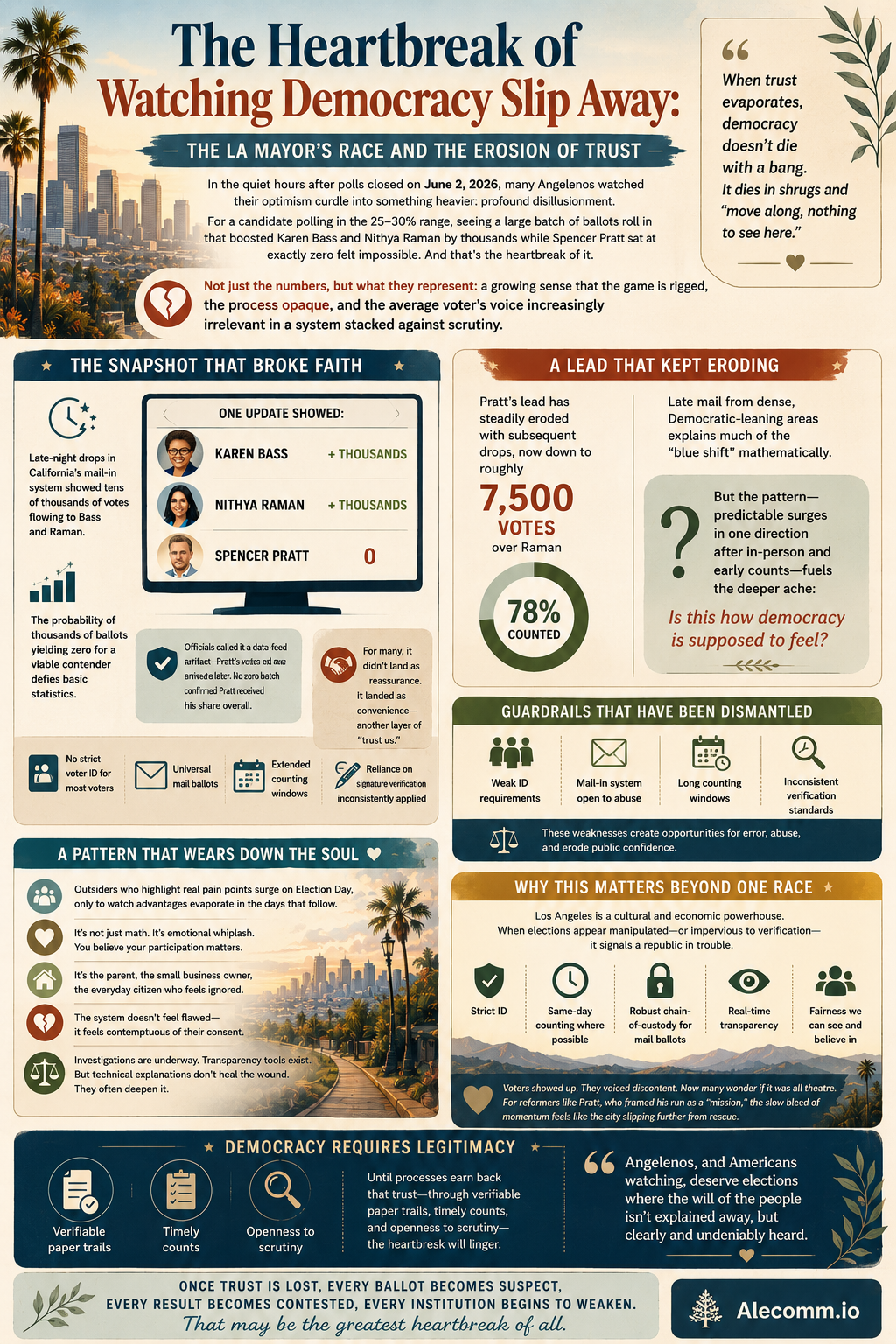
In the quiet hours after polls closed on June 2, 2026, many Angelenos who dared to hope for something different in the Los Angeles mayoral race watched their optimism curdle into something heavier:
PROFOUND DISILLUSIONMENT.
For supporters of Spencer Pratt — the reality TV star turned unlikely reformer who tapped into raw frustration over homelessness, crime, fires, and a city that feels increasingly ungovernable — one particular vote update felt like a gut punch.
A large batch of ballots rolled in, boosting Karen Bass and Nithya Raman by thousands while Pratt sat at exactly ZERO.
For a candidate polling in the 25–30% range, that visual was not just improbable.
IT FELT IMPOSSIBLE.
And that’s the heartbreak of it.
Not just the numbers, but what they represent:
A growing sense that the game is rigged, the process opaque, and the average voter’s voice increasingly irrelevant in a system stacked against scrutiny.
The Snapshot That Broke Faith
Early counts had Pratt in a strong position for second place, battling progressive Councilmember Raman for a spot in the November runoff against incumbent Bass.
Then came the late-night drops — classic in California’s mail-in heavy system.
One update showed tens of thousands of votes flowing heavily to Bass and Raman.
PRATT: ZERO.
Social media erupted.
The probability of thousands of ballots in a multi-candidate race yielding literally zero for a viable contender defies basic statistics, especially when early returns suggested broader support.
Officials and media quickly explained it as a data feed artifact — the Associated Press pulling updates in chunks, with Pratt’s portion arriving one minute later from the same ballots.
“No actual zero batch existed,” they said.
Raw data confirmed Pratt received his share overall.
Yet for many watching the screen, it didn’t land as reassurance.
IT LANDED AS CONVENIENCE.
Another layer of “trust us” in a state that has methodically dismantled guardrails:
The Guardrails Critics Say Have Been Removed
• No strict voter ID for most.
• Universal mail ballots.
• Extended counting windows.
• Reliance on signature verification that critics argue is inconsistently applied.
Pratt’s lead has steadily eroded with subsequent drops, now down to roughly 7,500 votes over Raman with about 78% counted.
Late mail from dense, Democratic-leaning areas explains much of the “blue shift” mathematically.
But the pattern — predictable surges in one direction after in-person and early counts — fuels the deeper ache:
IS THIS HOW DEMOCRACY IS SUPPOSED TO FEEL?
A Pattern That Wears Down The Soul
This isn’t isolated.
California’s elections have become synonymous with delayed results, urban clustering, and narratives that dismiss skepticism as conspiracy.
Voters see candidates like Pratt — outsiders highlighting real pain points like encampments, failing services, and post-fire recovery — surge on Election Day only to watch advantages evaporate in the days that follow.
IT’S NOT JUST MATH.
IT’S EMOTIONAL WHIPLASH.
You cast your vote, or advocate for change, believing your participation matters.
Then the process stretches on.
Updates trickle in under cover of night.
And explanations feel scripted.
The Heartbreak Is Personal
It’s the parent exhausted by crime and disorder wondering why reform voices get buried.
It’s the small business owner scraping by while bureaucracy balloons.
It’s the everyday citizen who turns on the news, sees the zero next to a name that represented their frustrations, and feels the system isn’t just flawed —
IT’S CONTEMPTUOUS OF THEIR CONSENT.
When trust evaporates, democracy doesn’t die with a bang.
It dies in shrugs and:
“Move along, nothing to see here.”
Federal prosecutors have opened investigations into election processes amid these concerns, and full canvassing continues toward certification.
Transparency tools like livestreamed counting and audits exist.
But in an era of eroded confidence, technical explanations for optical disasters don’t heal the wound.
THEY OFTEN DEEPEN IT.
Why This Matters Beyond One Race
Los Angeles isn’t just any city — it’s a cultural and economic powerhouse whose struggles ripple nationwide.
When elections appear manipulated, or at minimum, impervious to straightforward verification, it signals a republic in trouble.
People don’t want perfection.
THEY WANT FAIRNESS THEY CAN SEE AND BELIEVE IN.
What Voters Want
• Strict ID.
• Same-day counting where possible.
• Robust chain-of-custody for mail ballots.
• Real-time transparency.
These aren’t partisan asks.
They’re the bare minimum for a functioning system.
Watching this unfold is genuinely heartbreaking because it reveals how fragile faith in self-government has become.
Voters showed up, voiced discontent, and now wonder if it was theater.
For reformers like Pratt, who framed his run as a “mission” rather than a campaign, the slow bleed of momentum feels like the city slipping further from rescue.
Democracy Thrives On Legitimacy, Not Just Outcomes
Until processes earn back that trust — through verifiable paper trails, timely counts, and openness to scrutiny — the heartbreak will linger.
Angelenos, and Americans watching, deserve better than statistical anomalies and shrugged-off skepticism.
They deserve elections where the will of the people isn’t explained away, but clearly, undeniably heard.
The Bottom Line
ONCE TRUST IS LOST, EVERY BALLOT BECOMES SUSPECT.
EVERY RESULT BECOMES CONTESTED.
EVERY INSTITUTION BEGINS TO WEAKEN.
And that may be the greatest heartbreak of all.
Click here to review legislative initiatives designed to protect the integrity,
Leave a Reply