
The Squeeze On Australia’s Local Farmers: Consolidation, Closures, And Cheap Imports Undermining Rural Producers
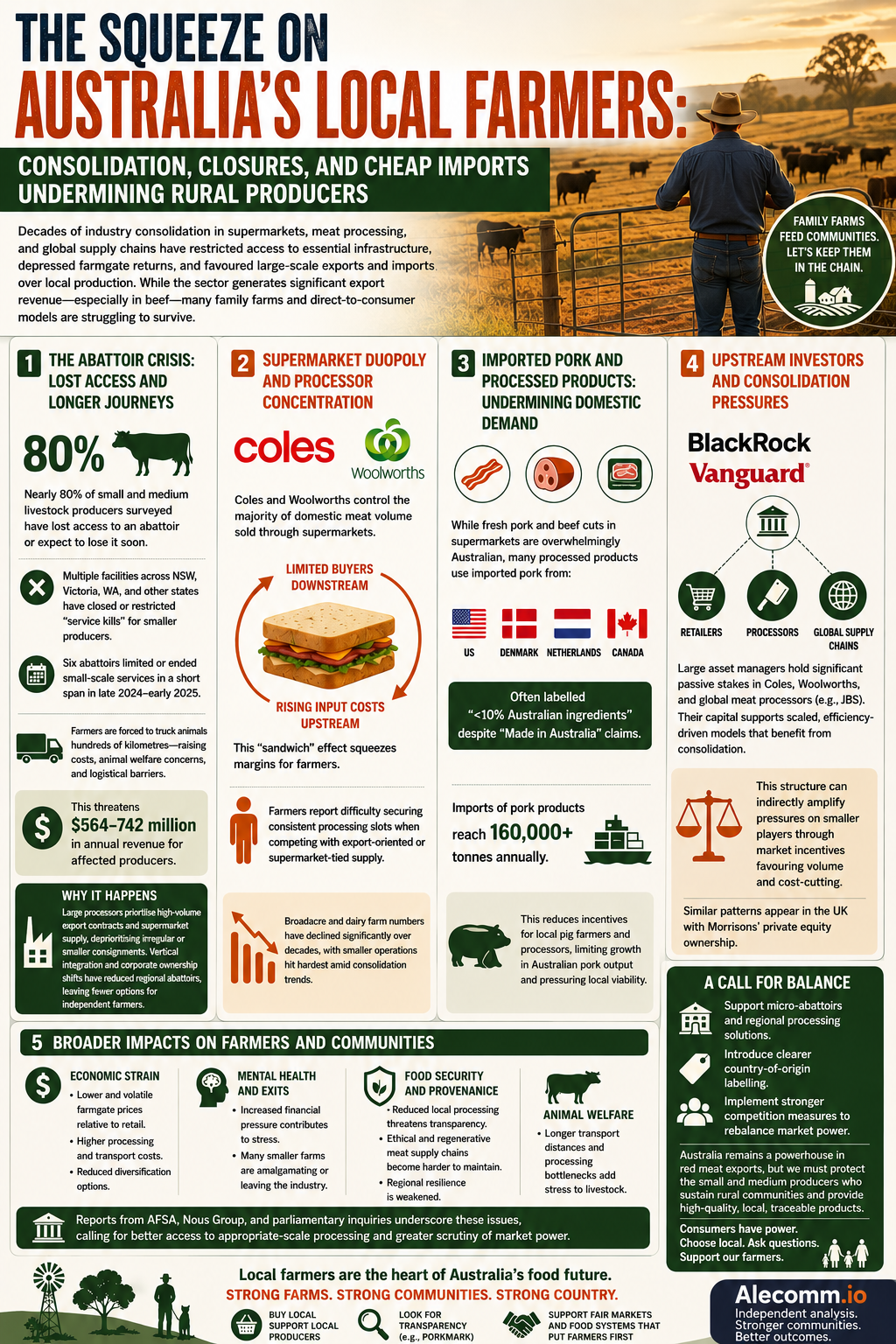
Australia’s farmers, particularly small and medium-sized livestock operations, are facing a deepening crisis. Decades of industry consolidation in supermarkets, meat processing, and global supply chains have restricted access to essential infrastructure, depressed farmgate returns, and favoured large-scale exports and imports over local production. While the sector generates significant export revenue—especially in beef—many family farms and direct-to-consumer models are struggling to survive.
The Abattoir Crisis: Lost Access And Longer Journeys
One of the most acute pressures is the loss of local slaughter capacity. Recent surveys by the Australian Farmers’ Market Association (AFSA) and others reveal alarming statistics:
- Nearly 80% of small and medium livestock producers surveyed have lost access to an abattoir or expect to lose it soon.
- Multiple facilities across NSW, Victoria, WA, and other states have closed or restricted “service kills” (processing for smaller, independent producers) in recent periods.
- Closures and restrictions have accelerated, with six abattoirs limiting or ending small-scale services in a short span in late 2024–early 2025.
This forces farmers to truck animals hundreds of kilometres, raising costs, animal welfare concerns, and logistical barriers. Many small producers lose the ability to supply premium, traceable, paddock-to-plate meat to local butchers, farmers’ markets, or direct customers. Estimates suggest this threatens $564–742 million in annual revenue for affected producers.
Large processors prioritise high-volume export contracts and supermarket supply, deprioritising irregular or smaller consignments that don’t fit industrial efficiency models. Vertical integration and corporate ownership shifts have reduced regional abattoirs, leaving fewer options for independent farmers.
Supermarket Duopoly And Processor Concentration
Coles and Woolworths dominate retail, controlling the majority of domestic meat volume sold through supermarkets. Their buyer power allows them to set terms that squeeze margins up the chain. Combined with concentrated processing (dominated by players like JBS Australia and others), this creates a “sandwich” effect on farmers—limited buyers downstream and rising input costs.
Farmers report difficulty securing consistent processing slots when competing with export-oriented or supermarket-tied supply. This has contributed to broader farm exits: broadacre and dairy farm numbers have declined significantly over decades, with smaller operations hit hardest amid consolidation trends.
Imported Pork And Processed Products: Undermining Domestic Demand
While fresh pork and beef cuts in supermarkets are overwhelmingly Australian (due to biosecurity rules), the story differs for processed items like bacon, ham, and smallgoods. A large share uses imported pork—primarily from the US, Denmark, Netherlands, and Canada—often resulting in labels showing “<10% Australian ingredients” despite “Made in Australia” claims.
This fills a gap where domestic production struggles to compete on price for high-volume processed markets. Critics argue it reduces incentives for local pig farmers and processors, limiting growth in Australian pork output while imports reach 160,000+ tonnes annually. Farmers and groups like Australian Pork Limited have highlighted how this dynamic pressures local viability, even as fresh meat remains domestic.
Upstream Investors And Consolidation Pressures
Large asset managers like BlackRock and Vanguard hold notable passive stakes in Coles, Woolworths, and global meat processors (e.g., JBS). As major shareholders across competitors, they sit high in the investment chain. While not directly managing operations or orchestrating closures, their capital allocation supports scaled, efficiency-driven models that benefit from consolidation. This structure can indirectly amplify pressures on smaller players through market incentives favouring volume and cost-cutting.
Similar patterns appear in the UK with Morrisons’ private equity ownership, reflecting a global trend in food retail and processing.
Broader Impacts On Farmers And Communities
Economic Strain
- Lower and volatile farmgate prices relative to retail.
- Higher processing and transport costs.
- Reduced diversification options.
Mental Health And Exits
- Increased financial pressure contributes to stress.
- Many smaller farms are amalgamating or leaving the industry altogether.
Food Security And Provenance
- Reduced local processing threatens transparency.
- Ethical and regenerative meat supply chains become harder to maintain.
- Regional resilience is weakened.
Animal Welfare
- Longer transport distances and processing bottlenecks add stress to livestock.
Reports from AFSA, Nous Group, and parliamentary inquiries underscore these issues, calling for better access to appropriate-scale processing and greater scrutiny of market power.
A Call For Balance
Australia remains a powerhouse in red meat exports, delivering consumer choice and economic value. However, the current trajectory risks hollowing out smaller producers who underpin rural communities and offer differentiated local products.
Reforms—such as supporting micro-abattoirs, introducing clearer country-of-origin labelling, and implementing stronger competition measures—could help restore balance without undermining efficiency gains.
Local farmers’ challenges highlight the growing tension between global scale and resilient domestic food systems. As consumers seek greater transparency through initiatives such as PorkMark and direct farm purchases, demand-side pressure may yet drive change.
For now, many producers are fighting to maintain their place in the chain.
Leave a Reply