
Captain Ibrahim Traoré’s Lesson For Australia: Time To Put Australians First In Our Resources
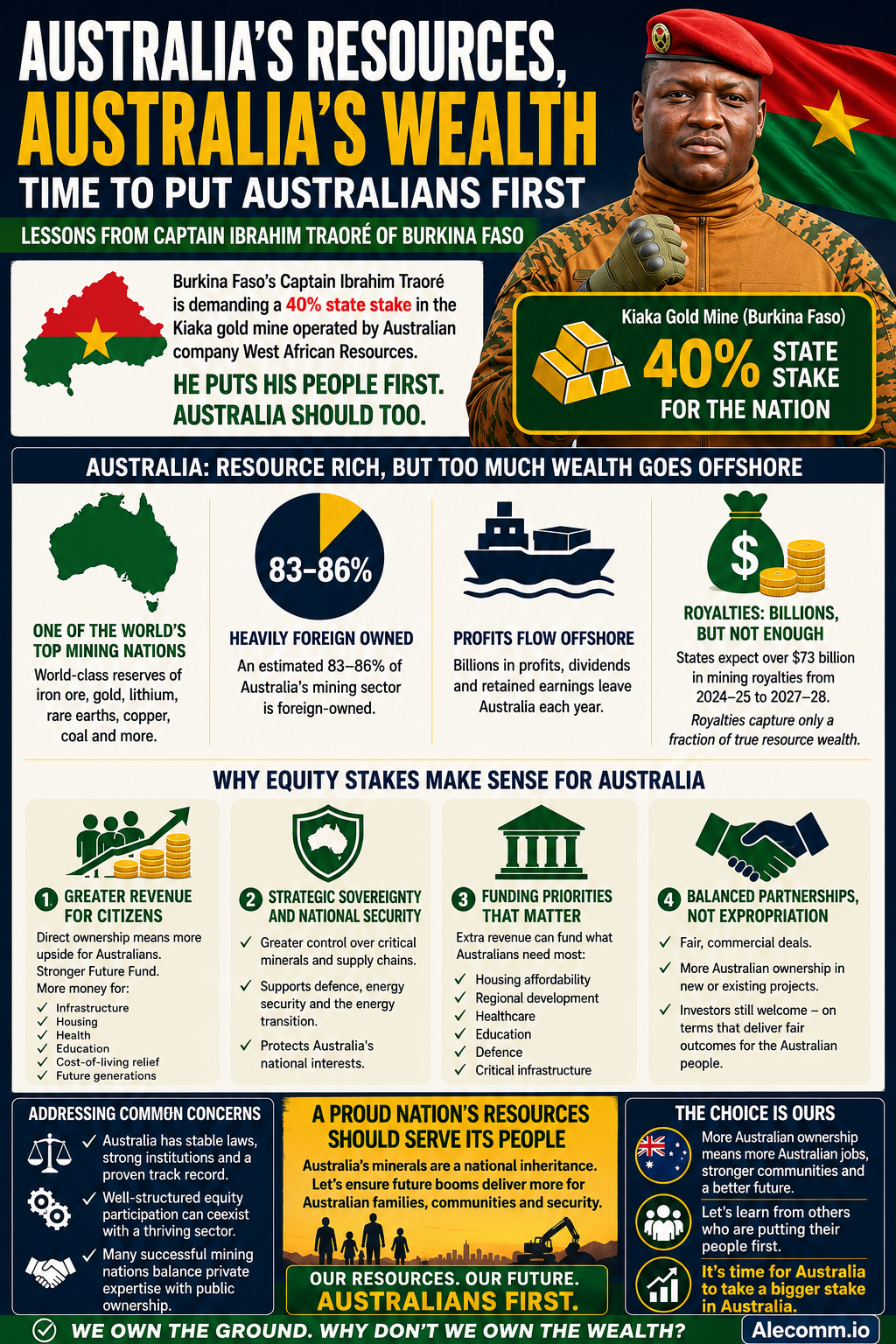
Captain Ibrahim Traoré of Burkina Faso is demonstrating a bold approach to resource sovereignty by pushing for a 40% state stake in the highly successful Kiaka gold mine, operated by Australian-listed West African Resources. His position is simple: a nation’s natural resources should deliver meaningful benefits to its own people, not merely generate profits for foreign investors.
Australia — one of the world’s greatest mining nations — should take note.
Our vast reserves of iron ore, gold, lithium, rare earths, coal, copper, and critical minerals represent an extraordinary national asset. Yet despite this immense wealth, many Australians are struggling with housing affordability, rising living costs, overloaded infrastructure, and declining economic security.
The question is obvious:
If Australia is one of the richest resource nations on Earth, why do so many Australians feel poorer every year?
Australia’s Mining Wealth Is World-Class, But Too Much Flows Offshore
Australia sits atop some of the richest mineral deposits on the planet. Mining generates enormous export earnings, supports high-paying jobs, and provides royalty income that helps fund state services.
However, the industry remains heavily foreign-owned, with estimates suggesting overseas interests control approximately 83–86% of the sector.
This means a significant share of profits, dividends, and retained earnings ultimately leaves Australia rather than being reinvested into Australian communities, infrastructure, and future prosperity.
Unlike Burkina Faso’s push for direct ownership, Australia primarily relies on royalties and company taxation to capture value from its non-renewable resources. While these mechanisms generate billions of dollars annually, they capture only a fraction of the true wealth created from resources that belong to the Australian people.
States are expected to collect more than $73 billion in mining royalties between 2024–25 and 2027–28, but royalties alone do not provide Australians with direct ownership of the enormous profits generated during commodity booms.
Why Equity Stakes Make Sense For Australia
Following Traoré’s example does not require nationalisation or hostility toward investors.
It simply means ensuring Australians receive a larger share of the wealth generated from Australian resources.
Greater Revenue For Citizens
Direct ownership stakes in major resource projects would allow Australia to share more fully in the success of high-performing mines.
Countries such as Norway have demonstrated how sovereign participation in resource industries can create long-term national wealth. Additional revenues could strengthen Australia’s Future Fund, helping finance:
- Infrastructure
- Housing
- Aged care
- Health services
- Education
- Cost-of-living relief
- Future generations’ retirement security
Instead of watching resource booms come and go, Australians could build lasting national wealth.
Strategic Sovereignty And National Security
Critical minerals are becoming increasingly important in a world shaped by geopolitical competition, supply chain vulnerabilities, and energy transition requirements.
Lithium, rare earth elements, cobalt, copper, and other strategic minerals will underpin future technologies, defence systems, and advanced manufacturing.
Greater Australian ownership would provide stronger influence over:
- Strategic supply chains
- Export priorities
- National security interests
- Domestic processing opportunities
- Energy transition planning
In an era where foreign influence is a growing concern, retaining greater control over strategic assets is simply prudent policy.
Funding Priorities That Matter
Resource wealth could help address many of Australia’s most pressing challenges without imposing additional burdens on taxpayers.
Additional revenues could support:
- Housing affordability initiatives
- Regional development
- Health services
- Education systems
- Defence capabilities
- Critical infrastructure
Burkina Faso has linked resource ownership to national development and security. Australia could do exactly the same.
Balanced Partnerships, Not Expropriation
This is not an argument for confiscation or anti-business policies.
International investment has played a major role in developing Australia’s mining industry and remains important.
However, future projects could be structured to include greater Australian participation through:
- Government equity stakes
- Sovereign wealth fund investments
- Strategic public-private partnerships
- Increased Australian institutional ownership
Foreign investors would still earn substantial returns, but Australians would receive a fairer share of the benefits generated from their own natural resources.
Addressing Common Concerns
Critics often argue that increased government involvement would deter investment or create inefficiencies.
These concerns are frequently overstated.
Australia offers:
- Strong property rights
- Stable government
- Independent courts
- Reliable regulations
- World-class geological resources
These advantages make Australia one of the safest mining destinations on Earth.
Well-designed equity participation can coexist with a thriving private sector, as demonstrated in numerous resource-producing nations around the world.
The choice is not between free markets and government ownership.
The real question is whether Australians should receive a larger share of the wealth generated from assets they collectively own.
A Proud Nation’s Resources Should Serve Its People
Captain Ibrahim Traoré’s focus on resource sovereignty reflects a straightforward principle:
A nation’s natural wealth should primarily benefit its citizens.
Australia possesses greater stability, stronger institutions, superior infrastructure, and vastly larger resource reserves than Burkina Faso. If resource sovereignty can be pursued there, it can certainly be pursued here.
Australia’s minerals are not renewable.
Once they are extracted and exported, they are gone forever.
That reality creates a responsibility to ensure current and future generations receive the greatest possible benefit from these finite national assets.
Whether through targeted equity participation, stronger sovereign wealth funds, enhanced resource rent capture, or new ownership models, Australia has an opportunity to ensure future mining booms deliver more than temporary export figures.
They can deliver lasting prosperity.
The Kiaka mine serves as a timely reminder.
While Burkina Faso is working to secure a larger share of the wealth beneath its soil, Australia should be asking whether we are doing enough to secure the same outcome for our own people.
A responsible, transparent, and strategic form of resource nationalism is not radical.
It is simply the recognition that Australian resources should work first and foremost for Australian families, Australian communities, and Australia’s future.
Leave a Reply