
The Tick Timeline: Questions Mount Over Engineered Vectors, Alpha-Gal Syndrome, and Synthetic Solutions
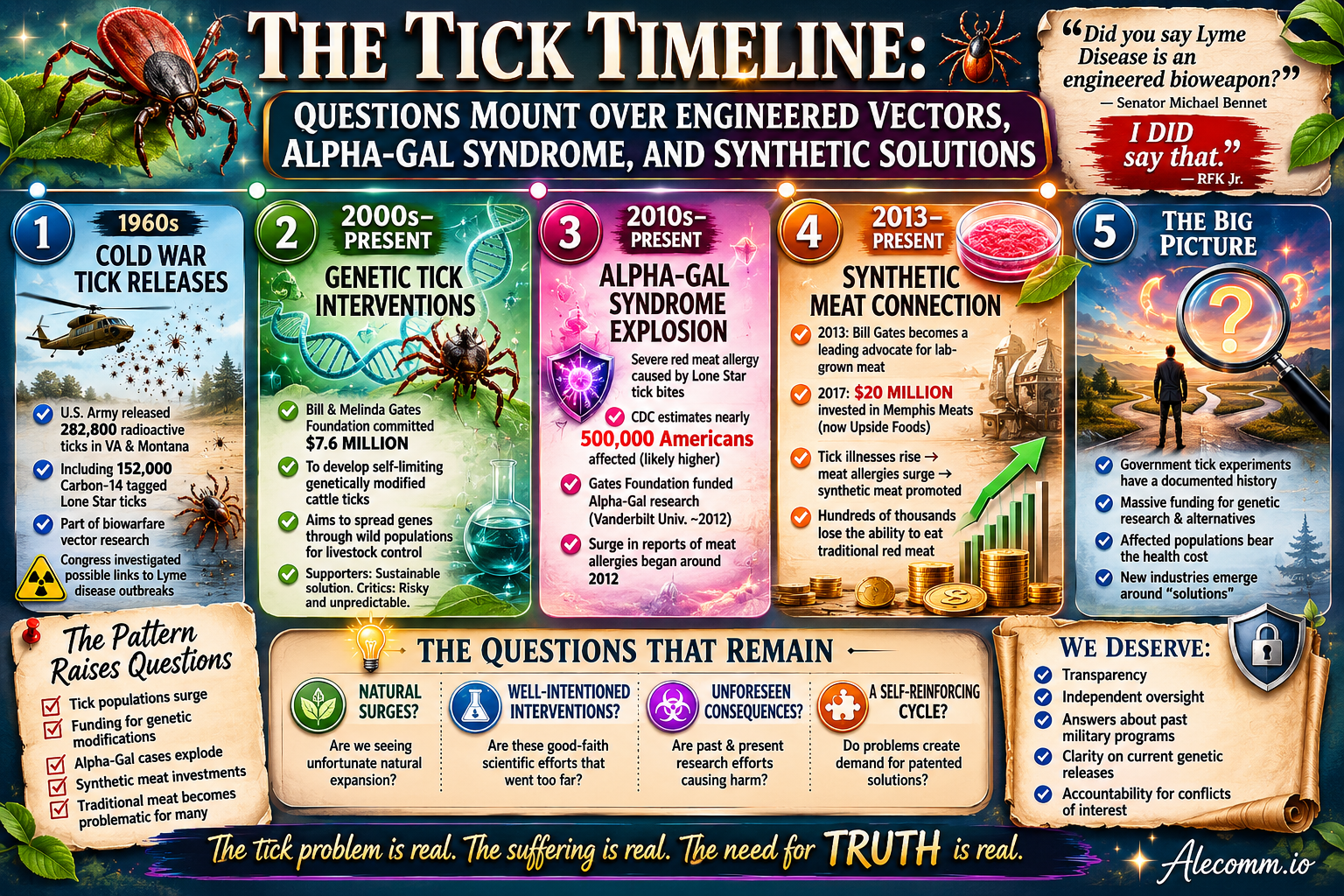
In a recent exchange, U.S. Senator Michael Bennet pressed RFK Jr.:
“Did you say Lyme Disease is an engineered bioweapon?”
RFK Jr. replied:
“I DID say that.”
Whether one accepts the strongest interpretations or not, documented history raises uncomfortable questions about ticks, government experiments, private funding, and emerging public health concerns.
Cold War Tick Releases
During the 1960s, the U.S. Army conducted open-air tests involving the release of 282,800 radioactive ticks across areas of Virginia and Montana to study dispersal rates and evaluate their potential use in biological warfare research.
These experiments reportedly included approximately 152,000 Carbon-14 tagged Lone Star ticks—the same species now most commonly associated with Alpha-Gal Syndrome.
Detailed in works such as Bitten by Kris Newby and referenced in congressional discussions, these programs formed part of a broader effort to examine insects and arthropods as potential delivery vectors. Congress later directed the Pentagon to investigate possible links between military tick research and the emergence of Lyme disease outbreaks, although official findings have generally rejected direct causation.
The historical record nevertheless confirms that governments explored the use of ticks and other insects within biological warfare programs, a fact that continues to fuel public concern and speculation.
Modern Genetic Interventions
Fast-forward several decades and a new chapter emerges.
The Bill & Melinda Gates Foundation committed approximately $7.6 million toward the development of self-limiting genetically modified cattle ticks designed to spread targeted genes through wild populations as a method of livestock pest control.
Supporters describe the technology as an innovative and environmentally sustainable approach to managing tropical cattle ticks (Rhipicephalus microplus), reducing reliance on chemical treatments and improving animal health.
Critics, however, argue that the project establishes a precedent for the release of genetically modified organisms into complex ecosystems, raising questions about long-term ecological impacts, containment, unintended consequences, and regulatory oversight.
Alpha-Gal Syndrome Explosion
At the same time, Alpha-Gal Syndrome (AGS) has emerged as one of the most unusual and rapidly growing tick-borne conditions in modern medicine.
Triggered primarily by bites from the Lone Star tick, AGS can cause severe allergic reactions to red meat and mammalian-derived products. For many sufferers, the condition leads to permanent dietary restrictions and significant lifestyle changes.
CDC estimates suggest that nearly half a million Americans may be affected, with researchers acknowledging that the true number could be considerably higher due to underdiagnosis and limited awareness among healthcare providers.
Interest in Alpha-Gal research has expanded significantly over the last decade. The Gates Foundation has funded research involving Alpha-Gal and related immunological mechanisms, including work at Vanderbilt University dating back to approximately 2012—around the same period that reports of tick-induced meat allergies began receiving wider attention.
The Synthetic Meat Connection
In 2013, as public awareness of tick-borne illnesses and Alpha-Gal Syndrome increased, Bill Gates became one of the most prominent advocates for alternative protein technologies and lab-grown meat.
By 2017, investments reportedly reached $20 million in companies such as Memphis Meats, now known as Upside Foods.
For skeptics, the sequence of events appears noteworthy:
- Tick populations and tick-borne illnesses continue expanding across large regions.
- Alpha-Gal Syndrome cases rise dramatically.
- Funding supports both genetic tick research and Alpha-Gal-related studies.
- Significant investment flows into synthetic and cultivated meat industries.
- Hundreds of thousands of people develop conditions that make traditional red meat difficult or impossible to consume.
Whether these developments are connected or entirely unrelated remains the subject of ongoing debate.
Business Model Or Coincidence?
This timeline has fueled calls for greater scrutiny.
Governments have a documented history of conducting insect-vector experiments. Wealthy philanthropic organizations routinely fund biological research, genetic interventions, and alternative food technologies. Meanwhile, affected populations often bear the immediate health consequences while new industries emerge around treatment, mitigation, or replacement solutions.
RFK Jr.’s comments, regardless of whether they are ultimately proven correct, tap into a broader public concern about transparency, accountability, and conflicts of interest.
When public health challenges, scientific research, government programs, and commercial opportunities appear to intersect, many citizens believe rigorous independent oversight is essential.
The Questions That Remain
The tick problem is real.
The suffering associated with Lyme disease, Alpha-Gal Syndrome, and other tick-borne illnesses is undeniable.
What remains unresolved for many observers is whether these developments represent:
- Natural ecological changes and disease expansion.
- Well-intentioned scientific interventions addressing emerging problems.
- Unforeseen consequences of past and present biological research.
- Or elements of a broader cycle in which new problems create demand for patented solutions.
The public deserves transparency regarding historical military programs, modern genetic intervention projects, funding relationships, and decision-making processes that influence public health policy.
Greater scrutiny, open debate, and independent investigation are not threats to science—they are essential components of public trust.
Leave a Reply