
Transparency, Water Security, And The Tinaroo Dam Controversy
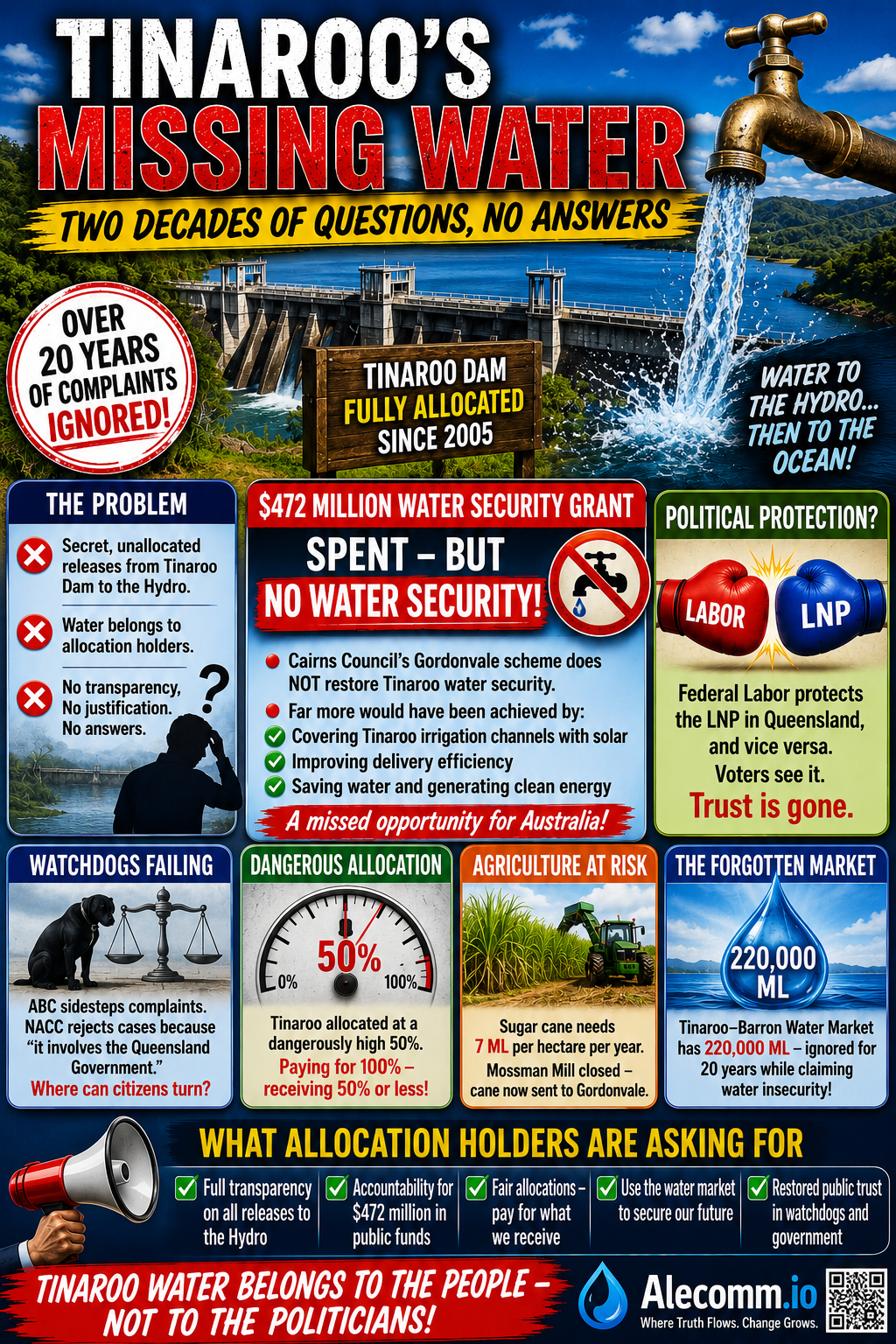
For more than two decades, serious questions have been raised about water management, transparency, and accountability within the Cairns–Tinaroo water system. According to long-time Tinaroo Dam allocation holder Don, who held water allocations from 1989 until 2018, governments, regulators, watchdog agencies, and the media have repeatedly failed to address concerns that continue to affect water users across the region.
Water Releases And Questions Of Transparency
At the centre of the controversy are claims that water from the fully allocated Tinaroo Dam has been released to the Barron River Hydro Scheme without adequate public transparency.
Tinaroo Dam has been fully allocated since 2005, meaning all available water entitlements are already owned by allocation holders. Despite this, allegations persist that significant volumes of water have been released through the hydroelectric system without clear public explanation, raising concerns among those who paid for and depended upon those allocations.
Critics argue that these releases have contributed to ongoing concerns about water security throughout the region. Water passing through the hydro scheme ultimately flows downstream and out to sea near Cairns, leading some allocation holders to question whether valuable water resources are being managed in the long-term interests of agriculture, regional development, and future water security.
The $472 Million Question
The debate has intensified following Cairns Regional Council’s use of a $472 million Water Security Grant on infrastructure at Gordonvale.
Opponents of the project argue that the investment does little to restore the security of the Tinaroo water system itself. Alternative proposals, including improving irrigation efficiency and covering major irrigation channels with solar infrastructure, have been suggested as potentially more effective long-term investments that could simultaneously:
- Reduce water losses
- Improve delivery efficiency
- Generate renewable energy
- Strengthen long-term water security
For critics, the fundamental question remains:
How can a project be labelled a water security solution if it does not improve the security of the region’s primary water storage system?
Political Accountability Under Scrutiny
The issue also highlights broader concerns regarding political accountability and oversight.
Some regional stakeholders believe both major political parties have failed to properly scrutinise water management decisions. Frustration has grown among residents who see little distinction between state and federal responses when concerns are raised about transparency and governance.
Many voters increasingly view the relationship between the major parties as one of mutual protection rather than genuine accountability, particularly when contentious state and federal issues intersect.
Questions About Oversight Bodies
Further controversy surrounds the operation of the National Anti-Corruption Commission (NACC).
Complaints relating to water management and government decision-making have reportedly been rejected on jurisdictional grounds because they involve Queensland Government matters.
For many residents, this response has reinforced perceptions that existing oversight mechanisms are either unable or unwilling to investigate matters of significant public interest.
The rejection of complaints on technical jurisdictional grounds has only deepened concerns about whether Australians have any effective avenue for independent scrutiny when governments fail to adequately explain their actions.
The Burden On Allocation Holders
The Tinaroo irrigation scheme remains critical to Far North Queensland agriculture.
The dam is currently managed under a Nominal Allocation System, with annual allocations often set at around 50 per cent. However, allocation holders continue to pay for 100 per cent of their entitlement, regardless of the volume ultimately made available.
Critics argue this creates a situation where water users bear the financial burden while receiving reduced access to the resource they have purchased.
In practical terms, allocation holders can find themselves paying full costs while receiving only a fraction of the water they are entitled to use.
The Importance Of Water To Agriculture
The region’s agricultural economy depends heavily on sugar cane production, a crop requiring substantial annual water inputs.
Industry estimates place water requirements at approximately 7 megalitres per hectare per year, making reliable access to irrigation water essential for growers.
The closure of the Mossman Sugar Mill and the subsequent concentration of cane processing at Gordonvale have further increased the importance of secure and reliable water supplies for growers across the Tablelands.
Without certainty of supply, agricultural productivity, investment confidence, and regional employment all face increased pressure.
The Forgotten Water Market
Underlying the debate is Australia’s broader water reform framework.
Reforms introduced under the Howard Government and adopted by the Beattie Government separated water entitlements from land ownership, creating water markets intended to allow water to move toward its highest-value use.
The Tinaroo–Barron Water Market now contains approximately 220,000 megalitres of tradeable water entitlements.
Critics question why this market has not been more actively utilised to address Cairns’ long-standing claims of water insecurity.
After two decades of warnings about future shortages, many are asking why available market mechanisms have not been used more aggressively before committing hundreds of millions of taxpayer dollars to new infrastructure projects.
A Crisis Of Trust
For many residents and water users, the issue is no longer simply about water.
It is about transparency, accountability, public trust, and confidence in institutions that are supposed to safeguard both public resources and public interests.
After years of unanswered questions, rejected complaints, and disputed water management decisions, confidence in oversight bodies has steadily eroded.
As pressures on Australia’s water systems continue to grow, calls for greater scrutiny of water allocations, infrastructure spending, government decision-making, and regulatory oversight are unlikely to disappear.
For those who have spent decades raising these concerns, the central question remains unanswered:
Who is ultimately accountable for ensuring that publicly managed water resources are used transparently, efficiently, and in the best interests of the communities that depend on them?
Leave a Reply