Peer-Reviewed Paper Argues for Genetically Engineering Ticks to Spread Meat Allergies as “Moral Bioenhancement”
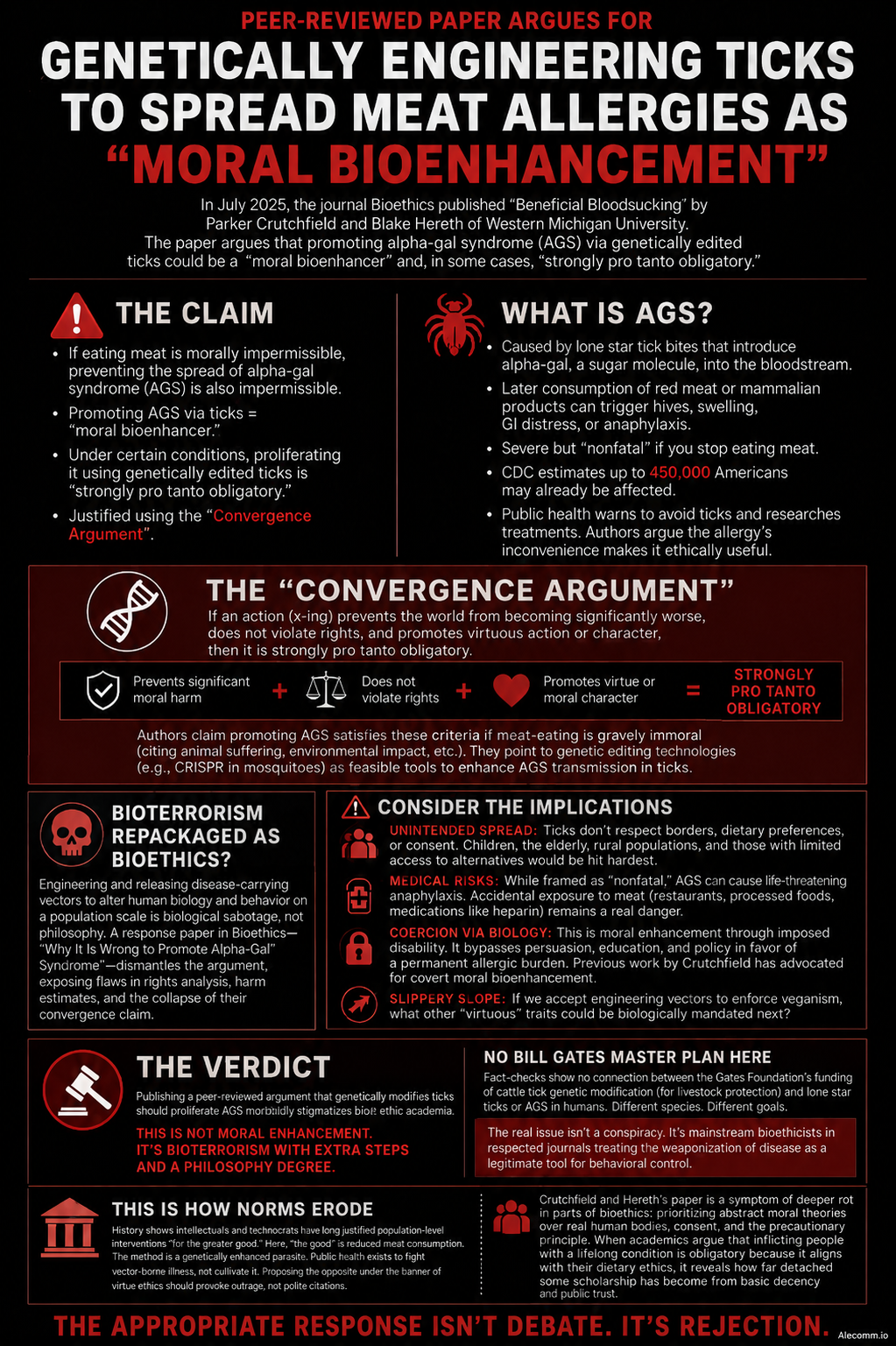
In July 2025, the journal Bioethics published a paper titled “Beneficial Bloodsucking” by Parker Crutchfield and Blake Hereth, academics affiliated with Western Michigan University.
The abstract lays out their core claim plainly: If eating meat is morally impermissible, then efforts to prevent the spread of alpha-gal syndrome (AGS)—the red meat allergy caused by lone star tick bites—are also impermissible. They go further, arguing that promoting tickborne AGS could function as a “moral bioenhancer” and that, under certain conditions, proliferating it via genetically edited ticks is “strongly pro tanto obligatory.”
What Is Alpha-Gal Syndrome?
AGS is triggered when a lone star tick bite introduces the sugar molecule alpha-gal into the human bloodstream, prompting an immune response. Subsequent consumption of red meat (beef, pork, lamb) or mammalian products can cause hives, swelling, gastrointestinal distress, or anaphylaxis. It is described as severe but “nonfatal” if one simply stops eating meat. The CDC estimates that as many as 450,000 Americans may already be affected.
Public health authorities currently warn people to avoid these ticks and researchers explore ways to treat or prevent AGS. Crutchfield and Hereth invert this: the allergy’s inconvenience for meat-eaters makes it ethically useful.
The “Convergence Argument”
The authors defend what they call the Convergence Argument: If an action (x-ing) prevents the world from becoming significantly worse, does not violate rights, and promotes virtuous action or character, then it is strongly pro tanto obligatory. They claim promoting AGS satisfies these criteria under the assumption that meat-eating is gravely immoral (citing animal suffering, environmental impact, etc.).
They note existing genetic editing capabilities in ticks (referencing CRISPR work on other species like mosquitoes) and suggest it could be applied to enhance AGS transmission.
Bioterrorism Repackaged as Bioethics?
Deliberately engineering and releasing disease-carrying vectors to alter human biology and behavior on a population scale sounds less like academic philosophy and more like biological sabotage. Critics have rightly called this out as dystopian. A subsequent response paper in Bioethics titled “Why It Is Wrong to Promote Alpha-Gal Syndrome” dismantles the argument, pointing out flaws in the rights analysis, the underestimation of harms, and the collapse of their convergence claim.
Consider the implications:
- Unintended spread: Ticks don’t respect borders, dietary preferences, or consent. Children, the elderly, people in rural areas, and those with limited access to alternatives would be hit hardest.
- Medical risks: While framed as “nonfatal,” AGS can cause life-threatening anaphylaxis. Accidental exposure to meat products (in restaurants, processed foods, medications like heparin) remains a real danger.
- Coercion via biology: This is moral enhancement through imposed disability. It bypasses persuasion, education, or policy in favor of a permanent allergic burden. Previous work by Crutchfield has advocated for covert moral bioenhancement, raising deeper concerns about transparency and autonomy.
- Slippery slope: If we accept engineering vectors to enforce veganism, what other “virtuous” traits could be biologically mandated next?
The paper frames itself as a thought experiment challenging assumptions about health and morality. One author reportedly clarified it does not call for immediate tick releases. Yet publishing a peer-reviewed argument that genetically modified ticks should proliferate AGS normalizes the idea in elite academic circles.
No Bill Gates Master Plan Here
Some online commentary links this to broader conspiracy narratives involving Bill Gates and tick research. Fact-checks show no connection between the Gates Foundation’s funding of cattle tick genetic modification programs (aimed at livestock protection in Africa/elsewhere) and lone star ticks or AGS in humans. Those are different tick species.
The real issue isn’t a shadowy billionaire plot. It’s mainstream bioethicists in respected journals treating the weaponization of disease as a legitimate tool for behavioral control.
This Is How Norms Erode
History shows intellectuals and technocrats have long justified population-level interventions for “the greater good.” Here, the “good” is reduced meat consumption. The method is a genetically enhanced parasite. Public health infrastructure exists to fight vector-borne illness, not cultivate it. Proposing the opposite under the banner of virtue ethics should provoke outrage, not polite citations.
Crutchfield and Hereth’s paper is a symptom of deeper rot in parts of bioethics: prioritizing abstract moral theories over real human bodies, consent, and the precautionary principle. When academics argue that infecting people with a lifelong condition is obligatory because it aligns with their dietary ethics, it reveals how far detached some scholarship has become from basic decency and public trust.
The appropriate response isn’t debate on the margins of their convergence argument. It’s rejection. Deliberately engineering ticks to spread allergies isn’t moral enhancement. It’s bioterrorism with extra steps and a philosophy degree.
Leave a Reply