
Carcasses Don’t Belch: The Case Against Live Export
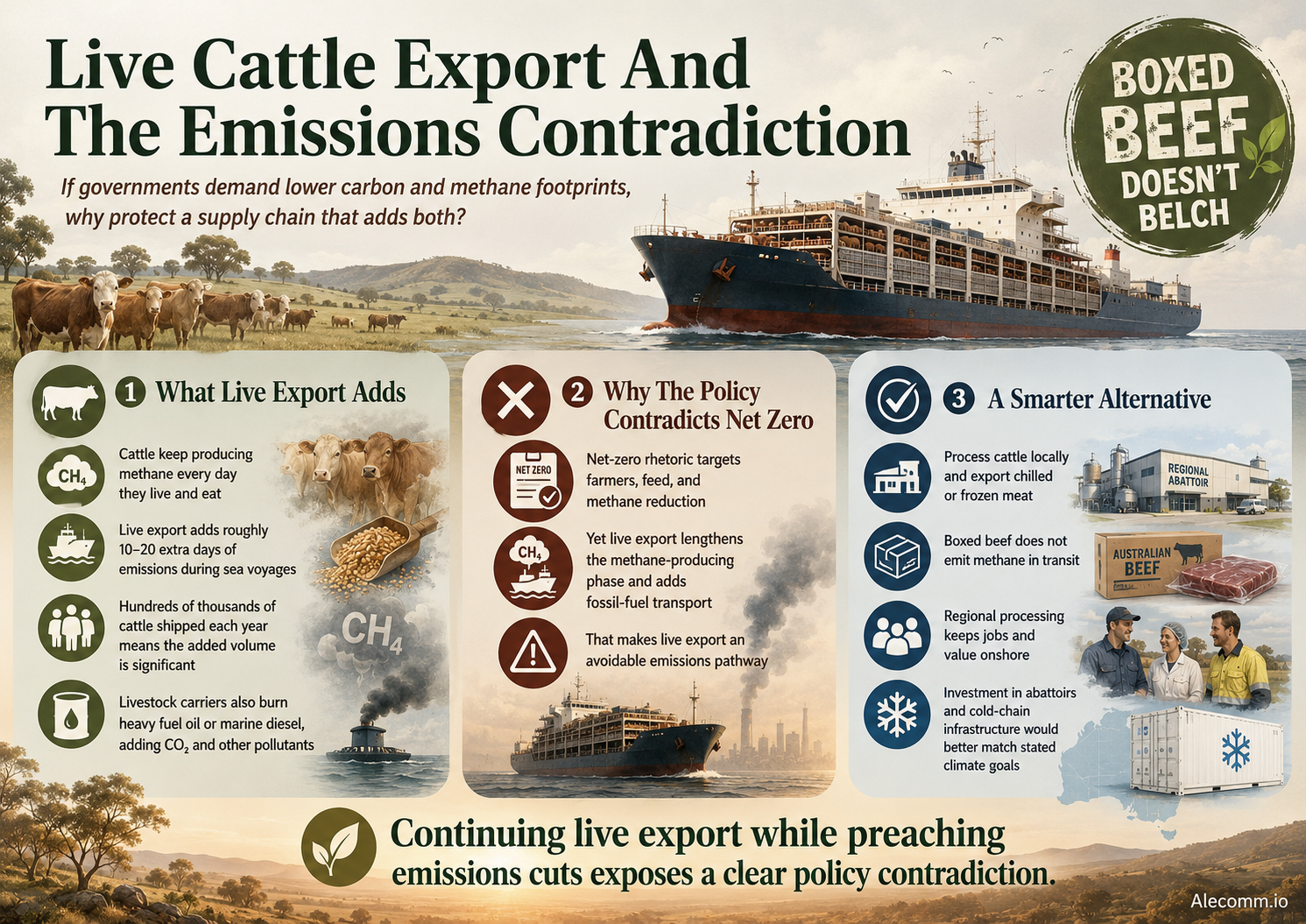
Governments and global bodies demand drastic cuts to humanity’s carbon and methane footprint.
They impose net-zero targets, methane taxes, feed regulations, and “sustainable” agriculture rules.
Yet they actively enable and subsidise live cattle exports — a practice that directly inflates emissions through unnecessary long-distance animal transport.
Cattle produce methane via enteric fermentation every day they live and eat. On farms or feedlots, this is already counted in national inventories. Live export adds weeks of extra production while animals are fed aboard ships.
A voyage from northern Australia to Indonesia or Vietnam keeps methane flowing for 10–20 days per shipment. Multiply that by hundreds of thousands of head annually, and the added volume is real, measurable, and avoidable.
Shipping compounds the problem.
Large livestock carriers burn heavy fuel oil or marine diesel, releasing CO2, black carbon, and other pollutants. These vessels are not low-emission. The fuel burned and the methane emitted during transit represent pure waste if the same cattle could be slaughtered locally and the meat exported chilled or frozen.
Carcasses and boxed beef do not belch methane en route.
This directly contradicts the “overlords’” stated goal of footprint reduction.
If total livestock emissions must fall, why permit a supply chain that deliberately lengthens the methane-producing life phase and adds fossil-fuel transport?
Local processing followed by meat export shortens that phase, captures value domestically, creates regional jobs, and removes the ship-borne methane and fuel burden.
Pasture-based systems in Australia already show lower emissions intensity per kilogram than long-fed feedlot models pushed by corporate interests.
The policy is inconsistent at best and captured at worst.
Public resources and regulatory tolerance flow to large vertically integrated operators and feedlot expansion while family-scale, grass-fed producers face higher costs and lost markets.
Net-zero rhetoric is used to justify restrictions on small farmers, yet the highest-emission live-export pathway remains protected.
This is not coherent climate policy.
It is selective enforcement that favours scale and distance over efficiency and locality.
A credible footprint-reduction agenda would end live cattle exports.
It would redirect support toward regional abattoirs, cold-chain infrastructure, and value-added meat exports.
That single change removes avoidable methane and fuel emissions, keeps economic activity onshore, and aligns action with the stated demand to shrink humanity’s global footprint.
Continuing live export while preaching emissions cuts exposes the contradiction at the heart of current policy.
Leave a Reply