
Opening The Gate To US Beef While Undercutting Australian Farmers
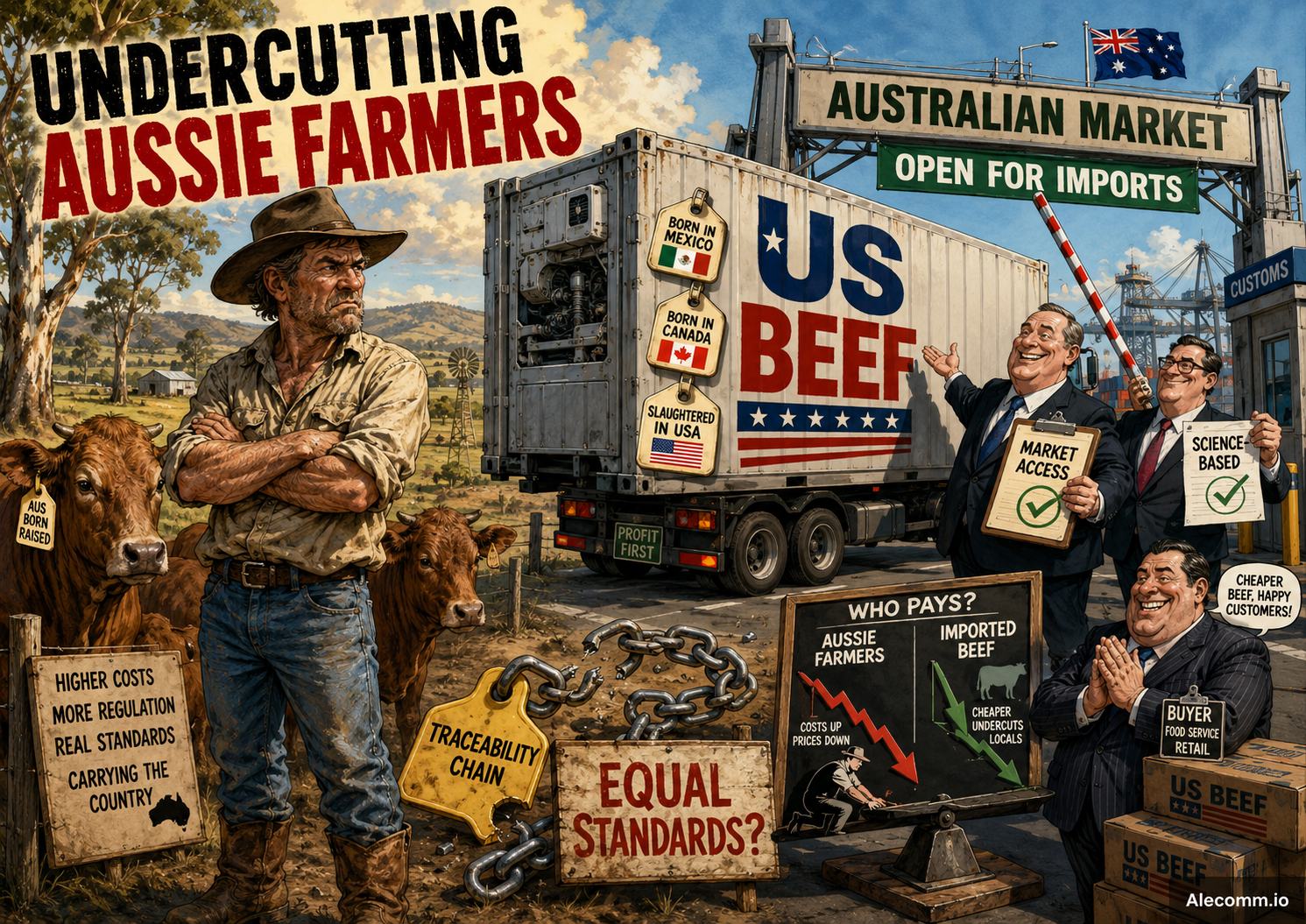
Australia is one of the best beef-producing nations on earth. We have the land, the cattle, the traceability systems, the farmers, the regional skill base, and the reputation. So why are Australian governments even entertaining a pathway that lets North American beef enter our market through the United States while local producers are battling costs, compliance, biosecurity pressure, and market concentration?
This is the question that should be asked loudly. The issue is not whether Americans can produce beef. They can. The issue is whether Australia should weaken the position of its own farmers by allowing imported beef into a market already supplied by Australian producers, while our own cattlemen and women are told to absorb higher costs, stricter rules, climate demands, biosecurity levies, transport pressure, and supermarket power.
That is not free trade. That is managed disadvantage.
The Real Issue Is Traceability
In 2025, Australia moved to allow more access for US beef, including beef from cattle born in Canada or Mexico, legally imported into the United States, slaughtered there, and then potentially exported here.
That matters because the old Australian concern was not simply “US beef.” It was traceability. It was whether an animal born outside the United States could be followed to a standard equivalent to what Australian farmers are expected to meet.
Australian producers live under strict identification, movement, animal health, residue, welfare, and biosecurity systems. Those systems cost money. They take time. They create paperwork. They are used to justify Australia’s premium reputation.
So if imported beef enters under a looser or less transparent chain, Australian farmers are not competing on equal terms. They are competing against product that may not carry the same cost burden, while being told to smile and call it market access.
That is how local industries get hollowed out.
Show Australians The Chain
The government says biosecurity is not being compromised. Fine. Then show Australians every part of the chain.
Show the inspection standard. Show the equivalence test. Show how Mexican-born or Canadian-born cattle moved into the US are traced, verified, slaughtered, certified, and separated. Show how the system is audited. Show who pays if something goes wrong.
Because Australian farmers know exactly who pays when government makes a trade decision and calls it “science-based” after the politics has already lined up.
A Pressure Play, Not A Partnership
The timing also stinks. The United States has been under pressure because its own cattle herd has been tight after drought and herd reduction. Australia has been supplying the US with large volumes of beef because American processors need product, especially lean beef for grinding and blending.
In other words, Australian beef is helping fill a US supply problem. Yet while Australian beef helps the US market, Australia is being pushed to open its own market to US-linked product.
That is not a partnership. That is a pressure play.
The Undercutting Will Not Always Be Obvious
Imported US beef is unlikely to beat Australian beef on quality, freshness, trust, or consumer loyalty. Australians overwhelmingly eat Australian beef because it is better suited to our market and because people trust it.
The danger is not necessarily that premium US steaks suddenly take over the butcher window. The danger is that imported product quietly slips into food service, processed meals, institutional supply, cheap mince channels, catering contracts, private-label products, and bulk blended supply chains.
That is where undercutting happens. Not with a cowboy hat and a flag on the packet. With vague labelling, bulk contracts, blended supply, and price pressure that flows backwards to the farm gate.
Equal Standards Or No Deal
If Australian farmers are forced to comply with higher standards, then imported beef should meet equal or higher standards.
Not “close enough.” Not “equivalent on paper.” Not “trusted because an overseas agency said so.”
Equal. Auditable. Transparent. Enforced.
Australia should not be importing beef to discipline local prices while pretending to support farmers. We should be backing Australian cattle producers, investing in regional processing, strengthening local supply chains, and making sure Australian beef remains Australian from paddock to plate.
What A Proper National Beef Policy Would Do
A serious national beef policy would protect strict country-of-origin labelling across supermarkets, butchers, food service, processed meals, catering, hospitals, schools, prisons, and aged care. Consumers deserve to know when they are eating Australian beef and when they are not.
It would require full traceability equivalence for all imported beef. If Australian farmers must prove where an animal came from, where it moved, and how it was handled, imported beef should meet the same standard. Not a watered-down overseas equivalent. The same standard.
It would also prioritise Australian procurement. Public institutions should not be using taxpayer money to buy imported beef while Australian farmers are fighting to survive. Hospitals, schools, defence, aged care, prisons, and government-funded catering should prioritise Australian beef wherever possible.
Most importantly, it would build more domestic processing capacity: regional abattoirs, boning rooms, cold-chain infrastructure, producer co-ops, local processing options, and export-ready regional meat hubs. That is how Australia captures more value here instead of relying on concentrated processors, live export pressure valves, and foreign-controlled market channels.
This Is Not Protectionism
This is not protectionism. It is national self-respect.
Australia does not need to become a dumping ground for someone else’s beef politics. We do not need to sacrifice biosecurity confidence to keep allies happy. We do not need to undercut our own producers while preaching food security, regional jobs, and sovereign capability.
If governments are serious about backing farmers, then back them where it counts.
Buy Australian. Process Australian. Label Australian. Protect Australian standards.
Anything less is just another polished trade deal with a farmer standing underneath it, wondering why the people who claim to represent him keep selling the ground out from under his boots.
Leave a Reply