
The Gates Foundation’s African “Help”: Seeds Of Dependency, Ticks Of Suspicion
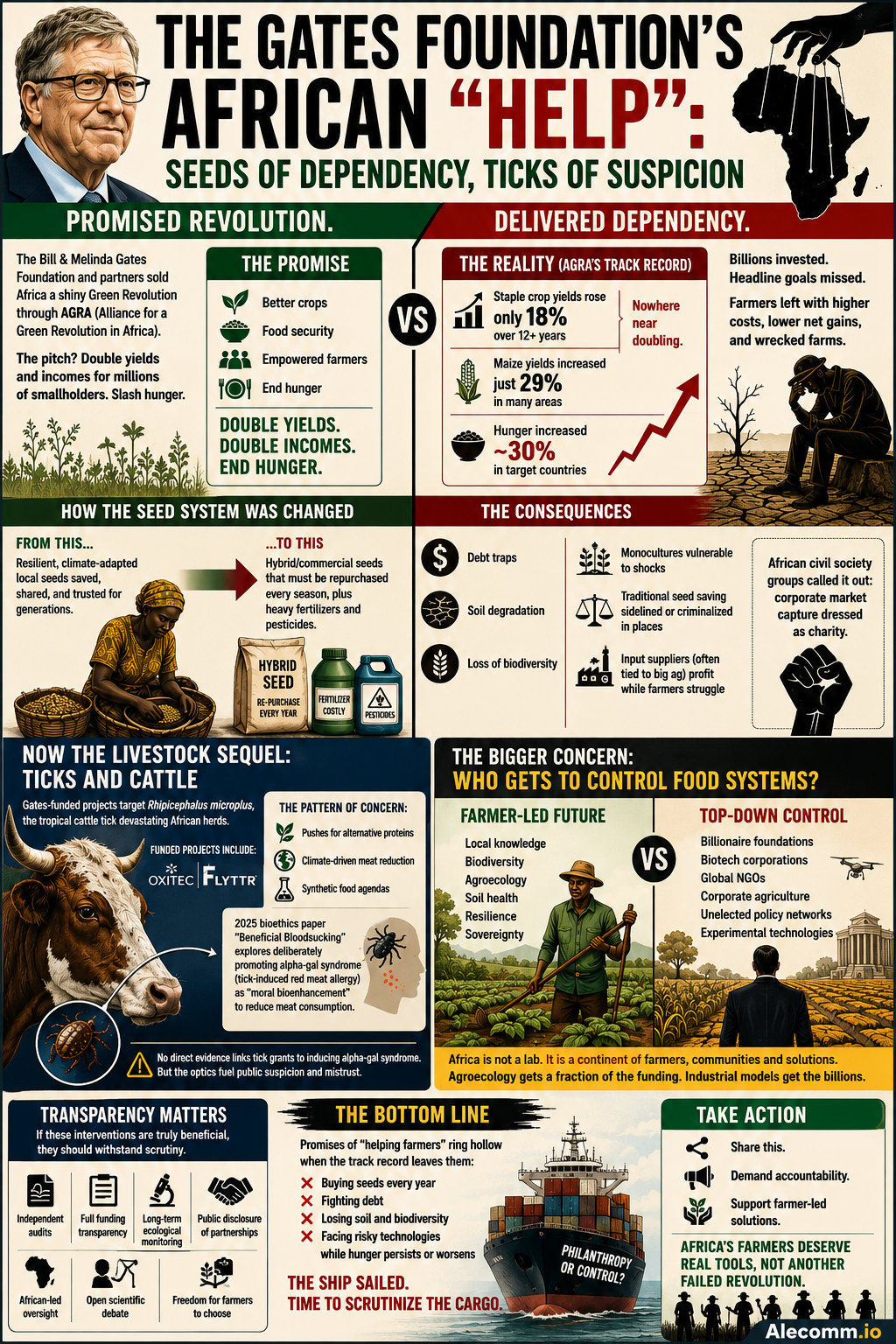
Promised revolution. Delivered dependency.
The Bill & Melinda Gates Foundation and its partners arrived in Africa promising transformation: bigger harvests, food security, modern agriculture, and prosperity for millions of small farmers. Through initiatives like AGRA (Alliance for a Green Revolution in Africa), billions flowed into what was sold as a humanitarian breakthrough.
The sales pitch sounded simple:
Double yields. Double incomes. End hunger.
The outcome was far less inspiring.
Independent assessments and donor-linked evaluations found AGRA failed to achieve its flagship promises. Across more than a decade, staple crop yields rose only modestly — nowhere near the dramatic gains advertised. Hunger in several participating nations reportedly worsened rather than improved. Farmers who once relied on resilient local seed systems were increasingly pushed toward commercial hybrid seeds requiring annual repurchase, alongside costly fertilizers and pesticides.
The consequences hit hard:
• Rising farmer debt
• Soil degradation
• Reduced biodiversity
• Monoculture dependence
• Loss of traditional seed sovereignty
• Greater exposure to climate and market shocks
For generations, African farmers saved and exchanged seeds adapted to local conditions. In many regions, that system sustained communities through droughts, floods, and economic instability. Critics argue that industrial agriculture models sidelined these practices in favor of corporate-controlled input systems benefiting multinational agribusiness suppliers more than smallholders themselves.
What was framed as empowerment increasingly looked like dependency.
Many African civil society organizations and food sovereignty advocates warned that the model resembled market capture disguised as charity — philanthropy functioning as a delivery mechanism for corporate agriculture.
Now Comes The Livestock Sequel: Ticks And Cattle
The next chapter appears to involve biotechnology and livestock.
Gates-linked funding has supported projects targeting Rhipicephalus microplus, the tropical cattle tick responsible for major livestock losses across parts of Africa and other regions. Companies such as Oxitec and Flyttr have received grants tied to genetic control technologies designed to suppress or collapse tick populations.
On paper, the objective sounds practical:
Protect cattle. Reduce disease. Lower pesticide use. Improve food production.
Ticks are unquestionably a genuine agricultural problem.
But the broader context raises concerns for many observers.
At the same time these projects move forward, major global institutions and influential elites increasingly promote:
• Reduced meat consumption
• Alternative proteins
• Synthetic foods
• Climate-driven livestock reduction strategies
Adding fuel to public suspicion was the 2025 academic bioethics paper “Beneficial Bloodsucking”, which explored whether intentionally spreading alpha-gal syndrome — a tick-associated red meat allergy — could theoretically function as a form of “moral bioenhancement” to reduce meat consumption.
To be clear:
There is no public evidence directly linking Gates-funded cattle tick projects to attempts to induce alpha-gal syndrome in humans. The cited livestock tick work focuses on different species and stated agricultural aims.
But public trust erodes when the same ecosystem of institutions simultaneously:
• Pushes biotech intervention into agriculture
• Promotes reduced meat consumption
• Expands synthetic food narratives
• Experiments with genetic control systems
• Encourages dependence on externally controlled technologies
For many farmers, especially in poorer regions, the pattern feels familiar:
First dependency through seeds.
Now dependency through livestock technology.
The Bigger Concern: Who Gets To Control Food Systems?
This debate is larger than ticks.
It cuts to a deeper question:
Who decides the future of agriculture?
Local farmers using regionally adapted knowledge and biodiversity?
Or billionaire-backed foundations, biotech firms, global NGOs, and unelected policy networks?
Critics argue Africa has repeatedly been treated as a testing ground for elite-driven development models designed far away from the people expected to live under them.
Meanwhile, farmer-led agroecology — focused on local seeds, biodiversity, soil restoration, water resilience, and decentralized systems — often receives only a fraction of the funding directed toward industrial or biotech-heavy approaches.
The concern is not innovation itself.
The concern is centralized control masquerading as humanitarianism.
Transparency Matters
If these interventions are truly beneficial, they should withstand scrutiny.
That means:
• Independent audits
• Full funding transparency
• Long-term ecological monitoring
• Public disclosure of partnerships
• African-led oversight
• Open scientific debate
• Freedom for farmers to reject imposed systems
Communities already dealing with poverty, climate instability, and fragile infrastructure should not be pressured into becoming dependent on expensive external technologies controlled by distant institutions.
Africa’s farmers deserve solutions that increase resilience and sovereignty — not systems that leave them permanently buying inputs, navigating debt, and trusting experiments designed in boardrooms thousands of kilometers away.
The ship has already sailed.
Now people want to know exactly what cargo is onboard.
References
https://www.gatesfoundation.org/
https://www.tandfonline.com/doi/full/10.1080/03066150.2020.1820642
https://www.iatp.org/sites/default/files/2020-07/AGRA%20Watch%20Report%20July%202020.pdf
https://bioethics.jhu.edu/research-and-outreach/projects/beneficial-bloodsucking/
https://www.sciencedirect.com/science/article/pii/S2214574523000418
Leave a Reply