
Bill Gates: The Reckless Billionaire Playing God With Our Planet
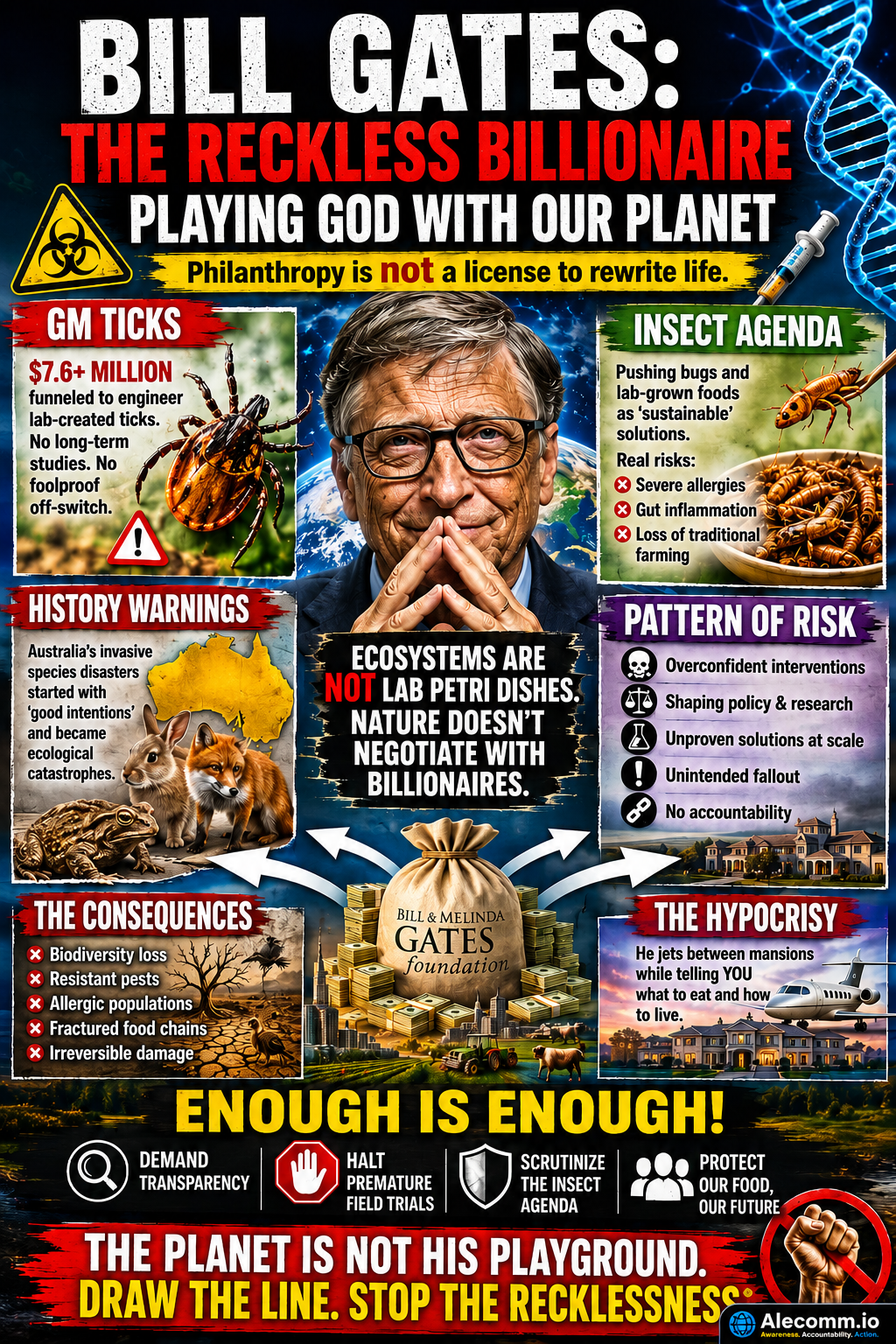
Bill Gates has positioned himself as the world’s self-appointed savior — philanthropist, climate warrior, and now, self-proclaimed architect of biology and food systems.
But behind the polished speeches, carefully managed media appearances, and foundation press releases lies a growing pattern of reckless intervention into complex natural systems that many critics argue could carry catastrophic long-term consequences.
This is no longer just about software or philanthropy.
It is about one billionaire wielding extraordinary influence over agriculture, genetics, food production, and global public policy — often with minimal democratic oversight and enormous downstream risk.
Genetic Engineering At Ecosystem Scale
One of the most alarming examples is the Bill & Melinda Gates Foundation’s multimillion-dollar investment into genetically modified cattle ticks.
More than $7.6 million has reportedly been directed toward biotech company Flyttr (formerly Oxitec) to develop genetically engineered ticks intended to interfere with or suppress wild tick populations.
On paper, it is marketed as livestock protection.
In reality, critics see it as another dangerously arrogant attempt to “fix nature” through large-scale biological manipulation.
Ticks are not isolated organisms floating in a vacuum.
They exist within deeply interconnected ecosystems involving livestock, wildlife, soil biology, predators, climate systems, and disease transmission networks.
Once genetically modified organisms are introduced into open environments, control becomes theoretical at best.
History already provides brutal warnings about what happens when humans interfere with ecosystems under the illusion of certainty.
Australia knows this lesson better than most nations on Earth:
- Cane toads introduced for pest control became an ecological plague.
- Rabbits exploded into environmental devastation.
- Foxes decimated native wildlife.
- Invasive plants transformed entire landscapes.
Every one of those disasters began with experts claiming they understood the risks.
Now imagine introducing genetically engineered parasites into the environment.
The scale of potential unintended consequences becomes immeasurably more dangerous.
The Insect Protein Agenda
Gates has also aggressively promoted alternatives to traditional meat production, including lab-grown foods and insect-based proteins.
Through investments, grants, and influence networks, he has supported initiatives exploring insects as “sustainable” nutritional sources for large populations.
The sales pitch is climate efficiency.
Critics argue the reality is a gradual attempt to reshape global diets from the top down while undermining traditional agriculture and food independence.
The concerns are not hypothetical.
Research already shows that insect proteins and chitin exposure can trigger allergic reactions in susceptible individuals, including severe immune responses and anaphylaxis.
Some researchers have also raised concerns regarding inflammatory effects and cross-reactivity with shellfish allergies.
Meanwhile, traditional farming communities increasingly face pressure from climate narratives, emissions targets, and shifting food policy frameworks heavily influenced by billionaire-backed organisations and NGOs.
Critics see a glaring hypocrisy:
While Gates travels between luxury estates and private aviation networks, ordinary people are increasingly told they must reduce meat consumption, alter traditional diets, and accept heavily engineered “future foods” as inevitable.
A Pattern Of High-Risk Intervention
For many observers, this is not an isolated issue.
It reflects a broader pattern:
- Large-scale interventions into highly complex systems
- Massive financial influence over science and policy
- Public messaging framed around urgency and inevitability
- Limited long-term independent safety data before deployment
- Minimal accountability if things go wrong
Whether discussing public health, agriculture, genetic engineering, or food systems, critics argue the same mentality repeatedly emerges:
A belief that technocratic elites can redesign natural and human systems faster than science can fully understand the consequences.
But ecosystems are not software programs.
Human biology is not a beta test.
Nature does not care how wealthy or influential someone is.
Why Critics Believe This Matters
The concern is not simply Bill Gates as an individual.
The deeper issue is concentrated private power shaping global biological systems without sufficient public scrutiny.
When one foundation can heavily influence:
- Agricultural research
- Food production policy
- Genetic engineering initiatives
- Public health infrastructure
- Climate narratives
- Global development priorities
…many believe society has crossed into dangerously unaccountable territory.
The stakes are enormous because biological interventions cannot always be reversed.
Once modified organisms spread into ecosystems, there may be no practical recall button.
Once food systems fundamentally change, restoring lost agricultural independence becomes difficult.
Once biodiversity collapses, recovery may take generations — if it happens at all.
Time To Draw The Line
Philanthropy should never grant unchecked authority to reshape the biological future of humanity and the planet.
Independent scientists, regulators, governments, farmers, and citizens have every right to demand:
- Full transparency
- Independent long-term safety studies
- Open ecological risk assessments
- Strict limits on environmental release programs
- Genuine public debate before irreversible deployment
The world has already witnessed what happens when powerful individuals and institutions overestimate their ability to control nature.
Critics argue Bill Gates represents the latest — and potentially most dangerous — version of that same historical arrogance.
The planet is not a billionaire’s laboratory.
And humanity should not be treated as test subjects for elite ideological experiments.
References
https://www.gatesfoundation.org/about/committed-grants
https://www.csiro.au/en/research/natural-environment/biodiversity/invasive-species
https://www.dcceew.gov.au/environment/invasive-species
https://www.fao.org/edible-insects/en/
https://www.nature.com/npjmgrav/
https://www.who.int/news-room/fact-sheets/detail/vector-borne-diseases
Leave a Reply