
IKEA’s Bug Burgers: The Corporate Push To Make People Eat Insects Needs To Stop
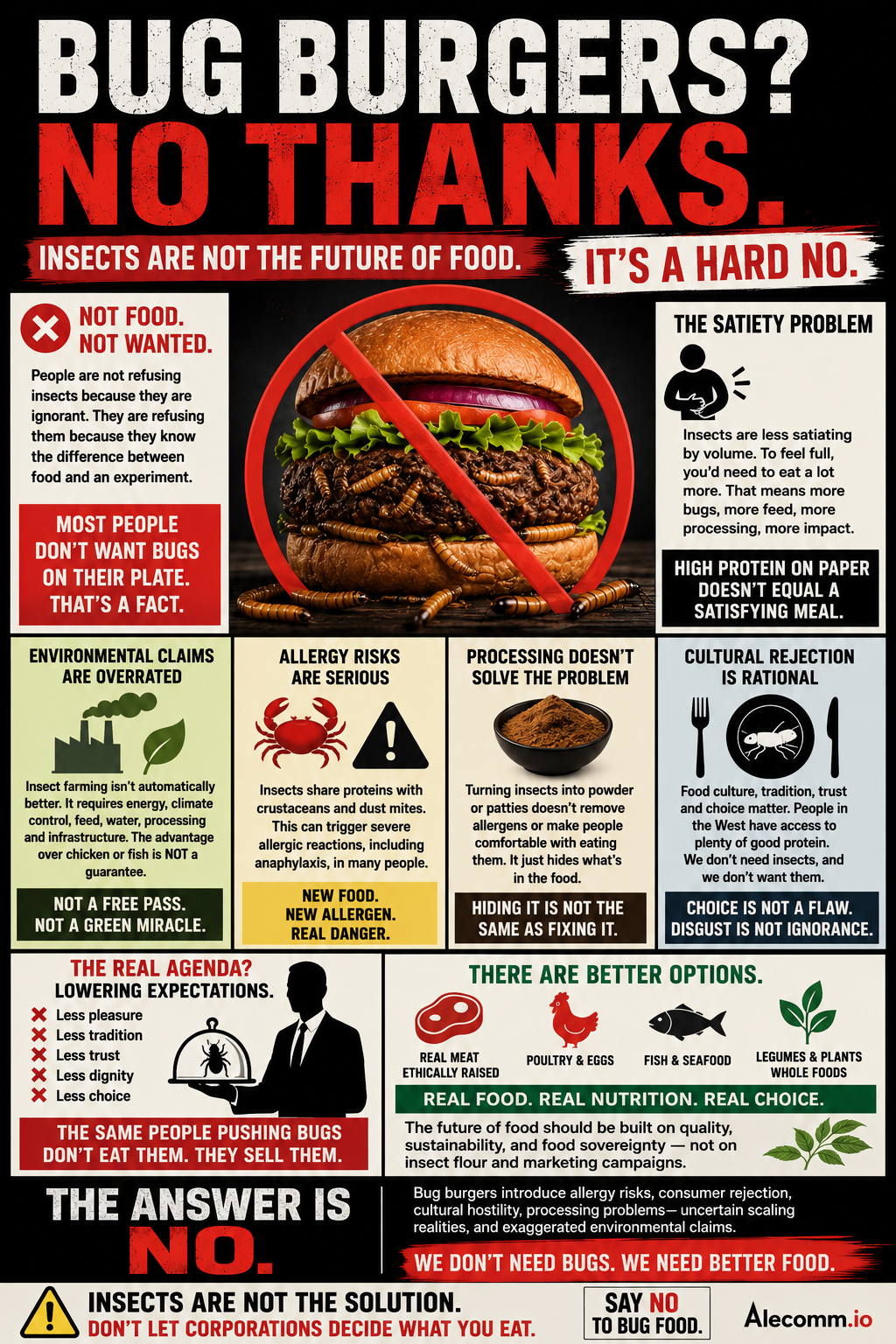
In 2018, IKEA’s innovation lab SPACE10 promoted the so-called “fast food of the future.” One of the headline experiments was the Bug Burger, made with vegetables and mealworms, alongside insect-based “Neatballs” styled as a replacement for traditional Swedish meatballs.
That was the sales pitch: clever, sustainable, futuristic, responsible.
Here is the reality: No.
Not “maybe.”
Not “with better branding.”
Not “once consumers are educated.”
Not “if the science improves.”
Just no.
The attempt to rebrand insects as normal food is not innovation. It is a downgrade dressed up as progress. It takes something most people instinctively reject and tries to launder it through climate language, corporate design, and fake moral pressure.
People are not refusing bugs because they are stupid. They are refusing them because they know the difference between food and an experiment.
This Is Not Food Progress
The insect-protein lobby wants the public to believe bugs are the next great leap in sustainable eating. The language is always the same: efficient protein, lower land use, less water, fewer emissions, future food.
But the pitch collapses once you stop treating people like spreadsheets.
A human being does not eat a protein percentage. A human being eats a meal. A meal has volume, texture, appetite satisfaction, cultural meaning, digestibility, safety, and trust.
A beetroot patty padded out with mealworms may tick a corporate innovation box, but that does not make it a serious replacement for real food. It makes it a marketing stunt.
The Satiety Problem Cannot Be Brushed Aside
The insect lobby loves comparing protein density on paper. That is convenient, because paper does not have a stomach.
A person eating a steak, a burger, eggs, chicken, fish, or a hearty legume-based meal is not just chasing grams of protein. They are eating for fullness, energy, pleasure, habit, and nourishment.
That is where the bug argument gets slippery. Dried mealworms may contain a high percentage of protein, but that does not magically make them a satisfying meal. To match the bulk, calories, mouthfeel, and fullness of ordinary food, people may need larger quantities, more processing, more binders, more flavour masking, and more industrial handling.
So the “efficient bug” suddenly becomes a highly processed product requiring farming, harvesting, killing, drying, milling, flavouring, packaging, marketing, and consumer manipulation.
That is not simplicity. That is a factory with legs.
The Environmental Claims Are Not A Free Pass
The usual claim is that insects are better than beef. That is the favourite comparison because beef is the easiest target.
But the real question is not whether bugs can beat the worst-case version of beef on selected metrics. The real question is whether insect farming is a sensible food-system replacement when compared with existing proteins people already eat, tolerate, understand, and accept.
Research shows insect production can have environmental advantages in some categories, but the picture is not clean. Industrial insect farming can require controlled temperatures, humidity systems, energy inputs, hygienic containment, feed sourcing, drying, processing, and transport. In colder climates or high-energy production systems, the supposed advantage can shrink fast.
Even some life-cycle analyses note that insect protein does not automatically outperform chicken or fish on greenhouse gas emissions. That matters, because chicken, eggs, fish, dairy, legumes, and other foods already exist without needing a public relations campaign to convince people they are not disgusting.
The Allergy Risk Is Not A Side Note
This is one of the biggest red flags.
Insects are arthropods, like crustaceans. Mealworms, crickets, grasshoppers, and similar edible insects can contain proteins that cross-react with allergens found in shrimp, crab, lobster, and dust mites. One of the major concerns is tropomyosin, a known cross-reactive allergen.
That means people with shellfish allergies or dust mite sensitivities may react to insect-based foods. In serious cases, food allergy is not a rash-and-move-on event. It can mean anaphylaxis.
That alone should kill the casual “bug burger” push stone dead.
You cannot quietly slide insect powder into snacks, burgers, protein bars, pet foods, or novelty foods and pretend this is just another harmless alternative. It is not. It is a new allergen exposure pathway being pushed into the food supply.
Processing Does Not Magically Fix It
Another lazy argument is that insects can be processed into powders, flours, burgers, or meatball substitutes so people will not notice.
That is not reassuring. That is worse.
If consumers need the insect hidden, disguised, milled, flavoured, and socially normalised before they will accept it, then maybe the public’s rejection is not the problem. Maybe the product is.
Processing also does not reliably remove allergen risk. Heating, grinding, drying, and turning insects into powder does not automatically neutralise the proteins that can trigger immune reactions.
So now the public gets the worst of both worlds: a product they do not want, carrying risks they may not understand, hidden inside food formats they already trust.
The Cultural Rejection Is Rational
The insect promoters love to sneer at Western reluctance as ignorance or privilege.
Wrong.
Food culture matters. Trust matters. Appetite matters. People are allowed to reject eating insects without being lectured like naughty peasants who failed climate obedience class.
Many cultures eat insects traditionally. Fine. That is their food history. But importing that practice into societies where people have abundant access to other proteins does not make it automatically noble, necessary, or desirable.
There is a huge difference between a traditional food culture choosing insects and corporations trying to manufacture consent for insect-based processed foods under the banner of sustainability.
One is culture.
The other is coercive branding.
IKEA Did Not Save The Planet With Mealworms
IKEA’s bug burger was not proof of a food revolution. It was proof that corporations love “future food” experiments that generate headlines.
The fact these products did not become normal menu items tells us what we already know: most people do not want them.
And they should not be shamed for that.
The public does not owe corporations enthusiasm for insect patties. Families do not owe the climate lobby their dinner plates. Consumers do not need to justify choosing normal food over bug-based alternatives.
The Real Agenda Is Lowering Expectations
This is the part nobody wants to say plainly.
The insect-food push is not about giving people better food. It is about convincing people to accept less.
Less pleasure.
Less tradition.
Less trust.
Less dignity.
Less choice.
And somehow, the people selling the downgrade still expect applause.
The same class of people who dine on premium produce, boutique meats, imported seafood, and expensive restaurant meals are suddenly very excited about telling ordinary people that mealworms are the future.
Funny how that works.
The Answer Is No
Insect burgers are not a bold new frontier. They are a warning sign.
They introduce allergy concerns, consumer rejection, cultural hostility, processing problems, uncertain scaling realities, and exaggerated environmental claims. They depend heavily on propaganda language because the product itself does not sell naturally.
People do not need bug burgers.
Children do not need insect flour.
Families do not need mealworm meatballs.
The food supply does not need another industrial experiment disguised as virtue.
There are already better options: real food, regenerative farming, ethical livestock systems, local agriculture, eggs, dairy, fish, poultry, legumes, vegetables, grains, and properly produced traditional foods.
The future of food should not be built by lowering the public’s standards until they accept insects.
It should be built by raising food quality, strengthening food sovereignty, protecting consumer choice, and refusing to let corporate laboratories decide what counts as dinner.
Bug burgers are not the future. They are the line in the sand.
Research And References
- De Marchi, L., Wangorsch, A., Zoccatelli, G., et al. (2021). Allergens from edible insects: Cross-reactivity and effects of processing. Current Allergy and Asthma Reports / PMC.
https://pmc.ncbi.nlm.nih.gov/articles/PMC8165055/ - Pali-Schöll, I., Binder, R., Moens, Y., Polesny, F., & Monsó, S. (2019). Edible insects: Cross-recognition of IgE from crustacean- and house dust mite-allergic patients, and reduction of allergenicity by food processing. World Allergy Organization Journal.
https://www.worldallergyorganizationjournal.org/article/S1939-4551(19)30051-1/fulltext - Food Standards Agency. (2024). Technical report: Risk profile on edible insects.
https://www.food.gov.uk/research/novel-and-non-traditional-foods-additives-and-processes/technical-report-risk-profile-on-edible-insects - Food and Agriculture Organization of the United Nations. (2021). Looking at edible insects from a food safety perspective.
https://openknowledge.fao.org/server/api/core/bitstreams/33de5ff0-3b21-4108-98bc-d2f6e190e992/content - CSIRO. (2024, July 31). Insect-based food could trigger allergies.
https://www.csiro.au/en/news/All/News/2024/July/Insect-based-food-could-trigger-allergies - Oonincx, D. G. A. B., & de Boer, I. J. M. (2012). Environmental impact of the production of mealworms as a protein source for humans: A life cycle assessment. PLOS ONE / PMC.
https://pmc.ncbi.nlm.nih.gov/articles/PMC3526541/ - Smetana, S., et al. (2023). Environmental impact potential of insect production chains for food and feed. Animal Frontiers.
https://academic.oup.com/af/article/13/4/112/7242422 - Lamberti, C., et al. (2021). Thermal processing of insect allergens and IgE cross-reactivity. Food Research International.
https://www.sciencedirect.com/science/article/abs/pii/S096399692100466X
Leave a Reply