Untangling The Mother–Family–Cult Knot
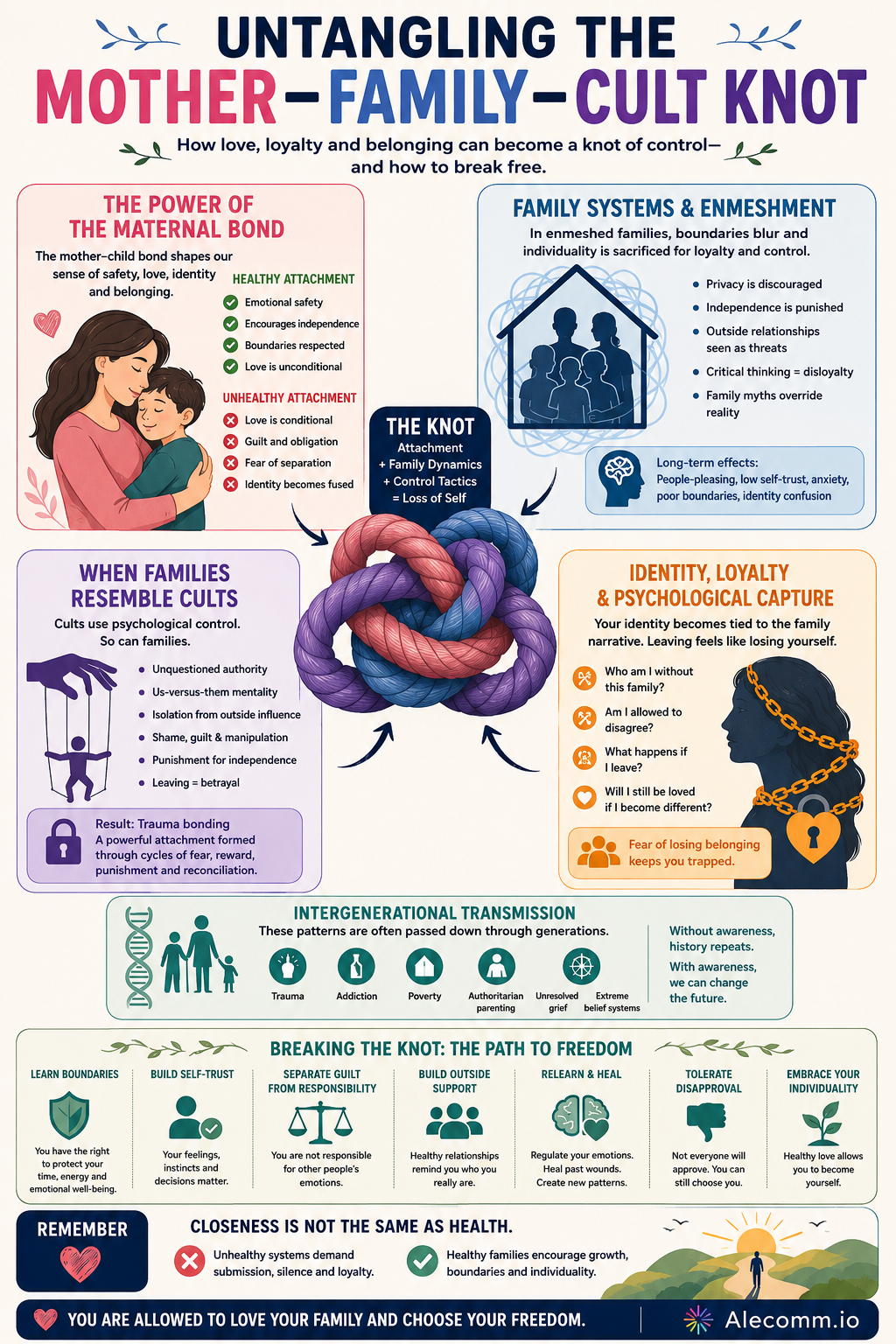
At first glance, “family,” “motherhood,” and “community” sound like the safest words in human language. They evoke warmth, protection, belonging, loyalty, and identity. But under certain psychological and social conditions, those same forces can become deeply entangled in unhealthy systems of control. What begins as care can slowly morph into coercion. What begins as protection can become dependency. What begins as family loyalty can become emotional imprisonment.
This is the “mother–family–cult knot” — the tangled overlap between maternal attachment, family systems, identity formation, and cult-like psychological dynamics.
It is not about blaming mothers. Nor is it about claiming every close-knit family is dangerous. Rather, it is about understanding how human attachment systems can be manipulated, distorted, or unconsciously weaponised inside families, religious groups, ideological movements, and even political cultures.
Understanding this knot matters because people trapped inside it often cannot see it while they are living inside it.
The Power Of The Maternal Bond
The mother–child bond is one of the strongest biological and psychological connections humans experience. From infancy, survival depends on attachment. A child learns:
- Who is safe
- What love feels like
- Whether emotions are accepted
- Whether independence is allowed
- Whether disagreement is dangerous
Healthy attachment creates resilience. The child eventually develops autonomy while still feeling emotionally secure.
But unhealthy attachment can create fusion instead of connection.
In fused systems:
- Love becomes conditional
- Guilt replaces communication
- Loyalty is demanded rather than earned
- Separation is treated as betrayal
- Individual identity becomes suppressed
The child does not grow into an independent person. Instead, they become psychologically tethered to the emotional needs of the parent or family unit.
This is where the “knot” begins forming.
Family Systems And Emotional Enmeshment
Psychologists often describe dysfunctional family systems using the term enmeshment.
Enmeshment occurs when personal boundaries become blurred or nonexistent. Family members may know too much about one another emotionally, control each other excessively, or feel responsible for each other’s emotional states.
In these environments:
- Privacy may be discouraged
- Independence may trigger punishment or guilt
- Outside relationships may be viewed as threats
- Critical thinking may be interpreted as disloyalty
- Family myths override reality
Children raised in these systems often struggle later with:
- Identity formation
- Decision-making
- Romantic relationships
- Saying no
- Trusting their own judgment
Many become hypervigilant people-pleasers because survival depended on emotional compliance.
The family may present externally as “close,” “loving,” or “tight-knit,” while internally functioning through fear, shame, obligation, or emotional control.
When Families Begin To Resemble Cults
Cults are not defined merely by strange beliefs or charismatic leaders. The defining feature of a cult is psychological control.
Many experts identify common patterns in cultic systems:
- Isolation from outside influence
- Suppression of dissent
- Emotional manipulation
- Us-versus-them thinking
- Dependency on authority
- Punishment for independence
- Control over identity and beliefs
Disturbingly, these same dynamics can appear inside families.
In family-cult systems:
- The parent becomes the unquestioned authority
- The family narrative becomes sacred
- Outsiders are distrusted
- Children are assigned rigid emotional roles
- Shame is used to maintain compliance
- Leaving the system is framed as abandonment or betrayal
The individual may feel they cannot survive emotionally without the family, even when the family itself is causing severe psychological harm.
This creates what trauma specialists sometimes call trauma bonding — a powerful attachment formed through cycles of affection, fear, punishment, and reconciliation.
The “Good Mother” Shield
One reason these systems are difficult to recognise is because society idealises motherhood.
The image of the self-sacrificing, nurturing mother is deeply embedded in culture. As a result, harmful maternal behaviour is often minimised, excused, or ignored entirely.
People struggle to accept that a mother can simultaneously:
- Love her child
- Harm her child emotionally
- Manipulate through guilt
- Sabotage independence
- Create dependency
- Fear abandonment so intensely that control becomes normalised
Many unhealthy dynamics are hidden behind phrases like:
- “She means well”
- “That’s just how mothers are”
- “Family comes first”
- “You only get one mother”
- “Blood is thicker than water”
These cultural narratives can trap people inside destructive systems for decades.
Identity, Loyalty, And Psychological Capture
One of the most powerful aspects of the mother–family–cult knot is identity capture.
In healthy development, a person gradually separates psychologically from their family and develops:
- Independent beliefs
- Personal values
- Emotional autonomy
- Self-trust
But in controlling family systems, identity may remain fused with the group.
The person may unconsciously ask:
- “Who am I without this family?”
- “Am I allowed to disagree?”
- “What happens if I leave emotionally?”
- “Will I still be loved if I become different?”
The fear is not merely conflict. It is annihilation of belonging.
Humans are social creatures. Rejection from the tribe historically meant death. Cultic systems exploit this ancient survival wiring.
That is why people often stay in psychologically damaging systems long after recognising the harm.
Intergenerational Transmission
These patterns rarely begin with one generation.
Trauma, emotional neglect, authoritarian parenting, war, addiction, poverty, religious extremism, or unresolved grief can pass through families for decades.
People often recreate the emotional systems they were raised inside because those systems feel “normal,” even when painful.
A controlling mother may once have been a controlled daughter. An emotionally absent father may once have been emotionally abandoned himself.
Without awareness, dysfunctional patterns repeat automatically.
This is why untangling the knot requires more than blame. It requires insight.
Breaking The Knot
Breaking free from unhealthy family-cult dynamics is psychologically difficult because the person is not merely changing relationships — they are reconstructing identity itself.
Recovery often involves:
- Learning boundaries
- Developing self-trust
- Separating guilt from responsibility
- Building outside support systems
- Relearning emotional regulation
- Tolerating disapproval
- Accepting that love and control are not the same thing
One of the hardest realisations is understanding that closeness is not automatically health.
Some relationships feel intense because they are built on fear, dependency, and emotional fusion rather than genuine connection.
Healthy love allows individuality. Unhealthy systems demand psychological surrender.
Why This Topic Matters Today
Modern society is seeing increasing concern around:
- Extremist ideological movements
- Online radicalisation
- Identity politics
- Parasocial dependency
- Groupthink
- Narcissistic family systems
- Authoritarian social dynamics
The psychological mechanisms behind cults do not suddenly appear in adulthood. They are often rooted in early attachment systems and family conditioning.
People who were never allowed to develop independent identity may later become highly vulnerable to:
- Charismatic leaders
- Ideological absolutism
- Conspiracy dependency
- Online cult communities
- Political tribalism
- Coercive relationships
Understanding the mother–family–cult knot therefore helps explain not only dysfunctional families, but broader patterns in society itself.
Final Thought
The most powerful forms of control rarely look violent at first. They look like love, protection, sacrifice, loyalty, duty, and belonging.
That is what makes them difficult to recognise.
Untangling the mother–family–cult knot is not about rejecting family or demonising mothers. It is about recognising when attachment becomes control, when loyalty becomes submission, and when identity becomes trapped inside systems that fear individuality.
Healthy families help people become themselves.
Unhealthy systems demand that people remain emotionally owned forever.
Leave a Reply