
MFS And Neural Interface Optimisation: A New Layer In Brain–Machine Performance
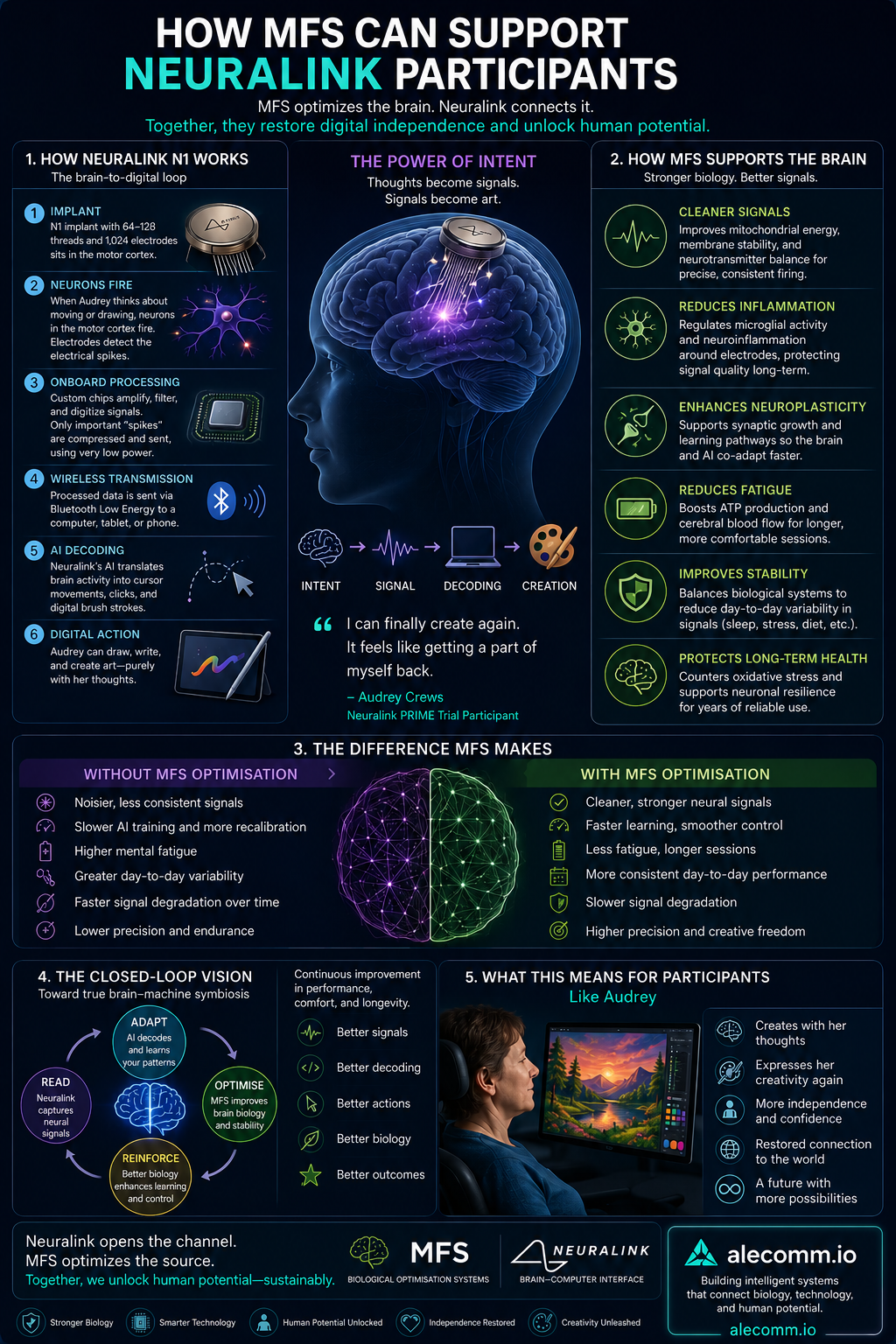
A new systems-level approach is emerging at the intersection of biology and machine intelligence, positioning MFS as a foundational layer in the evolution of brain–computer interfaces. As advanced neural interface platforms move from experimental trials into real-world application, attention is rapidly shifting toward the biological environment that underpins signal quality, learning speed, and long-term performance.
Early human use cases now demonstrate that restoring digital interaction through thought alone is no longer theoretical. The next phase is optimisation—refining the internal biological conditions that determine how effectively neural signals are generated, stabilised, and translated into precise digital actions.
The Core Reality Most People Miss
Neural interfaces do not generate ability.
They depend entirely on the quality of the brain they are reading from.
If the brain environment is:
- inflamed
- oxidatively stressed
- metabolically inefficient
- neurochemically unstable
…then the signal going into the AI decoder is noisy, inconsistent, and harder to train.
That’s where MFS becomes powerful.
Where MFS Intersects The BCI Loop
The system operates across three layers:
- Biological signal generation (brain)
- Hardware capture (implant electrodes)
- AI decoding (software)
The technology controls layers two and three.
MFS strengthens layer one—the layer everything else depends on.
Signal Quality And Neural Firing Precision
Motor cortex output relies on:
- synaptic efficiency
- ion channel stability
- mitochondrial ATP availability
If neurons are underpowered or stressed:
- firing becomes erratic
- timing precision drops
- signal-to-noise ratio worsens
MFS targets:
- mitochondrial output to support consistent spike generation
- membrane stability for cleaner electrical signalling
- neurotransmitter balance to reduce signal jitter
Result: more predictable neural patterns that AI systems can learn faster and more accurately.
Neuroinflammation And Electrode Interface Stability
Implanted electrodes trigger:
- microglial activation
- local inflammation
- gradual signal degradation over time
MFS supports:
- regulation of microglial activity
- reduction of chronic neuroinflammation
- stabilisation of the extracellular environment around electrodes
Result:
- slower signal degradation
- more stable long-term electrode performance
- reduced need for recalibration
Neuroplasticity And Decoder Training Speed
Neural interfaces rely on co-adaptation:
- the system learns the brain
- the brain learns the system
This depends on neuroplasticity.
MFS enhances:
- synaptic plasticity pathways
- dendritic remodeling
- learning efficiency under repeated tasks
Result:
- faster control acquisition
- more intuitive interaction
- a significantly higher performance ceiling
Cognitive Fatigue And Mental Endurance
Neural interface use is cognitively demanding.
Users must:
- sustain focused intent
- override natural pathways
- continuously correct outputs
MFS supports:
- sustained ATP production
- reduced neural fatigue
- improved cerebral energy dynamics
Result:
- longer usable sessions
- less cognitive burnout
- improved consistency over time
Signal Consistency Day-To-Day
Signal variability is a major limitation.
Factors like:
- sleep
- stress
- immune activity
…can all affect neural output.
MFS acts as a biological stabiliser by regulating:
- metabolic state
- immune signalling
- neural excitability
Result:
- reduced variability
- more stable daily performance
- less retraining required
Long-Term Neural Protection
Long-term neural interface use carries risks:
- chronic inflammation
- oxidative stress
- gradual neuronal decline
MFS supports:
- oxidative stress buffering
- neuronal protection mechanisms
- long-term cellular resilience
Result:
- sustained function over extended periods
- improved durability of performance
Closing The Loop: Toward True Brain–Machine Integration
Current systems operate as: read → decode → act
The next phase evolves into: read → adapt → optimise → reinforce
MFS becomes the biological layer that:
- conditions the brain
- aligns it with machine learning processes
- stabilises the entire feedback system
What This Means In Practice
Without optimisation:
- noisier signals
- slower learning
- higher fatigue
- greater variability
- faster degradation
With MFS:
- cleaner, stronger signals
- faster learning and adaptation
- reduced fatigue
- stable performance
- improved longevity
In simple terms:
It moves the system from functional to high-performance.
The Bigger Picture
Neural interface technology provides the connection.
MFS optimises the source.
Together, they represent the shift toward a fully integrated human–machine system where biology and technology are no longer separate layers, but parts of the same operational framework.
Leave a Reply