
Nestlé And The Price Of Profit: How Corporate Greed Turned Baby Formula Into A Death Sentence
There are corporate scandals… and then there are corporate body counts. What sits behind Nestlé’s expansion into the developing world is not just questionable marketing—it is a case study in how profit can override basic human decency, with consequences measured in graves, not quarterly earnings.
A Death Toll Hidden Behind Marketing Campaigns
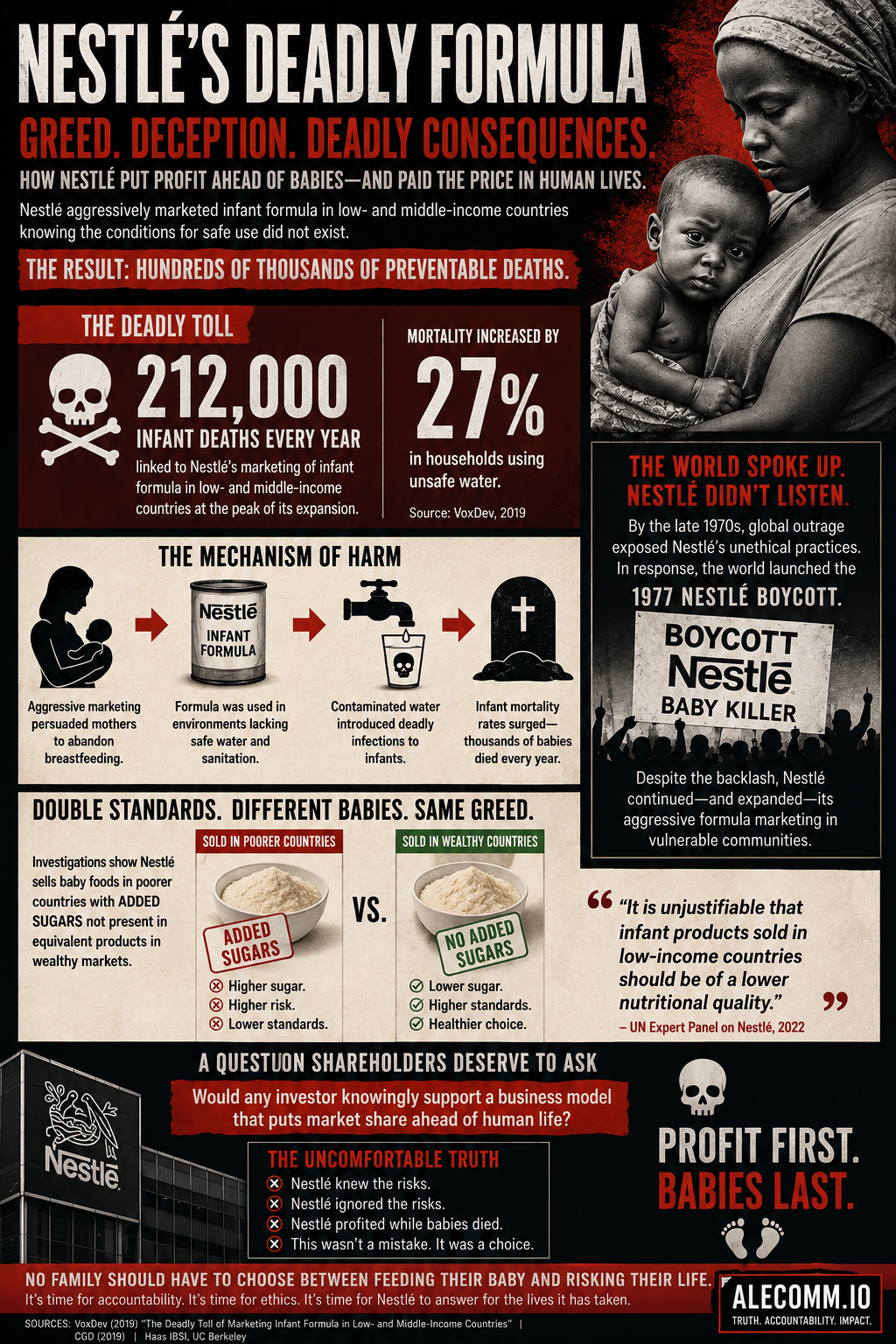
At the peak of its aggressive push into low- and middle-income countries, Nestlé’s promotion of infant formula wasn’t just controversial—it was catastrophic. Rigorous economic analysis shows that the company’s entry into these markets led to approximately 212,000 infant deaths per year among families without access to clean water.
That number isn’t a rounding error. It’s not a statistical quirk. It’s a systemic outcome of a business model that placed product expansion ahead of the most basic reality: formula requires clean water to be safe.
Without it, formula becomes a delivery system for disease.
And Nestlé knew exactly where it was selling.
The Mechanism Of Harm: Selling Risk To The Vulnerable
The damage wasn’t accidental. It followed a brutally simple chain reaction:
- Mothers were persuaded—through marketing—to abandon breastfeeding
- Formula was used in environments lacking safe water and sanitation
- Contaminated water introduced infections into infants’ bodies
- Mortality rates surged—by 27% in households using unsafe water
This wasn’t happening in wealthy suburbs with sterilised bottles and filtered water. This was happening in some of the most vulnerable communities on earth—places where the margin for error is already razor-thin.
And yet, instead of adapting its approach to protect those infants, Nestlé expanded deeper into those very markets.
Corporate Awareness Without Corporate Responsibility
By the late 1970s, the world had already caught on. The backlash was so severe it triggered the global 1977 Nestlé boycott—a rare moment where public outrage pierced corporate insulation.
Why? Because the pattern was clear:
- Aggressive marketing in vulnerable populations
- Downplaying the risks of formula misuse
- Encouraging dependency on a product that requires infrastructure many customers simply did not have
This wasn’t a misunderstanding. It was a calculated expansion strategy that treated human risk as an acceptable cost of market penetration.
A Pattern That Never Really Stopped
Fast forward decades, and the same ethical fractures are still visible.
Investigations have shown Nestlé selling baby foods in poorer countries with added sugars not present in equivalent products in wealthy markets—a double standard experts have called “unjustifiable.”
Different standards for different populations.
Different risks for different babies.
Same corporate brand.
The Shareholder Illusion
Here’s the uncomfortable truth most investors never see:
The same revenue streams that drive dividends may be built on decisions that, if fully exposed, would horrify any reasonable shareholder.
Because no sane investor signs off on:
- Marketing practices linked to mass infant mortality
- Products deployed in conditions known to be unsafe
- Ethical shortcuts that sacrifice human life for market share
But that is exactly what the data shows happened.
The Bottom Line
Nestlé didn’t just sell baby formula.
It sold a product into environments where it knew the conditions required for safe use didn’t exist.
It pushed that product hard enough to alter maternal behaviour.
And the result was a measurable, preventable surge in infant deaths.
That’s not just negligence.
That’s the kind of corporate conduct that forces a very blunt question:
At what point does “business strategy” become moral failure on an industrial scale?
Because when the outcome is hundreds of thousands of dead babies a year, the answer isn’t complicated anymore.
It’s just uncomfortable.
References
https://voxdev.org/topic/health/deadly-toll-marketing-infant-formula-low-and-middle-income-countries
https://haas.berkeley.edu/ibsi/research/mortality-from-nestles-marketing-of-infant-formula-in-low-and-middle-income-countries/
https://www.cgdev.org/event/mortality-nestl%C3%A9%E2%80%99s-marketing-infant-formula-low-and-middle-income-countries
https://www.nestle.com/ask-nestle/our-company/answers/nestle-boycott
https://www.theguardian.com/global-development/2024/apr/17/nestle-adds-sugar-to-infant-milk-sold-in-poorer-countries-report-finds
Leave a Reply