Coles And Woolworths Finally Held To Account Over Misleading “Down Down” Discounts
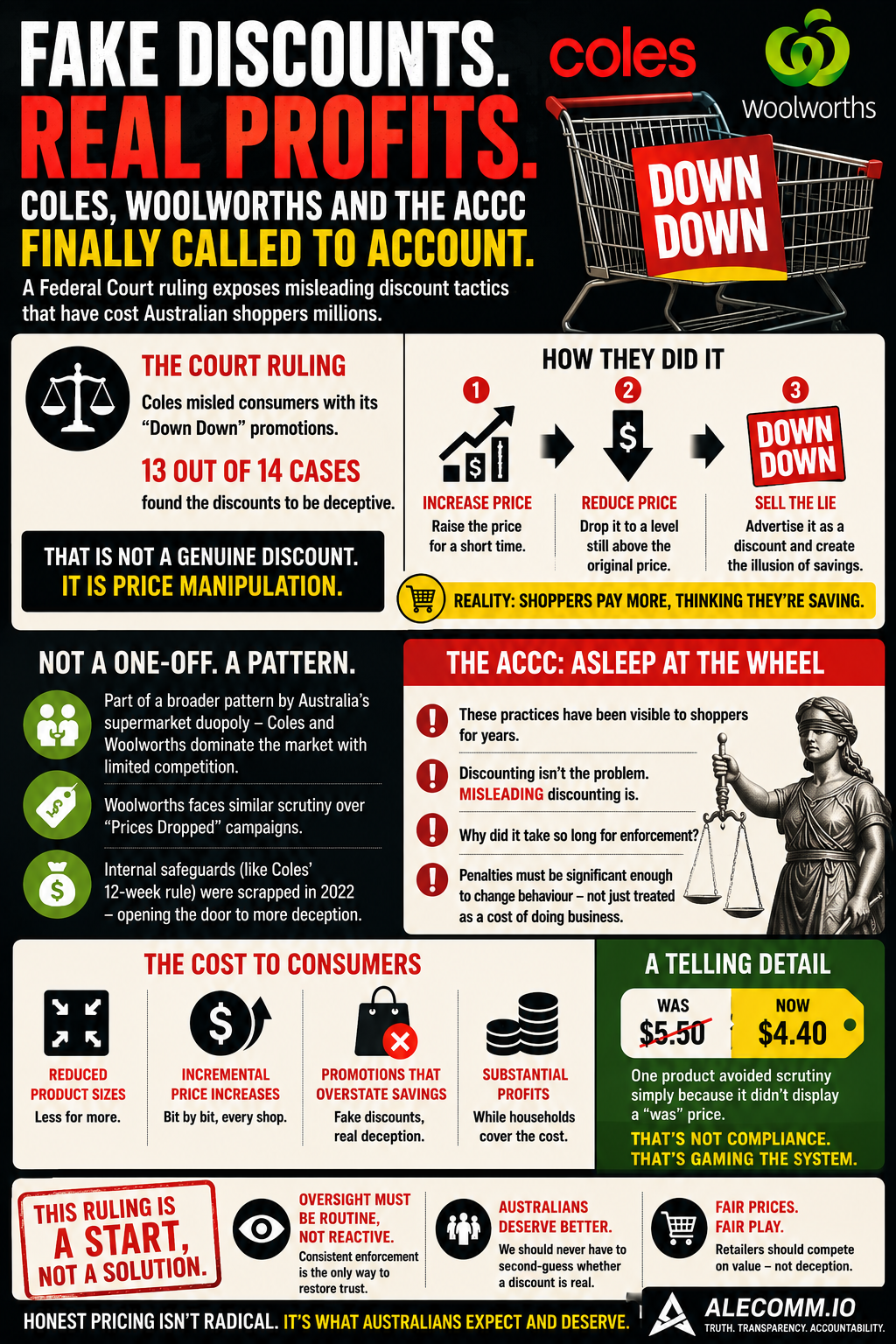
A Federal Court ruling has made it clear that Coles misled consumers with its “Down Down” promotions. In thirteen out of fourteen cases examined, the advertised discounts were found to be deceptive — with products spending little meaningful time at the higher “was” price before being promoted as reduced.
That is not a genuine discount. It is price manipulation dressed up as value.
The method was not complicated. Prices were increased for a short period, then reduced to a level still above the original baseline, and presented as a saving. For shoppers trying to manage rising grocery costs, the signal was obvious — but it was also misleading.
This was not a one-off mistake.
It reflects a broader pattern within Australia’s supermarket duopoly, where Coles and Woolworths operate with limited competitive pressure and significant control over pricing narratives.
Woolworths has faced similar scrutiny over its “Prices Dropped” campaigns, with both companies brought before the regulator for nearly identical conduct.
The issue at the centre of this is trust — and that trust has been abused.
Consumers are not standing in supermarket aisles auditing price histories. They rely on clear, honest representations.
When those representations are manipulated, the entire premise of fair competition collapses.
Coles previously maintained an internal rule requiring products to remain at a higher price for at least 12 weeks before being promoted as discounted. That safeguard was quietly abandoned in 2022.
In plain terms, internal standards were dropped the moment they became inconvenient.
What followed was predictable: a race to the bottom, where perception mattered more than accuracy and marketing overtook integrity.
The regulator has stated that discounting is not the problem — misleading discounting is. That is correct. But it raises a far more uncomfortable question:
Where has consistent enforcement been?
These practices did not emerge overnight. They have been visible to consumers for years — through:
• Shrinking product sizes paired with rising prices
• Artificial price spikes followed by “discounts”
• Promotions that exaggerate or fabricate savings
All while both companies continue to post substantial profits.
For corporations of this scale, occasional enforcement action is not enough. If penalties do not materially impact behaviour, they simply become another operating cost — absorbed, accounted for, and ultimately passed back to consumers.
Coles has stated it is “reviewing the judgment.”
That is not accountability. That is risk management.
Short-term share price dips are irrelevant in the broader context. The financial impact on households over time — through cumulative overpayment — is far greater.
Even more telling is the fine margin within which these tactics operated. One product avoided scrutiny simply because it did not display a “was” price at all.
That is not compliance. That is gaming the system as closely as possible without technically stepping over the line.
This ruling matters. But it is only a starting point.
If this behaviour is to stop, oversight must become routine — not reactive.
Consumers should not need a court ruling to confirm whether a discount is genuine.
And major retailers should not be permitted to build profit models on the assumption that scrutiny will be slow, sporadic, and ultimately manageable.
Leave a Reply