Stop the Supply, Stop the Harm: Why Prevention Must Come First in Australian Prisons
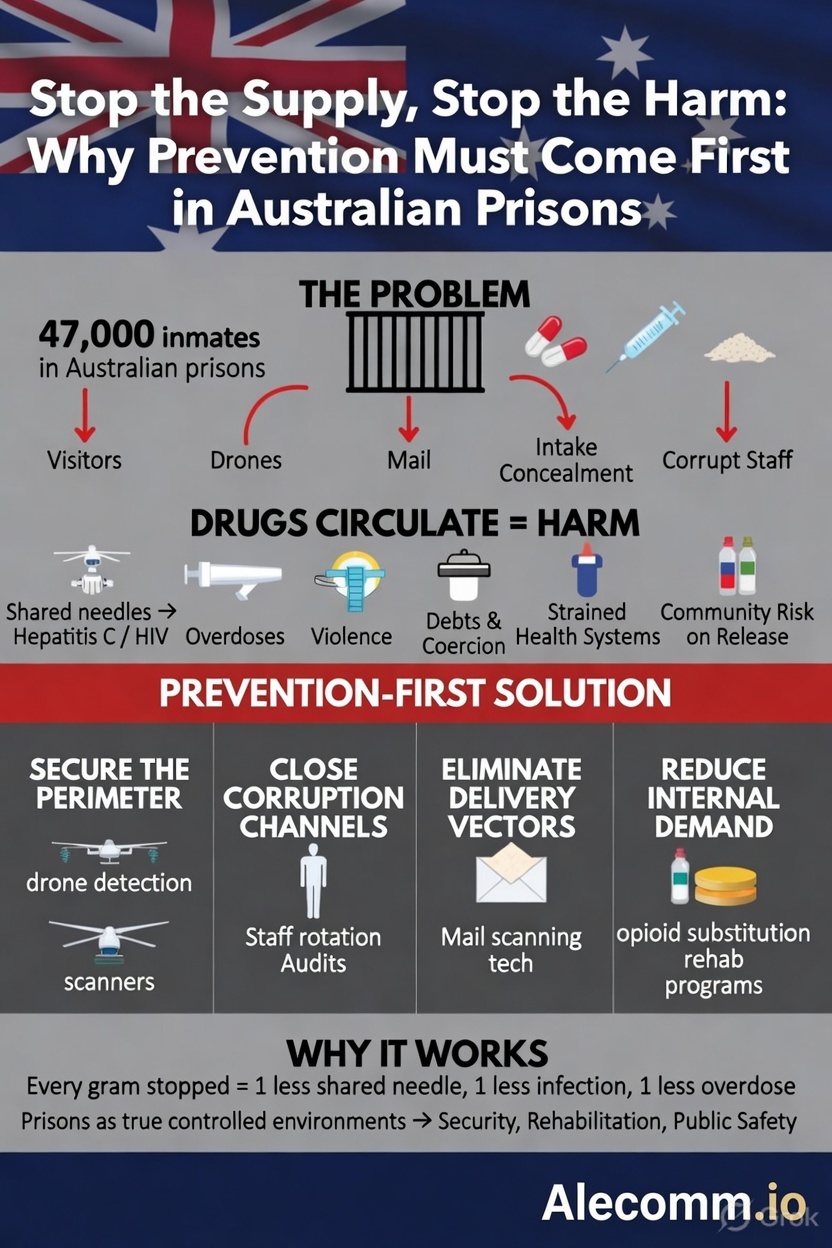
The debate over drugs in prison too often begins at the wrong end of the problem. We argue about needle exchanges, infection control, and emergency hospital transfers after the damage is already done. But the harder, more fundamental question is this: why are drugs getting into correctional facilities at all?
If illicit substances were not entering prisons in the first place, the cascade of consequences—shared needles, hepatitis C transmission, HIV exposure, bacterial infections, overdoses—would shrink dramatically. Harm reduction treats the symptom. Supply prevention targets the source.
Australia’s correctional system houses approximately 47,000 inmates. Facilities are controlled environments by design—restricted access, monitored entry points, regulated movement. Yet contraband drugs continue to circulate inside. That reality exposes systemic vulnerabilities that demand attention.
Drugs enter prisons through multiple channels: visitor smuggling, corrupt insiders, mail systems, drones, and concealment during intake. Each vector requires targeted disruption.
Intelligence-led security must replace reactive enforcement. That means expanding real-time data analysis to identify trafficking patterns, strengthening collaboration between corrections and federal law enforcement, and applying predictive risk modeling to high-risk facilities and individuals.
Technology deployment is critical. Advanced body scanners at intake and post-visit checkpoints significantly reduce internal concealment. Mail scanning technologies capable of detecting liquid-impregnated paper (used to transport synthetic drugs) should become standard. Drone detection systems must be expanded, particularly in low-security perimeters.
Staff integrity systems require equal attention. The small number of corrupt insiders can enable disproportionate harm. Regular rotation policies, financial disclosure audits for sensitive roles, and independent oversight mechanisms reduce vulnerability to coercion or bribery.
Prevention is not solely about enforcement. It also demands demand reduction inside prisons. Substance dependence does not disappear at sentencing. Expanding medically supervised opioid substitution therapy, evidence-based rehabilitation programs, and structured post-release transition plans reduces the incentive to seek illicit supply within custody.
This is not about moral panic. It is about institutional responsibility.
When drugs circulate freely behind bars, prisons cease to function as controlled environments. Violence increases. Debts accumulate. Coercion thrives. Health systems strain. And when inmates are released, untreated addiction and infectious disease risks follow them back into the community.
A prevention-first model reframes the issue:
• Secure the perimeter.
• Close internal corruption channels.
• Eliminate delivery vectors.
• Reduce internal demand.
Every gram that fails to enter a facility is one less shared needle, one less infection, one less overdose.
The public often assumes prisons are sealed systems. If drugs are routinely circulating inside, that assumption is false—and that failure is structural, not accidental.
The conversation must move upstream. Harm reduction has a role in crisis management. But long-term stability depends on disrupting supply at its origin.
If prisons are to fulfill their mandate—security, rehabilitation, public safety—then prevention cannot be optional. It must be foundational.
Leave a Reply