The “Stop Nick Shirley Act” Is California’s Latest Brazen Attempt to Shield Fraud and Silence Scrutiny
California didn’t just pass another bad bill. It crossed a line.
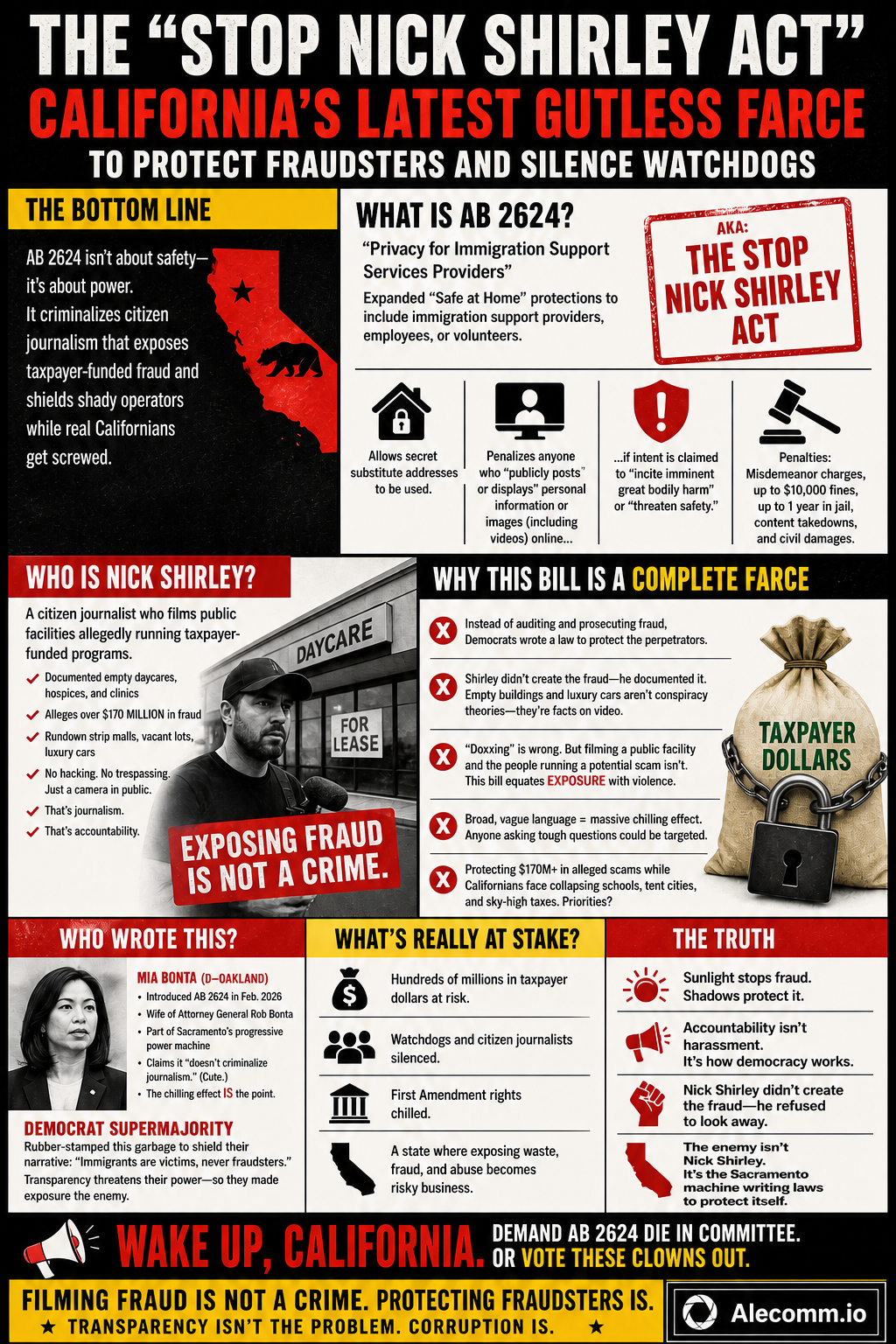
Assembly Bill 2624 — dressed up as “Privacy for Immigration Support Services Providers” and widely dubbed the Stop Nick Shirley Act — isn’t about safety. It’s about control. It’s about deciding who gets to look, who gets to question, and who gets punished for doing both.
Strip away the polished language and what’s left is simple: a law that risks criminalising public scrutiny of taxpayer-funded programs.
What This Bill Actually Does
The bill expands address-confidentiality protections to a broad category of individuals tied to immigration-related services — nonprofits, clinics, and associated workers.
On its face, that sounds defensible. Nobody reasonable supports harassment or threats.
But the problem sits in the fine print.
The legislation introduces penalties for publishing or displaying identifying information or images — including video — if it can be argued that the intent was to threaten safety or incite harm. That includes fines, potential jail time, and forced content removal.
Here’s where it gets murky fast.
Intent is subjective. “Harassment” can be stretched. And once those thresholds blur, the chilling effect kicks in hard. People stop asking questions not because they’re wrong — but because the cost of being right becomes too high.
Why This Is Raising Alarm Bells
Recent independent investigations — including those by online figures like Nick Shirley — have drawn attention to alleged irregularities in publicly funded programs. Reports of empty facilities, questionable billing practices, and large sums of taxpayer money flowing through opaque systems have triggered public concern.
Whether every claim holds up is beside the point.
The correct response to allegations of fraud is investigation and accountability — not legislation that risks discouraging scrutiny altogether.
Because once you start making people think twice about documenting what’s visible in public, you’re no longer just protecting individuals.
You’re protecting systems from examination.
The Real Risk: A Chilling Effect On Accountability
Governments rely on oversight. Not just from auditors and agencies, but from the public.
Journalists. Whistleblowers. Citizens with cameras.
When laws are written broadly enough to blur the line between harassment and documentation, people pull back. Not because they’re wrong — but because they don’t want to test how far the law will stretch.
That’s how accountability erodes. Quietly. Gradually. Effectively.
A System Under Pressure
California is already grappling with serious challenges — budget strain, service delivery issues, and ongoing concerns about fraud and misuse across various programs.
In that environment, transparency isn’t optional. It’s essential.
If there are bad actors exploiting taxpayer-funded systems, they should be exposed and prosecuted.
If there aren’t, then scrutiny should confirm that and strengthen public trust.
Either way, sunlight is the solution. Not shadows.
The Bottom Line
AB 2624 doesn’t exist in a vacuum. It lands at a moment when public confidence is already fragile.
And when a government responds to scrutiny with restrictions — even indirectly — people notice.
Because the question becomes unavoidable:
If everything is above board, why make it harder to look?
Leave a Reply