How Consent Decrees Are Used as Political Weapons
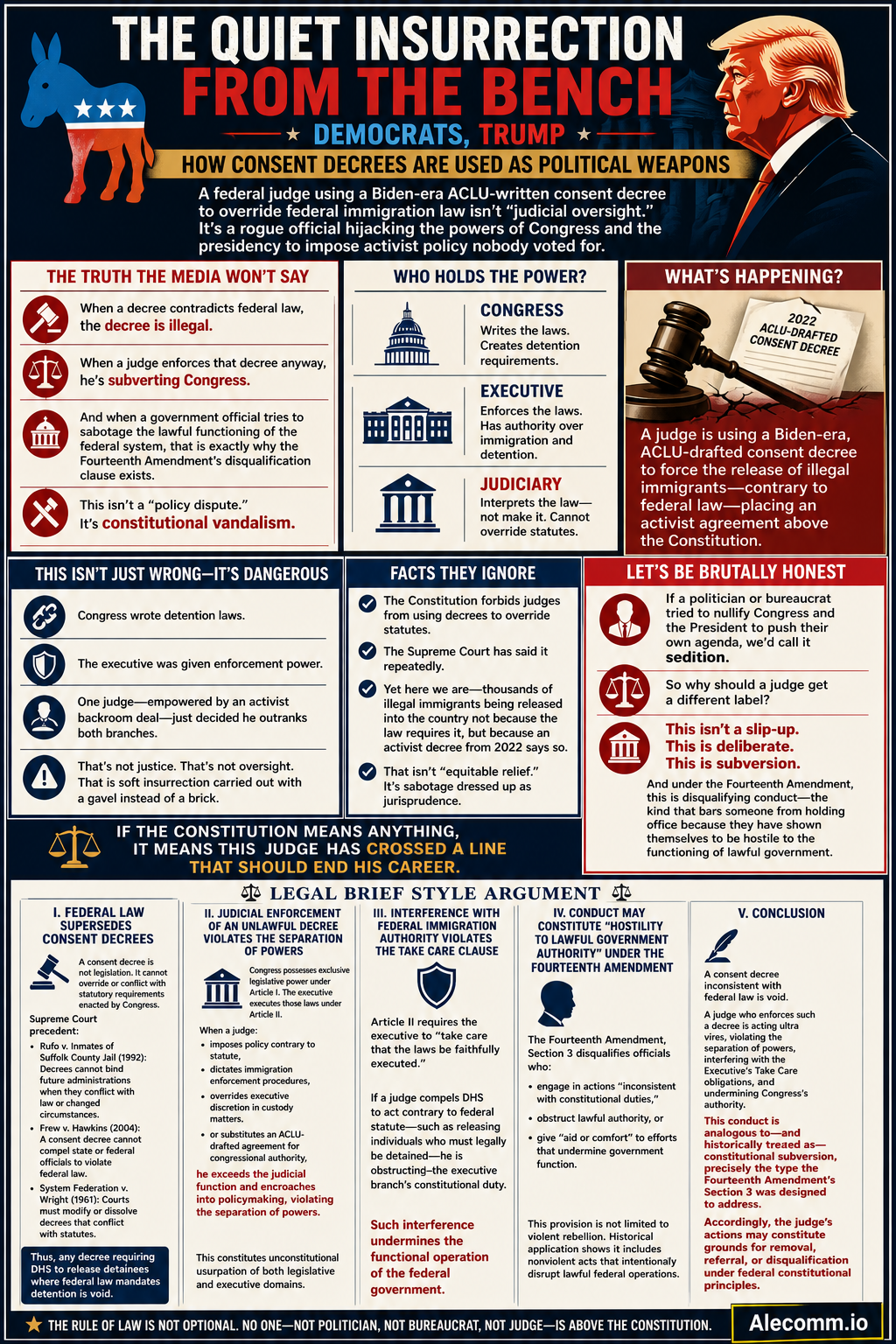
A federal judge using a Biden-era ACLU-written consent decree to override federal immigration law isn’t “judicial oversight.” It’s a rogue official hijacking the powers of Congress and the presidency to impose activist policy nobody voted for.
And here’s the truth the media won’t say out loud:
When a decree contradicts federal law, the decree is illegal.
When a judge enforces that decree anyway, he’s subverting Congress.
And when a government official tries to sabotage the lawful functioning of the federal system, that is exactly why the Fourteenth Amendment’s disqualification clause exists.
This isn’t a “policy dispute.”
It’s constitutional vandalism.
Congress wrote detention laws.
The executive branch was given enforcement power.
And instead, one judge — empowered by an activist backroom deal — just decided he outranks both branches.
That’s not justice.
That’s not oversight.
That is soft insurrection carried out with a gavel instead of a brick.
The Constitution forbids judges from using decrees to override statutes.
The Supreme Court has said it repeatedly.
Yet here we are — thousands of illegal immigrants being released into the country not because the law requires it, but because an activist decree from 2022 says so.
That isn’t “equitable relief.”
It’s sabotage dressed up as jurisprudence.
And let’s be brutally honest:
If a politician or bureaucrat tried to nullify Congress and the President to push their own agenda, we’d call it sedition.
So why should a judge get a different label?
This isn’t a slip-up.
This is deliberate.
This is subversion.
And under the Fourteenth Amendment, this is disqualifying conduct — the kind that bars someone from holding office because they have shown themselves to be hostile to the functioning of lawful government.
If the Constitution means anything, it means this judge has crossed a line that should end his career.
⚖️ ISSUE:
Whether a federal judge’s enforcement of a consent decree that contradicts federal immigration law constitutes unconstitutional subversion of congressional authority and conduct qualifying under the Fourteenth Amendment’s disqualification clause.
I. Federal Law Supersedes Consent Decrees
A consent decree is not legislation.
It cannot override or conflict with statutory requirements enacted by Congress.
Supreme Court precedent:
- Rufo v. Inmates of Suffolk County Jail (1992): Decrees cannot bind future administrations when they conflict with law or changed circumstances.
- Frew v. Hawkins (2004): A consent decree cannot compel state or federal officials to violate federal law.
- System Federation v. Wright (1961): Courts must modify or dissolve decrees that conflict with statutes.
Thus, any decree requiring DHS to release detainees where federal law mandates detention is void.
II. Judicial Enforcement of an Unlawful Decree Violates the Separation of Powers
Congress possesses exclusive legislative power under Article I.
The executive executes those laws under Article II.
When a judge:
- imposes policy contrary to statute,
- dictates immigration enforcement procedures,
- overrides executive discretion in custody matters,
- or substitutes an ACLU-drafted agreement for congressional authority,
he exceeds the judicial function and encroaches into policymaking, violating the separation of powers.
This constitutes unconstitutional usurpation of both legislative and executive domains.
III. Interference with Federal Immigration Authority Violates the Take Care Clause
Article II requires the executive to “take care that the laws be faithfully executed.”
If a judge compels DHS to act contrary to federal statute — such as releasing individuals who must legally be detained — he is obstructing the executive branch’s constitutional duty.
Such interference undermines the functional operation of the federal government.
IV. Conduct May Constitute “Hostility to Lawful Government Authority” Under the Fourteenth Amendment
The Fourteenth Amendment, Section 3 disqualifies officials who:
- engage in actions “inconsistent with constitutional duties,”
- obstruct lawful authority, or
- give “aid or comfort” to efforts that undermine government function.
This provision is not limited to violent rebellion. Historical application shows it includes nonviolent acts that intentionally disrupt lawful federal operations.
A judge who:
- nullifies congressional statutes,
- disables executive enforcement,
- and replaces lawful authority with activist policy,
is acting in a manner hostile to the constitutionally assigned roles of government.
Such conduct falls within the intended reach of the disqualification clause.
V. Conclusion
A consent decree inconsistent with federal law is void.
A judge who enforces such a decree is acting ultra vires, violating the separation of powers, interfering with the Executive’s Take Care obligations, and undermining Congress’s authority.
This conduct is analogous to — and historically treated as — constitutional subversion, precisely the type the Fourteenth Amendment’s Section 3 was designed to address.
Accordingly, the judge’s actions may constitute grounds for removal, referral, or disqualification under federal constitutional principles.
Leave a Reply