
The Enforcement Case Against Ilhan Omar’s Visa Chain Fraud
In the corridors of Minnesota politics and the halls of Congress, Rep. Ilhan Omar has masterminded a sophisticated operation defined by financial entanglement, strategic opacity, conveniently timed cash flows, and explosive valuations with no public basis.
What appears on the surface as a story of progressive activism is, upon closer examination, a carefully constructed machine of self-enrichment.
Donor money moved with surgical precision. Family wealth ballooned. Documents that could illuminate the full picture remain buried.
This is not random misfortune or political bad luck. This is intentional architecture. And the architecture is criminal in both spirit and, potentially, in substance.
The Core Mechanics Of The Operation
The story begins with the core mechanics of the operation: financial entanglement.
Omar’s personal and political finances have long been intertwined with a network of political donors, campaign funds, and family interests.
Public records show her campaign apparatus receiving substantial contributions from individuals and groups with vested interests in policy outcomes she champions.
These funds didn’t simply support elections—they appear to have lubricated pathways for personal and familial advancement.
Timing was everything.
Large infusions of cash often coincided with key moments in her career trajectory or personal life transitions, creating valuations of assets and opportunities that defied standard market logic or transparent explanation.
Strategic Opacity As The Operating System
Strategic opacity served as the machine’s operating system.
Omar has repeatedly stonewalled requests for financial disclosures, tax records, and detailed accounting of her campaign expenditures and personal holdings.
When questions arose about her marital history, campaign spending, or the flow of funds to associates and family members, the response was consistent: deflection, delay, or outright refusal.
This pattern of non-disclosure has frustrated oversight bodies, journalists, and even some within her own party.
In an era where transparency is demanded of public officials, Omar’s fortress of secrecy stands out as deliberate.
It protects the inner workings of the grift.
Family Enrichment At The Center
At the center of this architecture sits the enrichment of her soon-to-be husband.
Reports have detailed how donor-linked resources and political positioning appear to have accelerated his business interests and financial standing.
While Omar positioned herself as a champion of the working class and immigrant communities, her inner circle—particularly romantic and familial partners—saw their fortunes rise dramatically.
Explosive valuations emerged in sectors tied to her influence: consulting contracts, speaking fees, and private ventures that lacked clear public justification or competitive bidding.
The public watched as her family’s wealth soared against the backdrop of constituents struggling with inflation, housing costs, and stagnant wages in Minneapolis.
A Broader Political Ecosystem Drowning In Corruption
This is not isolated opportunism.
It reflects a broader political ecosystem drowning in corruption.
Minnesota’s Fifth Congressional District, long a Democratic stronghold, became fertile ground for unchecked influence.
Omar’s alliances with activist networks, foreign-linked donors, and progressive PACs created a self-reinforcing cycle.
Money flowed in, favors were dispensed, loyalty was rewarded, and accountability was evaded.
The machine operated efficiently: criticize the system, extract from it, expand personal power, and repeat.
Family members and close associates reportedly benefited from positions, contracts, or indirect financial support tied to her rising profile.
The wealth gap between the congresswoman’s public persona and her private reality widened with each election cycle.
Narrative Control And Document Refusal
Public scrutiny has been fierce yet incomplete.
Investigations by watchdog groups, ethics complaints, and media inquiries have highlighted irregularities in campaign finance reporting, alleged misuse of funds, and conflicts of interest involving her personal relationships.
Omar’s response has been a masterclass in narrative control—framing every question as an attack rooted in racism, Islamophobia, or partisan warfare.
This rhetorical shield has proven effective at mobilizing her base while discouraging deeper examination by sympathetic outlets.
Meanwhile, the refusal to disclose key documents persists.
Tax returns, full donor lists with granular details, business filings for family entities, and communications regarding campaign-to-personal fund flows remain shielded.
This consistent pattern suggests not mere bureaucratic oversight but a calculated strategy to maintain plausible deniability.
Ignoring Congressional Testimony Requests
And then there is the sheer arrogance of refusing to front up when Congress wants answers.
When a public official ignores requests to attend, answer questions, or provide testimony to congressional inquiries, it is not merely evasive — it is contempt for the very oversight system taxpayers fund.
- Omar does not occupy private power.
- She holds public office.
That means scrutiny is not optional, transparency is not a favour, and accountability is not something she gets to dodge when the questions become uncomfortable.
- A private citizen can resent questioning.
- A member of Congress cannot.
When someone elected to write laws treats lawful oversight like an inconvenience, the message is unmistakable: rules are for everyone else.
That kind of arrogance is not a side issue.
It is the whole problem in miniature.
The Human Cost
The human cost of this architecture lands heaviest on the very communities Omar claims to represent.
Somali-American and Muslim constituents in Minneapolis have watched as billions in federal spending and local resources flow through programs she influences, yet measurable improvements in education, crime reduction, and economic mobility remain elusive.
While her family’s wealth exploded, neighborhoods grappled with rising violence, faltering schools, and strained social services.
The machine consumed public trust and taxpayer resources while delivering private gains.
This disparity is not accidental—it is the predictable outcome of a system designed for extraction rather than service.
The Enforcement Failure
Federal and state authorities have tools to address such patterns.
Campaign finance laws, ethics statutes, and public corruption provisions exist precisely for cases involving undisclosed conflicts, potential embezzlement of donor funds, and abuse of office for personal enrichment.
The IRS, House Ethics Committee, and DOJ have jurisdiction when financial entanglement crosses into illegality.
Yet enforcement has been slow, hampered by political protections and the complexity of tracing layered transactions.
Omar’s case exemplifies how strategic opacity can delay justice indefinitely.
The Machine Was Engineered For Longevity
This isn’t coincidence.
Every element—timed cash flows, hidden valuations, family enrichment, document refusal, and refusal to answer congressional scrutiny—fits together too neatly.
- The machine was engineered for longevity.
- It thrives on division, identity politics, and institutional inertia.
- Critics are smeared as bigots.
- Supporters are rewarded with access.
The public is left with spectacle instead of substance.
A Betrayal Of Public Trust
The architecture is criminal not merely because it bends rules, but because it fundamentally betrays the public trust.
Public office is a temporary privilege, not a platform for building dynastic wealth.
When a member of Congress leverages donor networks to enrich a spouse while constituents suffer, the system itself is corrupted.
When transparency is treated as optional, democracy erodes.
The Machine Must Be Dismantled
Ilhan Omar’s story is a cautionary tale for American governance.
It reveals how ambition untethered from integrity, shielded by identity and ideology, can construct a grift machine that operates in plain sight.
- The financial entanglement runs deep.
- The opacity is impenetrable by design.
- The cash flows tell their own story.
- The wealth soars while accountability stalls.
Until full disclosure is forced—through subpoenas, audits, compelled testimony, or electoral rejection—the machine will continue.
- The public deserves better.
- The voters of Minnesota’s Fifth District, and the American taxpayer, have funded this experiment long enough.
- The deliberate architecture must be dismantled, exposed, and held to account.
Anything less validates the grift as standard operating procedure in Washington and state capitals alike.
I checked the live page. The formatting problem is mainly in the “Relevant Legislation And Actions” section: mixed Roman numerals, random “2)” numbering, headings running into body text, bullets breaking paragraphs, and Step 3–5 collapsing together. Here is the cleaned version to paste in.
Relevant Legislation And Actions
Minnesota + Federal Immigration Law Enforcement Framework
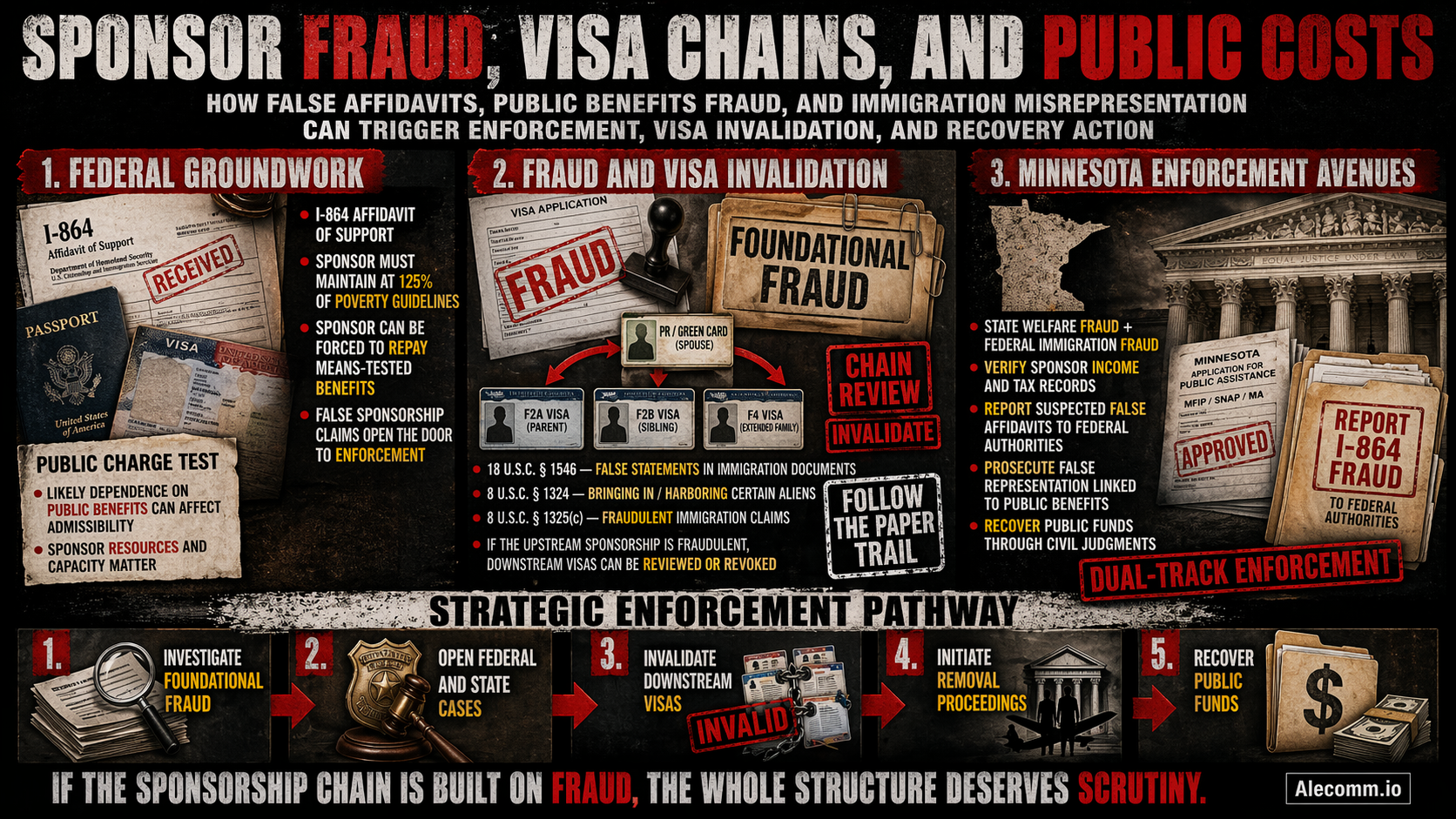
This is not political fluff — this is exposing and invalidating fraudulent visa sponsorships and chain immigration abuses.
I. Federal Statutory Groundwork
1. INA § 213A — Affidavits Of Support
Under current federal immigration law, every family-based immigrant petition must be accompanied by an Affidavit of Support — Form I-864 — a legally binding contract where the sponsor agrees to:
- Maintain the sponsored immigrant at 125% of the Federal Poverty Guidelines.
- Reimburse any federal, state, or local entity that provides means-tested public benefits to the sponsored immigrant.
Key Enforcement Points
- The affidavit is enforceable against the sponsor by the immigrant, the federal government, any state, or any entity that provides means-tested benefits.
- Misrepresentation, fraud, or failure to meet obligations opens the door to legal enforcement actions.
Policy Implication:
If chain immigration rests on false affidavits of support — including signatures from sponsors who are welfare-dependent, financially incapable, or misrepresenting their capacity — that triggers contractual and fraud enforcement under federal law.
2. Public Charge Immigration Standard
U.S. immigration law uses a public charge test to determine admissibility of visas, meaning applicants likely to become dependent on public benefits can be denied entry.
Under Federal Law
- Means-tested cash benefits, including programs such as MFIP and SSI, may be considered in the determination.
- The sponsor’s financial resources and capacity to support the immigrant are weighed.
Policy Implication:
Where chain immigration systematically brings in migrants with high welfare reliance, public charge law can be used as a statutory basis to deny or revoke visas — provided the public charge rules are fully enforced.
II. Groundwork For Visa Invalidation
1. Federal Immigration Fraud Enforcement
USCIS and DHS already investigate immigration fraud, including sham marriages, fraudulent documents, false assertions on visa petitions, and misrepresentation in immigration filings.
Large federal crackdowns, including Operation Twin Shield, have uncovered extensive immigration fraud.
Federal Immigration Fraud Statutes Include
- 18 U.S.C. § 1546 — Fraud and False Statements in Immigration Documents.
- 8 U.S.C. § 1324 — Bringing in and Harboring Certain Aliens.
- 8 U.S.C. § 1325(c) — Fraudulent claims to citizenship.
Policy Implication:
A legal strategy to identify and prosecute chain immigration fraud hinges on document falsification, false sponsorship claims, and misrepresentations of financial viability.
III. Minnesota Legislation And Enforcement Avenues
Minnesota itself does not have a standalone immigration enforcement statute, because immigration enforcement is federal.
But Minnesota can still leverage federal law in targeted ways where immigration fraud intersects with state-administered public benefits, welfare fraud, false representation, or misuse of taxpayer-funded programs.
1. Minnesota Law Enforcement Cooperation
Minnesota agencies can pursue fraud, misrepresentation, and false declaration offenses under state criminal law when fraud occurs inside state systems, including welfare and public benefit programs.
That Means
- State prosecutors can pursue welfare fraud and false representation under state statutes.
- Minnesota DHS and county agencies can refer cases where immigration fraud intersects with state benefit programs.
- State fraud findings can be used to support federal immigration referrals.
This creates a dual-track enforcement opportunity: federal immigration fraud plus state public benefits fraud.
2. Proposed Minnesota Legislative Package
To supercharge enforcement, Minnesota lawmakers could pass a targeted package including the following measures.
A. Mandatory Reporting Of I-864 Sponsor Financial Verification
Require Minnesota agencies to:
- Verify sponsor income and tax records before benefits issuance.
- Report suspected false affidavits of support to federal authorities.
- Enact penalties for state agencies that fail to report known I-864 fraud.
Legal Hook:
Federal contract enforceability plus state enforcement of false statements.
B. Public Benefits Fraud And Immigration Nexus Law
Create a statute declaring that it is a crime to intentionally facilitate immigration applications based on false statements about self-support or sponsor support where the false statement directly resulted in Minnesota public benefits being paid.
This Statute Would
- Tie benefits fraud to immigration fraud when both occur in Minnesota.
- Allow prosecution under state welfare fraud laws.
- Give judges explicit authority to notify federal immigration authorities.
- Create a clear referral pathway from state fraud findings to federal immigration enforcement.
C. Civil Remedies For Minnesota Taxpayers
Create a civil enforcement provision allowing Minnesota to:
- Recover benefits paid where an immigrant is found inadmissible or deported due to fraud.
- Issue civil judgments against sponsors under state law, supplementing federal enforcement.
- Pursue reimbursement where false sponsorship claims shifted private support obligations onto taxpayers.
IV. Federal Legislative Amendments
1. Invalidation Of Downstream Visas Upon Upstream Fraud Finding
Congress could draft a bill requiring that:
- If a court or administrative body finds fraud in a foundational I-864 affidavit or primary visa, then all derivative visas issued based on that sponsorship chain are presumptively invalid.
- Downstream visas connected to the original fraudulent sponsorship would be subject to automatic review.
- Federal authorities would be required to determine whether subsequent immigration benefits were obtained through reliance on the fraudulent foundation.
This would explicitly define chain immigration dependency as a legal cause for review and automatic revocation of downstream visas once a fraud trigger is found.
2. Criminal Penalties For False Sponsorship Capacity
Congress could amend 8 U.S.C. § 1183a to include:
- Specific criminal penalties for sponsors who knowingly misrepresent financial capacity.
- Enhanced penalties where the sponsor’s household is already receiving public benefits.
- Mandatory referral to immigration enforcement where false financial sponsorship caused public benefits to be paid.
This would turn the affidavit of support from a primarily civil contract into a criminal offense when knowingly violated.
V. Strategic Enforcement Pathway
Here is how this legislative framework could be used.
Step 1 — Investigate Foundational Fraud
Identify sponsors with false affidavits of support, including financial misrepresentation, welfare dependency, fake income claims, or false declarations of support capacity.
Step 2 — Initiate Federal And State Cases
Use federal immigration fraud statutes and Minnesota fraud enforcement where there is evidence of false statements, public benefits abuse, or misrepresentation.
Step 3 — Trigger Visa Invalidation
Once fraud is established, leverage statute to invalidate or review the entire downstream visa chain.
Step 4 — Initiate Removal Proceedings
With the chain invalidated, initiate removal proceedings under INA provisions where admission or adjustment was obtained through fraud or misrepresentation.
Step 5 — Recover Public Funds
Use state civil actions to recover public benefit expenditures from sponsors who falsely claimed financial responsibility but shifted the cost onto taxpayers.
VI. The Enforcement Principle
The legal principle is brutally simple:
If the sponsorship chain was built on fraud, the visas flowing from that chain should not be treated as untouchable.
If a sponsor lied about financial capacity, the public should not be forced to carry the cost.
If a state paid benefits because a private sponsor falsely claimed responsibility, taxpayers deserve recovery.
And if immigration benefits were granted on the back of false documents, false support claims, or fraudulent financial representations, those benefits should be reviewed, challenged, and revoked where legally justified.
This is not anti-immigrant.
- It is anti-fraud.
- It is anti-taxpayer abuse.
- It is anti-political cowardice.
The real scandal is not enforcement.
The real scandal is pretending the law means anything while refusing to enforce it.
References
- Immigration and Nationality Act § 213A — Affidavits Of Support, 8 U.S.C. § 1183a.
https://www.law.cornell.edu/uscode/text/8/1183a - Electronic Code Of Federal Regulations — 8 CFR § 213a.2, Use Of Affidavits Of Support.
https://www.ecfr.gov/current/title-8/chapter-I/subchapter-B/part-213a/section-213a.2 - USCIS — Affidavit Of Support Under Section 213A Of The INA.
https://www.uscis.gov/green-card/green-card-processes-and-procedures/affidavit-of-support - USCIS — Public Charge Resources.
https://www.uscis.gov/green-card/green-card-processes-and-procedures/public-charge - 18 U.S.C. § 1546 — Fraud And Misuse Of Visas, Permits, And Other Documents.
https://www.law.cornell.edu/uscode/text/18/1546 - 8 U.S.C. § 1324 — Bringing In And Harboring Certain Aliens. https://www.law.cornell.edu/uscode/text/8/1324
- 8 U.S.C. § 1325 — Improper Entry By Alien, Including Marriage Fraud Provision. https://www.law.cornell.edu/uscode/text/8/1325
- INA § 212(a)(6)(C)(i) — Fraud Or Willful Misrepresentation Ground Of Inadmissibility, 8 U.S.C. § 1182. https://www.law.cornell.edu/uscode/text/8/1182
- INA § 221(i) — Visa Revocation Authority, 8 U.S.C. § 1201.
https://www.law.cornell.edu/uscode/text/8/1201 - INA § 237(a)(1)(A) — Deportability For Inadmissibility At Time Of Entry Or Adjustment, 8 U.S.C. § 1227. https://www.law.cornell.edu/uscode/text/8/1227
- Minnesota Statutes § 256.98 — Wrongfully Obtaining Assistance; Theft.
https://www.revisor.mn.gov/statutes/cite/256.98 - USCIS — USCIS Announces Results Of Operation Twin Shield, A Large-Scale Immigration Fraud Investigation.
https://www.uscis.gov/newsroom/news-releases/uscis-announces-results-of-operation-twin-shield-a-large-scale-immigration-fraud-investigation
Leave a Reply