The Shadow Pipeline: How Western “Democracy Promotion,” Privatization, And Child Welfare NGOs Created Europe’s “Fourth Wave” Of Child Trafficking
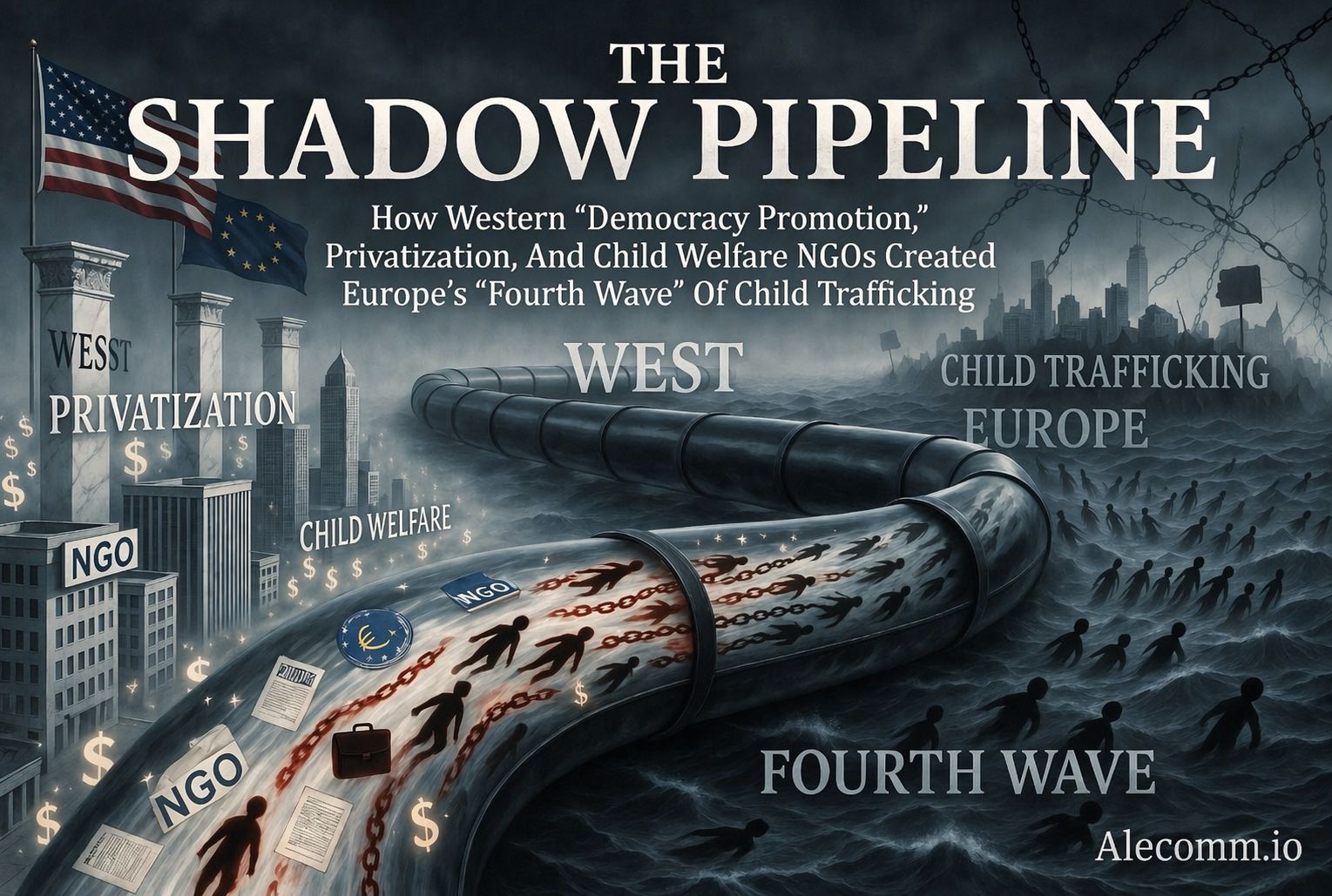
In the chaotic aftermath of communism’s collapse, a disturbing pattern is alleged to have emerged across Eastern Europe and the Balkans. According to an anonymous investigation circulated online (circa 2016–2017), U.S. and EU-backed “stabilization” efforts—via regime change, IMF loans, and rapid privatization—may have inadvertently or deliberately opened pathways for organized crime, particularly in the trafficking of children.
What began as humanitarian aid and child welfare reform, the theory claims, evolved into something far darker once funding declined. Nations such as Romania, Bulgaria, Albania, Moldova, Ukraine, and Kosovo are described as epicenters of a so-called “fourth wave” of human trafficking—where orphanages, foster systems, and street-child programs were allegedly repurposed into pipelines for sexual exploitation, forced begging, and organ trafficking.
The Template: Destabilize, Privatize, Install Proxies
The framework presented is blunt:
Destabilize political systems → Impose economic restructuring → Privatize social infrastructure → Transfer control to aligned or compromised actors.
This mirrors long-standing critiques of neoliberal policy expansion. Under this model:
- “Pro-democracy” initiatives reportedly disrupted existing governance structures
- IMF-backed reforms enforced rapid privatization, including child welfare systems
- NGOs—some with ties to major Western institutions—promoted foster care and adoption models over state-run systems
For a time, these initiatives attracted significant humanitarian funding. However, the allegation is that once funding waned, control shifted—not to stable local governance—but to organized crime networks.
The result, as claimed:
- Foster homes allegedly converted into covert brothels
- Adoption pipelines allegedly exploited for trafficking into sexual servitude
- Street-child programs allegedly used as recruitment funnels for forced labor and begging rings
Notably, the theory asserts that such large-scale trafficking structures were far less prevalent under tightly controlled communist systems, where movement and borders were heavily restricted.
Romania And The Balkans: From Aid To Exploitation
Romania is repeatedly cited as a central case study. Following the fall of Nicolae Ceaușescu, the country became a focal point for international child welfare intervention.
According to the allegations:
- A surge of NGOs entered the region, restructuring childcare systems
- As oversight weakened, control allegedly transitioned to criminal actors
- Children from these systems began appearing in Western European trafficking circuits, particularly in Italy
Additional claims include:
- Partnerships between NGOs and Italian municipalities
- Alignment with emerging Balkan organized crime networks trained under Italian mafia structures
- Misuse of humanitarian funds, including luxury expenditures and political patronage
One frequently referenced organization allegedly cycled identities over time:
- Romanian Orphanage Trust (1990–1997)
- European Children’s Trust (1997–2001)
- EveryChild (2001 onward)
Connections are alleged—though not substantiated in formal records—to broader international figures and institutions.
Kosovo: KLA, Geopolitics, And The “Yellow House”
The most serious and partially documented allegations center on Kosovo.
Following the Kosovo conflict, Western powers—including the U.S.—supported the rise of the Kosovo Liberation Army (KLA) and figures such as Hashim Thaçi.
Key documented elements intersect with the broader claims:
- , former chief prosecutor at the International Criminal Tribunal for the former Yugoslavia, described allegations of organ trafficking in her memoir The Hunt
- A 2010 report by investigator Dick Marty outlined a “mafia-like” network involving KLA-linked figures
- Sites such as the “Yellow House” in Albania were identified as alleged locations where prisoners were killed for organ harvesting
These findings included:
- Claims of kidnapping and transport of detainees across borders
- Allegations of organ extraction for international black markets
- Reports of witness intimidation and suppression
While these elements are documented in formal investigations, the broader extension into child trafficking pipelines remains unproven and highly contested.
Infrastructure, Drugs, And Financial Convergence
The theory expands into a wider systems-level claim:
Privatization did not only affect childcare—it extended to energy, telecom, water, and education, allegedly creating systemic vulnerabilities.
Within this vacuum:
- Organized crime allegedly became the de facto operator of illicit economies
- The Albanian mafia’s rise in heroin trafficking aligned with shifting global narcotics flows
- Logistics networks used for drugs could also be used for human trafficking
Additional speculative links include:
- Historical cases like the “Pizza Connection” trial (drug trafficking via legitimate businesses)
- Financial laundering mechanisms such as art markets and tax exchanges
- Political lobbying connections involving Western figures (unproven in this context)
These claims are broad, complex, and often rely on circumstantial association rather than direct evidence.
Symbolism And Cultural Interpretations
The final layer of the theory ventures into symbolic and cultural interpretations, including:
- Analysis of national symbols such as the Albanian double-headed eagle
- Interpretations of geographic names, political nicknames, and ceremonial imagery
- Speculation about occult or esoteric influences within power structures
These elements are entirely speculative and not supported by verifiable evidence. They reflect interpretive frameworks rather than factual findings.
A Call For Scrutiny
Stripped of its more speculative components, the core issues raised are serious and deserve attention:
- Failures in post-conflict child protection systems
- Documented cases of trafficking and exploitation in the Balkans
- Confirmed investigations into organ trafficking networks
- Risks associated with rapid privatization of vulnerable social systems
At the same time, it is critical to separate:
- Documented findings (e.g., Council of Europe reports, ICTY-linked investigations)
- From unverified or anonymous claims circulating online
Child exploitation is a real and documented global issue.
But claims of coordinated international systems involving NGOs, governments, and criminal networks require rigorous, evidence-based investigation—not assumption or amplification without proof.
The unresolved tension remains:
When systems meant to protect the vulnerable fail—or are compromised—the consequences are catastrophic.
Whether through negligence, corruption, or structural collapse, the outcome is the same:
Children become commodities.
And that alone demands accountability.
Leave a Reply